
National Issues
A 61-Year-Old Rehabilitated Bridge Should Not Become a Political Tool for 2027 Campaigning in the South-East, or a Means of Seeking Political Relevance -By Daniel Nduka Okonkwo
The First Niger Bridge should remain a national asset rather than become a symbol of political ownership. Its rehabilitation should be judged by its safety, quality, cost-effectiveness, and durability. If the intervention was successful, the evidence should speak for itself. If shortcomings remain, they should be investigated and addressed. The same standards should apply regardless of which political party controls the Federal Government.

It is important to understand that the rehabilitation of the First Niger Bridge was neither a philanthropic gesture nor a personal gift from the President or the Minister of Works to Nigerians. It was a public infrastructure intervention funded with taxpayers’ money. The resources used to maintain public infrastructure belong to the Nigerian people, whose taxes and other public revenues sustain the government. Therefore, repairing a bridge that serves millions of citizens should be regarded as a public responsibility, not a personal favour for which the population must demonstrate political gratitude.
The First Niger Bridge was not constructed by the present administration. It has served Nigerians for approximately 61 years, surviving successive governments and generations of public expenditure. Its rehabilitation was necessary to address concerns about the bridge’s condition and the reported vandalism of structural components, including bolts and parts of the expansion joints. The government deserves a fair assessment of the work undertaken, but the scale of political publicity surrounding the intervention raises questions about whether the maintenance of existing infrastructure is being elevated into an extraordinary political achievement.
The construction of the Second Niger Bridge spanned multiple administrations, but it was conceptualised, substantially funded, and completed under the administration of President Muhammadu Buhari. Yet Nigerians were not expected to sing political praises or hang portraits of the officials responsible for its construction as though the bridge were their personal donation to the country. Public infrastructure should be judged by its necessity, quality, durability, cost, and benefit to the people, not by the volume of political celebration surrounding its delivery.
Nigerian leaders must abandon the mentality that constructing or maintaining public infrastructure entitles them to personal glorification. A road, bridge, hospital, school, or public transport system is not a gift from a politician to a grateful population; it is part of the obligation of government to use public resources for public benefit. When an administration governs responsibly, delivers essential services, builds durable infrastructure, and respects the dignity of citizens, its record should speak for itself. In such circumstances, the spectacle of politicians turning routine public responsibilities into grand performances of self-congratulation would look less like leadership and more like political comedy.
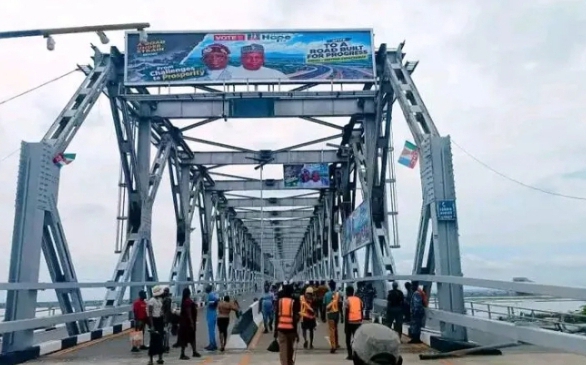
Nigeria’s First Niger Bridge, commissioned in 1965, has become the centre of public debate following its emergency rehabilitation in 2026, which kept it closed to traffic for about 38 days, from September 7 to October 15. The bridge, which connects Onitsha in Anambra State with Asaba in Delta State, is a vital national transport link serving millions of Nigerians. However, the display of photographs of President Bola Ahmed Tinubu and Vice-President Kashim Shettima, with captions carrying political messages and, according to published reports, APC banners, has raised questions about the relationship between public infrastructure, taxpayers’ money, and the ruling party’s electoral ambitions ahead of the 2027 general election.
The controversy goes beyond the presence of presidential photographs on a bridge. It concerns a fundamental question of democratic governance: should infrastructure maintained with public funds be presented as a personal achievement or political gift from the President, or should its rehabilitation be treated as the fulfilment of a government responsibility to the people?
Minister of Works Dave Umahi, during an inspection on Wednesday, September 23, directed that unauthorised advertisements be removed and that the bridge be decorated with photographs of the President. What Umahi described as the President’s contribution to infrastructure development in the South-East and South-South. While governments have a legitimate right to communicate their achievements, the use of a national infrastructure asset for prominent political messaging deserves scrutiny, particularly as the country approaches another election cycle.
The argument that the displays and banners risk turning a national asset into a political billboard. Their concern is not necessarily that the rehabilitation lacked value, but that a publicly funded intervention should not become a platform for partisan self-promotion. Public infrastructure belongs to Nigerians, irrespective of their political affiliations. The bridge serves supporters of the All Progressives Congress (APC), opposition parties, and citizens who have no political allegiance.
The most important question remains: if taxpayers’ money financed the rehabilitation, why should President Tinubu and the APC receive the political benefits as though the money came from their personal pockets?
The President has a legitimate constitutional and administrative role in setting priorities and directing government policy. If his administration approved the emergency expenditure promptly, that decision can be acknowledged and assessed on its merits. However, public revenue is not personal wealth, and the exercise of executive responsibility does not transform public expenditure into a private gift. Nigerians contribute to the economy regardless of which party they support, and the benefits of public infrastructure should not be presented as rewards for political loyalty.
The distinction between legitimate government communication and partisan campaigning is therefore crucial. Publishing the project’s cost, scope, contractor details, completion records, and engineering assessments would promote transparency. Displaying political portraits and slogans, particularly alongside an electoral appeal, creates a different impression. Whether the displays breached any applicable law, regulation or official policy requires evidence and a proper legal assessment. Their political implications, however, are legitimate subjects of public debate.
The controversy became more pronounced when Umahi, at the September 23 inspection, appealed to South-East voters not to throw away their votes in 2027 and challenged supporters of Peter Obi to explain what Obi had attracted to the region. He also reportedly described Obi as a brother whom he did not hate. At the reopening on Thursday, October 15, Umahi reportedly urged people in the South-East and South-South to support Tinubu’s re-election bid and said the occasion was intended to demonstrate that the South-East was for the President. Photographs of Shettima and Anambra State Governor Chukwuma Soludo were also reportedly displayed, alongside APC banners on the railings. Such statements are political arguments that may be made and challenged in a democracy. However, when electoral persuasion accompanies the reopening of a publicly maintained national asset, citizens are entitled to question whether a government event is also being used to advance partisan interests.
Supporters of the administration may argue that the emergency intervention demonstrated political will, rapid decision-making, and a commitment to regional integration. They may also contend that the President deserves recognition for prioritising the project. These arguments should not be dismissed without consideration. Nevertheless, the appropriate way to demonstrate performance is through verifiable evidence of expenditure, engineering quality, improved safety, and sustained infrastructure delivery, not merely through presidential imagery or political slogans.
The episode also exposes a deeper problem in Nigerian governance: the tendency to celebrate routine public responsibilities as extraordinary personal achievements. In a country with effective infrastructure-management institutions, maintaining an ageing bridge should be a planned administrative responsibility supported by regular inspections, preventive maintenance, and transparent budgeting. Such work can be acknowledged without turning it into a political spectacle.
A well-managed economy relies on professional expertise, engineering standards, long-term planning, and institutional accountability. Technocrats should be able to identify infrastructure problems, recommend solutions, and evaluate results based on evidence. Political leaders provide direction, but the success of public administration should not depend on the extent to which officials publicly praise those who appointed them. Effective governance should be measured by results, not by the volume of political celebration surrounding them.
This raises the question of political sycophancy and patronage. Where appointments, influence, and political survival are perceived to depend heavily on demonstrating loyalty to powerful individuals, officials may feel compelled to exaggerate achievements or frame ordinary government responsibilities as personal favours from political leaders. This is a broader institutional concern, not proof of any individual’s private motives. Umahi has publicly expressed pride in supporting the President and said he has no regret doing so. That is a political position he is entitled to hold, and it is mentioned here to illustrate the public expression of political loyalty, not to establish or speculate about his private motives. Nevertheless, public service is weakened when the desire to remain politically relevant takes precedence over independent judgment, professional integrity, and accountability.
The consequences extend beyond the bridge. Nigeria continues to face substantial infrastructure needs, economic pressures, unemployment, and challenges in providing essential public services. Citizens require functioning roads, reliable electricity, accessible healthcare, quality education, and an environment in which businesses can grow. A repaired bridge contributes to economic activity, but it cannot substitute for a comprehensive development strategy or justify an assumption that the electorate owes its political support to the administration.
A serious investigation should establish the approved cost and scope of the rehabilitation, the contractor’s responsibilities, the relevant engineering assessments, and the maintenance arrangements following reopening. The Federal Ministry of Works should also clarify the authority for installing presidential photographs, captions, and banners, the criteria used to distinguish official project information from partisan advertising, and who financed the displays. The APC should be allowed to clarify whether it organised or funded any of the materials, including the banners reportedly displayed.
The government should also publish evidence of its wider infrastructure investments in the South-East and South-South. Citizens deserve to know what has been budgeted, what has been completed, what remains outstanding, and how the administration intends to sustain the infrastructure already delivered. Such information would provide a stronger basis for evaluating the government’s record than political symbolism. The relevant assessment should consider not only completed projects but also their cost, quality, durability, and impact on the lives of the people they are intended to serve.
The First Niger Bridge should remain a national asset rather than become a symbol of political ownership. Its rehabilitation should be judged by its safety, quality, cost-effectiveness, and durability. If the intervention was successful, the evidence should speak for itself. If shortcomings remain, they should be investigated and addressed. The same standards should apply regardless of which political party controls the Federal Government.
Nigeria must move from a politics of appreciation to a politics of institutional accountability. Public officials should be assessed by the quality of their decisions and the results citizens experience, not by the intensity of their praise for the President. No political party owns public infrastructure, and no administration should treat the fulfilment of its responsibilities as a personal favour to the electorate.
A bridge maintained with taxpayers’ money is a public responsibility fulfilled, not a private gift for which Nigerians must repay their political benefactors at the ballot box.
Daniel Nduka Okonkwo is an investigative journalist, human rights advocate, and policy analyst based in Nigeria. He is the founder and publisher of Profiles International Human Rights Advocate (PIHRA), a platform documenting the courage of human rights defenders and examining issues of governance, accountability, security, and fundamental rights.
His reporting on Nigerian governance, security-sector accountability, public finance, and human rights has appeared in Sahara Reporters, Vanguard, Daily Trust, African Defence Forum, Opinion Nigeria, and Daily Intel.
Read more of his work on the PIHRA website:
https://www.profilesinternationalhumanrightsadvocate.com.ng/
For tips, feedback, or collaboration, contact him at dan.okonkwo.73@gmail.com.














You must be logged in to post a comment Login