
Forgotten Dairies
An Owl Cried Last Night And A Baby Died In The Morning: Did Kwan 1’s Show Of Shame Inspire Ibom Air’s Passenger Outburst? -By Isaac Asabor
It is time for Nigerians to reject this culture of public embarrassment, to demand that both celebrities and ordinary citizens conduct themselves with dignity, and to restore the values that protect our collective image.

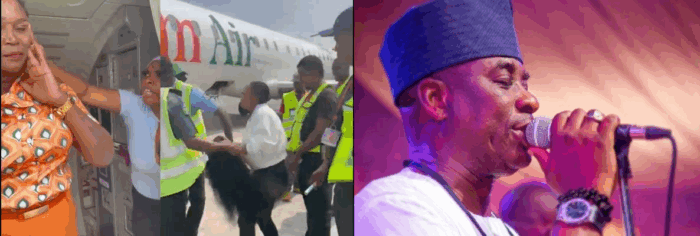
There is an African proverb that says: “An owl cried last night and a baby died in the morning.” In the wisdom of African thought, this is not merely a statement about birds and infants, it is a deeply symbolic reflection on the chain of events in life, on the way one act may herald or even precipitate another, often in ways we fail to connect until the damage is done.
Sometimes, an unpleasant event seems to open a door for more unpleasantness, as though one person’s brazenness gives another the courage, or the excuse, to behave badly. That is why the recent sequence of public embarrassments involving popular Fuji musician Wasiu Ayinde Marshal, also known as Kwan 1, and a female passenger aboard Ibom Air deserves to be examined side by side.
One cannot help but ask: was the disgraceful drama that Kwan 1 staged with ValueJet an “owl cry” whose echo we are now hearing in the “baby’s death” of the Ibom Air passenger’s shameful conduct? Or are we simply witnessing a deeper cultural erosion in which civility, restraint, and public decorum are being trampled by the self-entitled swagger of individuals who think the world revolves around them?
To refresh memories, Kwan 1 was recently caught in a storm of public condemnation after an ugly episode with ValueJet. The details are public knowledge: the confrontation, the arrogance, the sense that his celebrity status gave him the license to behave in a manner that embarrassed not only himself but Nigerians as a whole.
It was a masterclass in how “not” to conduct oneself in public. There was no humility, no tact, no consideration for the optics of the situation. Instead, there was an open display of the very type of “Do you know who I am?” mentality that fuels a culture of impunity. And when such behavior is splashed across headlines and social media, it does more than simply stain a person’s reputation, it normalizes misconduct for those who look up to, or at least take cues from, public figures.
Barely had the dust settled from Kwan 1’s saga when another drama unfolded, this time aboard an Ibom Air flight. In a scene that left fellow passengers in disbelief, a female passenger decided to stage her own theatre of public misbehavior. She was loud, confrontational, and dismissive of the authority and procedures of the airline.
While the specifics of her grievance remain secondary to the manner in which she expressed it, the truth is glaring: her antics projected the same strain of self-importance, the same disregard for collective comfort, and the same appetite for unnecessary drama that we saw with Kwan 1.
Now, the question emerges, was this just coincidence, or are we in an era where every self-entitled individual feels emboldened to disgrace themselves in public because someone else just did and got away with it?
In sociology, there’s a concept known as “signal amplification.” It suggests that when an action, especially a controversial or deviant one, is given attention, it sends a signal that can encourage others to behave in similar ways.
In this case, the Kwan 1 incident was not just a personal disgrace, it was a cultural signal. It told the watching public that celebrity or social status can be a weapon to bend rules and confront authority without shame.
If this is the signal that is now being amplified, then it is hardly surprising that another person, in this case, an Ibom Air passenger, felt confident enough to unleash her own chaos in a shared space where courtesy and calm should have been the norm.
There is a deeper issue here, one that transcends the two incidents themselves. Nigerians, ordinary citizens, business leaders, public officials, are battling a global reputation problem. It is bad enough that we struggle to shake off stereotypes of corruption, lawlessness, and disorderliness. What we don’t need is for high-profile individuals or brazen everyday citizens to keep acting out in ways that feed those narratives.
When Kwan 1 acted out, Nigerians felt the sting of collective embarrassment. And just as that wound was healing, the Ibom Air passenger came along with salt to rub in it. The cycle of public disgrace is not just a matter of personal behavior, it becomes a national branding problem.
The common thread between both incidents is entitlement. Entitlement makes people believe that rules are for others, not for them. Entitlement makes someone think that their grievance, no matter how small, is worth inconveniencing dozens or hundreds of others. Entitlement makes people believe that shouting the loudest is the same thing as being right.
In both the ValueJet and Ibom Air episodes, the individuals involved behaved as though the rights, comfort, and peace of other passengers were irrelevant. This is not a coincidence, it is symptomatic of a deeper social decay in which humility and respect for others have become undervalued.
This is where the African proverb resonates powerfully: “An owl cried last night and a baby died in the morning.” It speaks of cause and effect, of how one event can be an omen or precursor to another.
The Kwan 1 saga was the “owl’s cry.” It was loud, attention-grabbing, and unsettling. And before the public could fully recover, the “baby” died, in this metaphor, the Ibom Air passenger’s episode brought fresh disgrace.
This is not superstition; it is a commentary on social patterns. If we tolerate or sensationalize bad behavior without consequence, we should not be surprised when similar or even worse behavior follows closely behind.
Some might dismiss these incidents as mere entertainment or the kind of viral drama that social media feeds on. But that’s the wrong approach. Public misconduct, especially by people in high-visibility situations, creates ripple effects that shape social norms.
If people see that you can misbehave publicly, insult authority, or inconvenience others and still walk away without any meaningful consequence, the next person will feel empowered to do the same. Before long, it becomes part of the national character, and that is a dangerous slope.
To break this chain, there must be consequence. Airlines, for example, must have and enforce strict codes of conduct for passengers. High-profile individuals must learn that their status does not place them above the rules, it actually obligates them to set an example.
In African communal culture, a person’s shame is the community’s shame. That is why our forebears valued restraint, humility, and self-control. These were not just personal virtues, they were social safeguards. The moment we start rewarding or tolerating shamelessness, we lose a key defense against societal breakdown.
The proverb warns us: if the owl cries at night, we should be on alert for what the morning might bring. The “morning” after Kwan 1’s ValueJet scandal brought us the Ibom Air passenger’s disgrace. If we don’t act now, through social condemnation, through legal enforcement, and through a revival of basic public etiquette, what will tomorrow morning bring?
It is time for Nigerians to reject this culture of public embarrassment, to demand that both celebrities and ordinary citizens conduct themselves with dignity, and to restore the values that protect our collective image.
Because if we keep ignoring the owl’s cry, we might wake up one day to find that the “baby” that died was our national reputation itself.

























You must be logged in to post a comment Login