
Africa
Derailing Safety: The Growing Concern Over Frequent Train Accidents In Nigeria -By Rabi Murtala
As the sun sets over the rusting rails of Nigeria’s aging train network, one truth remains clear: progress without protection is a dangerous illusion. Until the country learns to value maintenance as much as modernization, the sound of a train’s whistle may continue to carry not just the promise of travel—but the echo of tragedy.

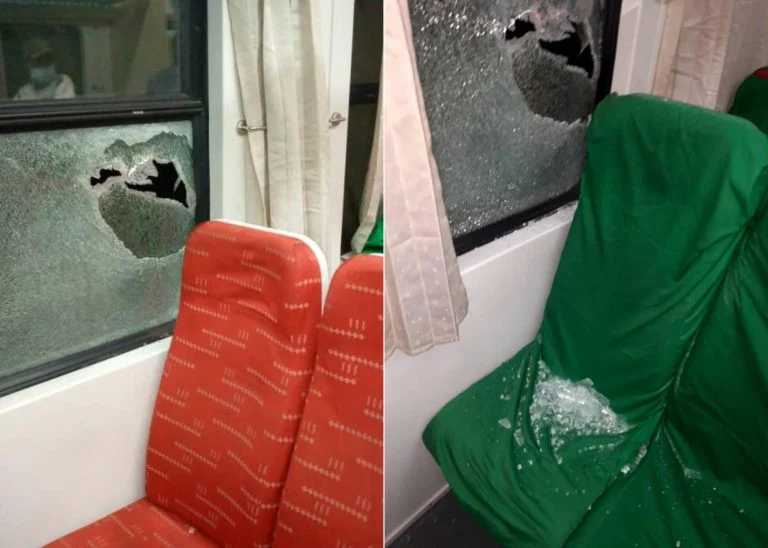
In a country where rail transport was once hailed as a symbol of progress and modernity, the increasing number of train accidents across Nigeria has become a troubling national issue. What should represent safety, efficiency, and economic development has too often turned into scenes of chaos, injury, and tragedy. From Lagos to Kaduna, and Warri to Abuja, the disturbing recurrence of train collisions and derailments has left commuters anxious and questioning the integrity of Nigeria’s railway system. What went wrong with one of the oldest and most promising transport sectors in Africa?
For decades, rail transport in Nigeria struggled under neglect and poor maintenance. The renewed push to revive the railway system—through government partnerships, modernization projects, and foreign investments—brought hope of safer, faster, and more affordable travel. However, recent accidents have cast a dark shadow over these efforts. In March 2022, for instance, the Abuja-Kaduna passenger train was attacked after derailment, leading to loss of lives and abductions. More recently, collisions between passenger and freight trains, mechanical failures, and track collapses have raised serious safety concerns. The promise of a modern railway system now stands at a crossroads between progress and peril.
Experts point to multiple causes behind these frequent accidents. Poor maintenance culture tops the list. Many of Nigeria’s railway lines were laid decades ago and have not received consistent upgrades to meet modern safety standards. The signaling systems, which should automatically prevent collisions, are either outdated or nonfunctional in several routes. Human error is another major factor—drivers, station officers, and control operators often work under stressful conditions with limited training or supervision. In some cases, accidents have occurred due to communication breakdowns between train crews and dispatch centers. These lapses are not isolated mistakes but symptoms of a system in urgent need of reform.
Beyond technical and human factors, vandalism and encroachment on railway tracks have made the situation worse. In many parts of Nigeria, illegal crossings, market stalls, and residential structures are built dangerously close to railway lines. Vandals steal metal parts, bolts, and clips from tracks, weakening their stability and increasing the likelihood of derailment. Some even remove components of newly installed rail infrastructure for scrap sales. Despite laws prohibiting such acts, enforcement remains weak. Each time tragedy strikes, the blame game resumes, but preventive measures rarely follow through.
The Nigerian Railway Corporation (NRC) has repeatedly promised to enhance safety measures, yet results have been slow to materialize. Authorities have introduced new safety protocols, including speed restrictions and regular inspections, but implementation is inconsistent. Many of these policies exist only on paper, with limited accountability when accidents occur. Victims and their families are often left to bear the consequences without adequate compensation or justice. Public outrage usually fades after a few days, only to resurface when another accident occurs. This lack of sustained action and follow-up underscores the country’s broader struggle with policy continuity and institutional responsibility.
The human cost of these accidents cannot be overstated. Each derailment or collision leaves behind stories of grief, trauma, and economic loss. Survivors often recount harrowing experiences—broken bones, shattered dreams, and lingering fear of public transport. Families lose breadwinners, businesses lose goods, and confidence in the railway system erodes further. “Every time I board a train now, I pray from departure to destination,” said Esther, a trader who frequently travels between Lagos and Ibadan. “We were told trains are safer than roads, but now, even that safety is uncertain.”
Beyond the emotional toll, frequent train accidents carry serious economic implications. The government’s multi-billion-naira investment in railway modernization is at risk of losing public trust. Investors who once saw potential in Nigeria’s transport infrastructure are now growing cautious. The tourism and logistics sectors—both reliant on efficient train networks—are equally affected. Delays, cancellations, and safety scares have dampened enthusiasm for what was once a promising mode of transport. In a country already battling poor road safety, the deterioration of railway confidence is a step backward in national development.
To address these problems, experts recommend a comprehensive overhaul of the railway safety framework. First, the government must prioritize maintenance and modernization over expansion. Upgrading tracks, signaling systems, and communication networks is crucial. Second, personnel training and accountability must become a top priority—railway workers need regular retraining, safety drills, and clear reporting mechanisms for potential hazards. Third, security around rail infrastructure must be strengthened to prevent vandalism and unauthorized access. Finally, there must be transparency and accountability whenever accidents occur. Investigations should lead to policy reforms, not just press releases.
Nigeria’s railway system can still fulfill its promise as a reliable and safe mode of transport, but it requires serious commitment from all stakeholders. Safety should not be an afterthought—it should be the foundation of every rail operation. The government, railway authorities, private contractors, and the public must work together to protect lives and restore confidence. Clean tracks and shiny trains mean nothing without safety and trust.
As the sun sets over the rusting rails of Nigeria’s aging train network, one truth remains clear: progress without protection is a dangerous illusion. Until the country learns to value maintenance as much as modernization, the sound of a train’s whistle may continue to carry not just the promise of travel—but the echo of tragedy.
Rabi Murtala is a Student of Mass Communication, Kashim Ibrahim University (Formerly Borno State University)



























You must be logged in to post a comment Login