Forgotten Dairies
In Nigerian Politics, Peter Obi Is Playing Like The Striker Every Defender Fears -By Isaac Asabor
Like the striker every defender fear, he remains the player many eyes are fixed upon, not because the match has already been won, but because everyone understands he still has the potential to influence how it unfolds.

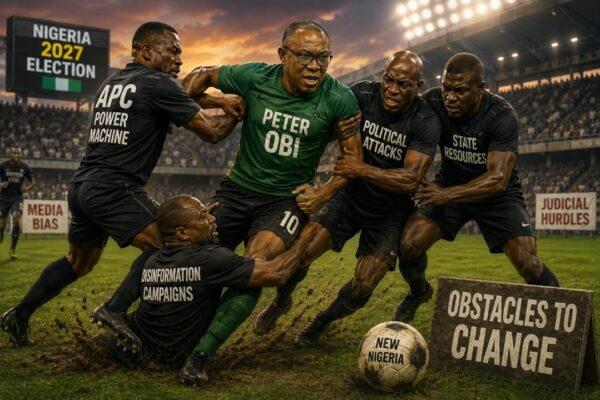
Every seasoned football lover knows one undeniable truth: defenders do not waste precious energy chasing an ordinary striker. They reserve their fiercest tackles, tightest marking and most aggressive challenges for the player they believe can decide the match.
When a striker is constantly double-marked, shirt-pulled, hacked down and denied breathing space, it is rarely because he is the weakest player on the field. It is because he is considered the greatest threat.
That same logic extends beyond the football pitch. It is equally visible in the arena of politics. Political parties do not invest enormous time, energy and communication resources attacking politicians they regard as inconsequential. They focus instead on personalities capable of shaping public opinion, energizing supporters and unsettling the political calculations of those in power.
It is against this backdrop that the sustained attention Peter Obi continues to receive from the ruling All Progressives Congress (APC) deserves careful examination.
Whether one belongs to the Obidient Movement or remains an ardent supporter of the APC is not the issue here. Political loyalty should never blind anyone to observable realities. The issue is whether the pattern of political engagement surrounding Peter Obi reveals something deeper than ordinary partisan exchanges.
My answer is yes. Nearly three years after the 2023 presidential election, Peter Obi remains arguably the most discussed opposition politician in Nigeria. He holds no executive office. He controls no state government. He does not command the machinery of the Federal Government. Yet scarcely does he comment on inflation, insecurity, unemployment, public debt, governance or the economy without attracting swift reactions from APC spokespersons, government officials or party loyalists. That, in itself, is politically significant.
If Obi were politically irrelevant, why devote so much attention to him? If he posed no electoral challenge, why does virtually every major intervention he makes generate an equally vigorous counteroffensive?
Politics, like football, often reveals its true priorities through conduct rather than declarations. No coach assigns three defenders to a player incapable of scoring. No sensible political party concentrates significant communication resources on someone it genuinely considers harmless. Those are simply not winning strategies.
History offers countless examples. In democracies across the world, ruling parties instinctively keep their eyes on opposition figures capable of capturing the public imagination. They monitor them closely. They respond to them quickly. They seek to neutralize their influence before it expands further. That is not unusual. It is politics.
Peter Obi has, whether his critics admit it or not, established himself as one of Nigeria’s most influential political voices outside government. His observations on national affairs routinely dominate newspaper headlines, television discussions and social media conversations.
His critics often accuse him of exaggeration, selective criticism or political grandstanding. His supporters see him as one of the few politicians consistently holding government accountable.
Regardless of which side one takes, one fact remains difficult to dispute: Obi has succeeded in remaining politically relevant long after the ballots of 2023 were counted. That is no small achievement.
Many presidential candidates disappear from public consciousness within months of losing elections. They retreat into silence until another campaign season approaches. Peter Obi has done the opposite. He has remained visible. He has remained vocal. Most importantly, he has remained impossible to ignore.
To further buttress this view, think of Lionel Messi in his prime. Think of Cristiano Ronaldo. Think of Didier Drogba. Think of Kylian Mbappé. Opposing defenders rarely allowed them freedom. Every touch invited pressure. Every run was tracked. Every movement attracted immediate attention.
Against the backdrop of the foregoing analogy, it is germane to ask, “Was it because they always scored? No. It was because defenders understood the consequences of giving them space. Politics follows remarkably similar instincts. When an opposition politician consistently attracts political rebuttals, rapid responses and sustained criticism, many observers naturally interpret that attention as recognition of his continuing political influence.
That interpretation may be debated. Indeed, APC officials would argue that they are merely responding to Obi’s public interventions, as any governing party would respond to criticism. That is a legitimate position.
At the same time, others see the intensity and frequency of those responses as evidence that Obi remains one of the opposition figures the ruling party considers worth engaging most directly. Politics often accommodates both interpretations. There is another dimension that deserves attention. Every attack carries risk.
Communication scholars have long argued that persistent engagement with an opponent can inadvertently amplify that opponent’s visibility. Every rebuttal keeps the opponent in the headlines. Every counterstatement extends the news cycle. Every attempt to discredit ensures the individual remains part of the national conversation.
Sometimes, in trying to stop a striker from scoring, defenders remind everyone on the pitch exactly who they fear most. This does not mean Peter Obi has already won any future election. Far from it. Political relevance is not the same as electoral victory. Winning elections requires structures, alliances, resources, grassroots mobilization, persuasive policy alternatives and millions of votes.
The APC also remains a formidable political machine with substantial institutional advantages and a nationwide presence. It would therefore be simplistic to suggest that frequent criticism of Obi alone determines the outcome of future elections. It does not.
Ultimately, Nigerians will judge all political actors by more substantive considerations: the cost of living, inflation, employment opportunities, security, electricity, education, healthcare, infrastructure and the overall direction of the country. Those issues, not political exchanges alone, will shape electoral choices.
Still, symbolism matters in politics. Perception matters. So, repeatedly focusing political firepower on one opponent inevitably sends a message, intended or otherwise. Football fans understand that message instinctively.
The striker receiving the hardest tackles is rarely the one defenders consider incapable of hurting them.
As Nigeria gradually approaches another election season, political temperatures will continue to rise. Campaigns will become more intense. Narratives will clash. Accusations and counter-accusations will multiply. That is the nature of democratic competition.
Yet amid all these developments, one political reality continues to stand out. Peter Obi remains one of the central figures around whom much of Nigeria’s political conversation revolves. Whether one admires him or disagrees with him, whether one believes he can win the presidency or not, his capacity to command attention remains unmistakable.
In football, defenders are judged by how effectively they stop dangerous strikers. In politics, ruling parties are judged not only by how effectively they answer their opponents but, more importantly, by how well they govern.
If governance delivers tangible improvements in the lives of citizens, opposition attacks gradually lose their sting. But where citizens remain dissatisfied, even the most relentless political tackling may not be enough to stop a determined striker from eventually finding the back of the net.
That is why, in my view, Peter Obi continues to occupy a unique position in Nigeria’s political landscape.
Like the striker every defender fear, he remains the player many eyes are fixed upon, not because the match has already been won, but because everyone understands he still has the potential to influence how it unfolds.