Forgotten Dairies
Lagos Is Drowning in More Than Rain -By Kator Ifyalem
Obstruction of drainage channels through unauthorised structures. Beyond large-scale reclamation, the proliferation of unapproved buildings and makeshift shops across the city has, over time, obstructed natural waterways and smaller drainage channels, compounding blockages caused by waste.

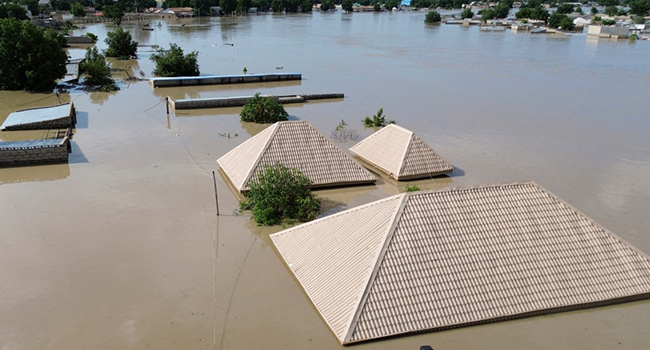
Over the past few weeks, videos of submerged buildings and vehicles being swept away have flooded Nigerian social media, most of them from Lagos. Flooding has long been a seasonal feature of life in the city, but the scale this year feels different. On Sunday, June 28, hours of heavy rainfall put major roads and residential communities under water across Oshodi, Mushin, Surulere, Egbeda, Gbagada, Ilupeju and Idi-Oro, among other areas. Even the temporary international terminal at Murtala Muhammed International Airport (MMIA), busiest in Nigeria, was not spared: floodwater entered the departure hall, boarding gates and airline offices, reaching the terminal’s powerhouse and forcing FAAN to cut power and relocate Air France-KLM, Ethiopian Airlines and Fly Gabon to Terminal Two.
And this is not yet the peak of the season. According to NiMet’s 2026 seasonal climate prediction, a weak La Niña transitioning into a neutral ENSO phase points to an elongated rainy season with a delayed end, with projected annual rainfall reaching up to 2,010mm in Badagry and averaging around 1,965mm across the 20LGEAs in Lagos. NIHSA’s 2026 Annual Flood Outlook has already listed Lagos among 33 high-risk states nationwide, and NiMet, NIHSA and NEMA have jointly flagged July to September as the period of greatest vulnerability. If the airport can flood before the peak has even arrived, the months ahead deserve serious attention.
The Government carries the primary responsibility for flood prevention and control: building and maintaining drainage infrastructure, enforcing planning laws, dredging channels and issuing early warnings. Lagos State did warn residents roughly two weeks before the June 28 flooding, naming Apapa, Badagry, Epe, Eti-Osa, Ikeja, Ikorodu, Ikoyi, Lagos Island, Lekki, Ojo, Orile-Agege, Surulere, Agege, Alimosho and Kosofe as areas at critical risk. The state has since approved emergency dredging of 28 primary drainage channels and ordered the removal of illegal structures on drainage alignments and wetlands.
But government action only works if it is not being undone daily by the very people it is meant to protect. That is the part of the story that gets less attention than the dramatic flood footage, and it deserves to be named plainly.
The poor human activities driving the floods
Dumping refuse and debris into drains and canals: Reporters who reviewed footage from the June 28 flooding found canals across the state choked with plastic waste, old tyres, rubber and other debris that visibly blocked the free flow of water. In Mushin, floodwater swept uncollected refuse straight onto the roads, compounding an already difficult situation for residents. This is not incidental litter, it is a routine practice of using open drains and waterways as dumping grounds, and it is one of the two behaviours the Commissioner for the Environment and Water Resources, has repeatedly and explicitly asked residents to stop.
Building on drainage setbacks and waterways: This is the more structural offence. Officials inspecting Lagos Agungi-Ajiran, Gravitas and Ikota areas confirmed that construction continues on wetlands and natural water channels, with buildings erected directly on drainage alignments meant to be kept clear. Around Graceland Estate, officials alleged illegal reclamation of wetlands; on the Ikota River, a private developer was accused of narrowing the natural course of the river without approval, despite a mandated setback of 150 to 200 metres meant to preserve its flow. The Ikota River discharges into the lagoon, meaning a single unauthorised reclamation upstream can worsen flooding across an entire corridor.
Illegal reclamation of wetlands: Wetlands are nature’s sponge, absorbing excess rainwater before it can pool in built-up areas. It was pointed out that a significant share of land in Lagos area is naturally water, and that many of the neighbourhoods now experiencing recurrent flooding sit on land that used to be wetland before it was reclaimed for development. Every additional reclamation removes a piece of that natural buffer.
Encroachment on drainage corridors and floodplains by developers and even traditional landowning families. Officials have noted that land ownership does not exempt anyone from environmental and planning regulations, and that some developers begin construction without environmental impact assessments in the hope of regularising the project afterward. The government has now warned that all illegal structures on these alignments will be removed “regardless of ownership.”
Obstruction of drainage channels through unauthorised structures. Beyond large-scale reclamation, the proliferation of unapproved buildings and makeshift shops across the city has, over time, obstructed natural waterways and smaller drainage channels, compounding blockages caused by waste.
Why this matters more than the videos suggest
None of this erases the underlying geographic reality: Lagos sits where the Atlantic Ocean, the Lagos Lagoon and an extensive network of rivers and creeks meet, and high tide can slow stormwater discharge into the sea even when drains are functioning properly. Climate change is stretching the rainy season and intensifying rainfall. These are facts government cannot dump-truck or dredge its way out of alone.
But a flood-control system engineered for a functioning drainage network cannot compensate for that same network being physically blocked by refuse or narrowed by unauthorised construction. Every cubic metre of stormwater that a wetland used to absorb, or a drain used to carry, has to go somewhere once that capacity is gone. Increasingly, it is going into departure halls, market stalls, bedrooms and vehicles.
Governments have the job to build, maintain, dredge and enforce. The job of the people is daily and far simpler: do not dump refuse into drains, and do not build on land that is meant to carry water away from the rest of us. Lagos cannot engineer its way out of a problem that keeps being recreated by hand.