
Forgotten Dairies
Media Cooperation Between Russia and Africa: Stimulating Joint Projects -By Kestér Kenn Klomegâh
Andrey Gromov, Executive Secretary of the Board of the African-Russian Energy Association (AREA), summarized the roundtable by presenting the resolution’s provisions containing specific recommendations on measures to stimulate Russian-African cooperation in the information sphere.

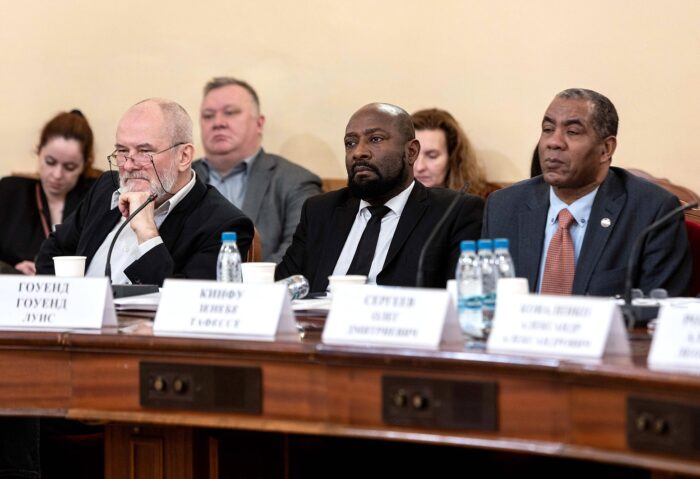
On 6th March 2025, the State Duma of the Federal Assembly of the Russian Federation hosted the roundtable “Information Bridge: Russia – Africa.” The event was organized by the Expert Council on Development and Support of Comprehensive Partnership with African Countries under the Deputy Chairman of the State Duma of the Russian Federation, Alexander M. Babakov, and the Afro-Russian Energy Association.
Representatives from the Russian Ministry of Foreign Affairs, leading Russian and African journalists and editors, well-known bloggers, media company officials from both Russia and Africa, information security specialists, and representatives from analytical centers and research organizations participated in the roundtable.
The event was moderated by Nikolai Novichkov, a deputy of the State Duma of the Federal Assembly of the Russian Federation and Deputy Chairman of the Expert Council. The co-moderator was Yulia Berg, head of the Globus expert club and co-author of the GlobalInsights program on Pan-African television.
Participants of the discussion developed specific proposals and recommendations on using media and the blogosphere to promote Russian-African projects, initiatives, and to expand cooperation between Russia and African countries in the field of media communications.
The event was opened by Alexander Babakov, Deputy Chairman of the State Duma of the Federal Assembly of the Russian Federation and Chairman of the Expert Council on Development and Support of Comprehensive Partnership with African Countries. He emphasized that the issues in media communication between Russia and Africa cannot be resolved without state participation.
“We will certainly, at least within the framework of the State Duma, look for mechanisms that would primarily prioritize state influence and create conditions under which our state’s information agenda could be implemented. There are many institutes and resources available for this. We need to approach them very carefully and seriously today,” said Babakov.
Maria Zakharova, the official representative of the Ministry of Foreign Affairs, highlighted the existing problems in the media field between Russia and Africa:
“The network of correspondents of Russian and African media has the potential to develop, but it is insufficient. There are no accredited African media in Russia. Interaction with local correspondents exists, but African journalists visit Russia episodically, mainly for major events. Against the backdrop of French and English-speaking media influence and a lack of Russian content, the African audience gets a distorted view of Russia and bilateral cooperation.”
Zakharova also proposed ways to resolve the issues in establishing media relations:
“It is important to continue contacts between Russian and African media. Strengthening cooperation through educational programs, press tours, and major media conferences is essential. Africa’s population is 1.5 billion, half of whom are under 20 years old. This is an age when people want to learn, set goals, and break into the world. Modern technologies create an information environment that cannot be overlooked. We have achievements, but we need more.”
Irina Abramova, Director of the Institute for African Studies of the Russian Academy of Sciences, made several proposals to develop media relations between Russia and Africa:
“It is crucial for journalists to understand Africa to avoid mistakes. We are ready to give lectures and cooperate to improve literacy in covering African topics. In large countries, media should broadcast not only in capitals but also in provinces, addressing educational issues as 50% of Africa’s population is under 20 years old.”
“Furthermore, it is important to bring African bloggers to show the reality of Russia and unite efforts to expand the themes and understanding of mutual interests. Africa is young, open to new things, and should not be portrayed only as a poor and hungry territory,” concluded Abramova.
Louis Gowend, Chair of the Commission for African Diaspora Relations and Public Relations at the Russia-Africa Club of Lomonosov Moscow State University, expressed the viewpoint that Irina Olegovna Abramova’s idea of creating a unified information space between Russia and Africa should be implemented.
However, to achieve this, as emphasized by Artur Kureev, Editor-in-Chief of “African Initiative,” it is first necessary to unify all resources and media related to Africa to establish a cohesive agenda. Artur Sergeevich added that a comprehensive strategy and understanding are necessary to determine the most effective way to engage with the African audience. It’s also crucial to assist the African infrastructure and develop it on a Russian foundation, including technological projects for internet development.
Kinfu Zenebe, head of African diasporas, stated that collaboration with media should focus on African media representatives in the Russian Federation. He suggested that the Russian Ministry of Foreign Affairs facilitate accreditation for representatives of African media in the Russian Federation. Through a mechanism, African countries should also be allowed to establish small bureaus in Moscow, which would serve as a strategic step towards strengthening strong diplomatic ties.
Cameroonian journalist and member of the Globus expert club, Clarissa Waidorven, highlighted the role of media in strengthening Russian-African ties, emphasizing that coverage of these relations in the global media landscape requires attention to both traditional and new media.
“Western media actively influence African narratives by enticing local bloggers. Russia should strategically use media platforms to advance its interests, creating a positive image through media diplomacy.”
Svyatoslav Shchegolev, Head of African Content Production at RT, emphasized the broadcasting challenges in delivering the Russian perspective to the audience:
“Today in Africa, they are finding new ways to convey information to viewers, sometimes in spite of Western pressure. There is a great deal of attention and willingness to cooperate directly from African media. In several countries, this includes state television channels.”
Victoria Smorodina, Editor-in-Chief of International Reporters, provided recommendations for France on “surviving” on the African continent:
“France needs to rethink its information warfare strategy in Africa, acknowledging the break from past influence. Instead of opposing pan-African demands, it should support the creation of an independent Africa by developing local media, culture, cinema, and theater.”
According to the Editor-in-Chief, this approach will help counter the influence of Turkey, the USA, and other powers.
“France’s defeat in the information sphere should stimulate the development of a new doctrine that combines cognitive sovereignty defense with offensive tools. Partnerships with private companies, a legal framework, and structures are needed to regulate information operations,” she argued.
Andrey Gromov, Executive Secretary of the Board of the African-Russian Energy Association (AREA), summarized the roundtable by presenting the resolution’s provisions containing specific recommendations on measures to stimulate Russian-African cooperation in the information sphere.
“We know of many business projects that simply fell apart because there wasn’t enough coverage. We didn’t understand from our side the contribution of the Russian Federation,” he stressed. Following the roundtable, recommendations were sent to the Government of the Russian Federation, in particular to develop and implement a comprehensive program to promote a positive image of Russia in African countries and to counteract the spread of disinformation about Russia in African media.

























You must be logged in to post a comment Login