Politics
Peter Obi Must Be an Idiot (Or So They Say) -By Onyejaka Alexander Arinzechukwu
Until then, if believing that public money should be protected, schools should be supported, hospitals should be strengthened, leaders should live modestly, unnecessary privileges should be rejected, and Nigerians should aspire to unity qualifies one as an idiot, then our dictionary may require urgent revision.

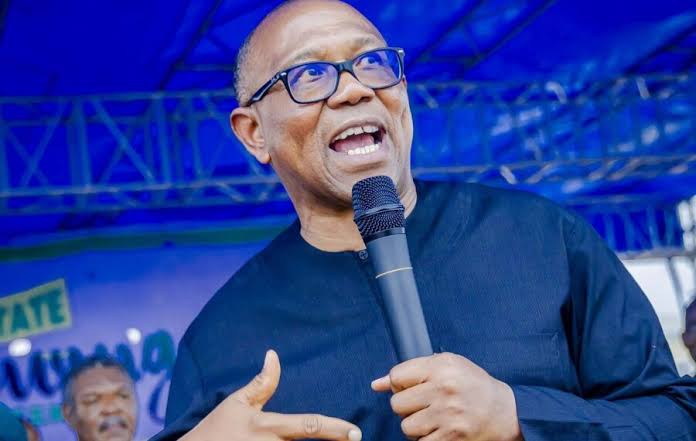
Every generation invents its own definition of an idiot. Once upon a time, it was the village fellow who mistook a goat for a horse. Today, it appears the qualification is much simpler: promise to unite Nigerians, refuse unnecessary luxury, account for public funds, and somehow still believe public office is meant for public service.
By this curious modern standard, Peter Obi must indeed be an idiot.
The latest evidence came after his interview on Channels Television with Seun Okinbaloye, where he declared that, if elected president, he would strive to unite Nigerians. That statement was enough for social media to burst into its usual carnival of outrage. Among the loudest voices was Deji Adenuya, who reportedly described Obi as an “idiot.”
One must admit that social media has a remarkable talent for reducing complicated ideas into playground insults. It is easier to dismiss a dream than to debate it. After all, calling someone an idiot requires only one word; explaining why national unity is impossible requires considerably more effort.
But perhaps Mr. Adenuya is onto something.
Imagine spending eight years governing Anambra State and leaving office with a reported reserve of about $150 million—an achievement repeatedly cited by Obi’s supporters as unprecedented among Nigerian public office holders. What kind of politician leaves money behind instead of excuses? Surely that is suspicious behaviour in a country where abandoned projects often multiply faster than completed ones.
An ordinary politician might have perfected the ancient art of ribbon-cutting ceremonies for projects that never quite survive the rainy season. Obi, instead, developed a reputation for financial prudence and fiscal discipline.
What an odd fellow.
Then there is the matter of philanthropy.
Instead of disappearing into comfortable retirement after leaving office, Obi has continued to support schools, mission institutions, hospitals, nursing schools and educational causes across Nigeria. In many communities, his visits are remembered not for speeches but for donations that arrived without television cameras announcing them weeks in advance.
An idiot indeed.
Who, in this age of endless self-promotion, gives quietly?
Who contributes to institutions without insisting that every classroom bear his portrait?
Who regards education as an investment rather than a campaign slogan?
Clearly, someone who has not mastered contemporary political marketing.
The evidence grows stronger.
Having completed two terms as governor, Peter Obi reportedly declined the allocation of government land in Awka that was available to former governors. Now this is where the case becomes overwhelming.
In a nation where public office often resembles a lifetime subscription to government privileges, rejecting a prime piece of land borders on economic recklessness.
Most people spend years seeking government favours.
This man reportedly turned one down.
Perhaps he misunderstood the rules.
Or perhaps he believed public service was not supposed to become a real estate investment scheme.
How naïve.
Then there is his travel habit.
When many public officials consider private jets an extension of democracy itself, Obi has frequently been seen boarding commercial flights, often in economy class.
Imagine the embarrassment.
How can airport protocol officers impress ordinary passengers if the former governor insists on joining the same security queue?
How can fellow travellers properly appreciate political importance when the politician insists on carrying his own bag?
Surely there ought to be a law against such simplicity.
After all, politics is supposed to create distance between leaders and citizens, not reduce it.
Yet this supposed “idiot” keeps doing the opposite.
He walks through airports.
He greets strangers.
He speaks with students.
He visits markets.
He attends schools.
He appears almost determined to behave like a public servant rather than a public emperor.
Very strange.
Of course, none of this means Peter Obi is beyond criticism.
Far from it.
Like every politician, his policies deserve scrutiny, his promises deserve questioning, and his ambitions deserve democratic examination. Democracy demands scepticism, not worship. No public figure should be insulated from criticism merely because supporters admire him.
But criticism works best when it attacks ideas instead of intelligence.
If one disagrees with Obi’s belief that Nigerians can be united, then explain why. Present evidence. Offer an alternative vision. Democracy flourishes through argument, not insults.
Calling someone an idiot may generate likes on social media, but it rarely generates light.
Perhaps that is the greatest irony of all.
History has a habit of confusing yesterday’s fools with tomorrow’s visionaries. Many ideas once mocked eventually became common sense. Whether Peter Obi succeeds or fails in national politics remains for Nigerians—not Facebook—to decide.
Until then, if believing that public money should be protected, schools should be supported, hospitals should be strengthened, leaders should live modestly, unnecessary privileges should be rejected, and Nigerians should aspire to unity qualifies one as an idiot, then our dictionary may require urgent revision.
Or perhaps the definition of wisdom has become the real casualty.
Sometimes satire tells us less about its target than about the society producing it.
And if this is truly the age in which simplicity is foolish, accountability is suspicious, humility is weakness, and unity is laughable, then perhaps the joke is not on Peter Obi after all.