
Forgotten Dairies
Rivers Commissioner-Nominees Screening: Vindictive Or Justified? -By Isaac Asabor

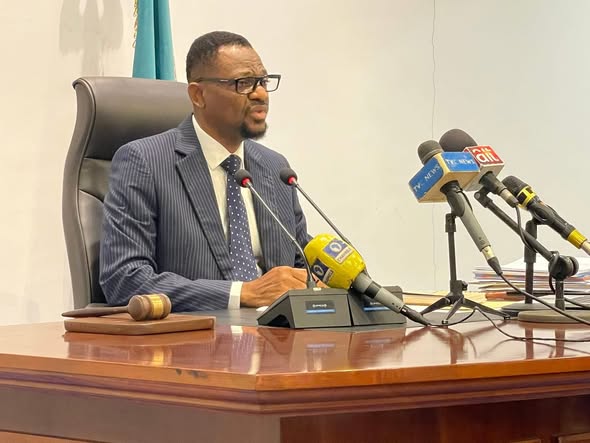
The recent screening of commissioner-nominees presented by Governor Siminalayi Fubara to the Rivers State House of Assembly no doubt assumed the tone of political drama rather than a straightforward exercise in legislative oversight. What should normally be a routine constitutional duty generating a series of controversies that have captured public attention.
Ordinarily, the screening of nominees was intended to assess competence, integrity, and preparedness for public service. It existed to reassure citizens that those entrusted with key government responsibilities possess the capability to deliver. However, the unfolded events inside the Assembly chambers in Port Harcourt suggested that the process drifted from this core objective.
Many observers, including this writer, who watched the screening exercise as it was transmitted live by Channels Television, and invariably followed the proceedings noted a pattern in the approach adopted during the sessions. Rather than concentrating on policy direction, administrative capacity, or the nominees’ vision for governance in Rivers State, some interactions leaned toward moments that appear unnecessarily theatrical. At times, the atmosphere seemed less like a professional evaluation and more like a public spectacle.
One episode that drew widespread attention involved a nominee who could not recite the second stanza of the national anthem. While familiarity with national symbols is certainly important, transforming such a moment into a prolonged public scene does little to determine whether a nominee is capable of effectively managing a government ministry.
The situation drew even greater scrutiny during the proceedings when the Speaker of the House, Martin Chike Amaewhule, questioned the academic background of one of the nominees. Citing the candidate’s academic history, the Speaker pointed to the number of attempts made at the West African Senior School Certificate Examination and referenced a third-class degree obtained from the University of Lagos, suggesting that the nominee’s academic record was far from impressive.
The nominee, believed to be under consideration for the position of Commissioner for Justice and Attorney-General, responded calmly. His position was straightforward: the number of attempts made in an examination should not overshadow what an individual ultimately achieves afterward. History is filled with professionals who began with modes academic records but went on to build remarkable careers. In public service, competence, experience, and integrity often matter far more than the classification on a certificate.
Also, Prof. Tamuno Williams was interrogated over several public statements and legal opinions he had published during the political crisis in Rivers State. The Speaker argued that many of the positions Williams publicly promoted were contradicted by subsequent court judgments, stating that the legal arguments he advanced “did not see the light of day” after the courts delivered their rulings.
In his response, Williams defended his comments, explaining that his opinions were based on legal jurisprudence and professional interpretation of the law. He insisted that his remarks were not intended to undermine or “talk down” on the House of Assembly.
Despite his defence, the Assembly rejected his nomination, citing what it described as his role in misleading the public about the activities and positions of the legislature during the crisis.
Williams was not the only nominee rejected during the exercise. Three other nominees were also not confirmed by the Assembly. Professor Datonye Alasia was rejected on the grounds of what lawmakers described as poor performance during the screening process. Charity Deemua was turned down for failing to present the required tax clearance documents, while Otonye TKD Amachree was rejected following the submission of more than 11 petitions against him by members of his community.
For many stakeholders, the tone of the exchange reinforced suspicions that the screening exercise may not be entirely insulated from the ongoing political tensions between the Assembly leadership and the governor. Critics argue that some of the intense questioning may be less about assessing merit and more about casting doubt on the governor’s choices.
Whether or not that perception reflects reality, it is an impression that democratic institutions must guard against. Legislative oversight risks losing credibility when it begins to resemble political retaliation rather than objective scrutiny.
The people of Rivers State deserve a screening process that is serious, fair, and focused on governance. While the Assembly has every constitutional right to rigorously question nominees, such scrutiny should be conducted with professionalism and respect. Firm questions are necessary, but they should not cross the line into humiliation.
Ultimately, the screening process should not be framed as a contest between the governor and the Speaker, nor should it become a stage for political brinkmanship. The real beneficiaries or victims, of the outcome are the people of Rivers State, whose wellbeing depends on the competence of those appointed to manage public institutions.
However, there is still room for the lawmakers to regain their collective image , and that of the state assembly as an institution by rescreening the nominees that were ejected. While reassessing them, there should be an urgent need to shift away from spectacle and return to substance. Rivers State requires commissioners capable of delivering meaningful results, just as it requires a legislature willing to perform its oversight role with maturity and fairness. Anything less risks reducing an important democratic responsibility to little more than political noise.






















You must be logged in to post a comment Login