
Africa
“Arise, O Compatriots”: A Line We Chant But Rarely Live By -By Isaac Asabor
Show love by funding health and education. Show strength by fighting corruption, not opposition. Show faith by investing in youth and infrastructure. Show unity by appointing across merit, not ethnicity. That is how to turn the anthem from a recital into a reality.

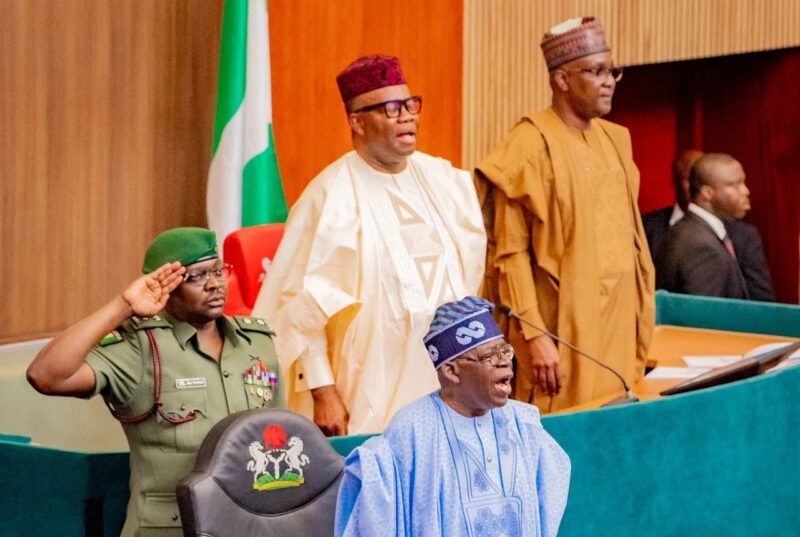
Every morning, across schools, offices, military parades, and formal events, Nigerians rise to chant the first stanza of the national anthem, a symbol of unity, duty, and national consciousness. The words roll off our tongues with pride, yet our collective behavior as a nation stands in ironic contrast to these noble lines.
Let us in this context recite this first stanza again: “Arise, O compatriots, Nigeria’s call obey/To serve our fatherland with love and strength and faith/The labour of our heroes past shall never be in vain/To serve with heart and might, one nation bound in freedom, peace and unity”.
Given the backdrop of the foregoing viewpoint, there is no denying the fact that they are powerful lines. Stirring words. But let us now confront the truth: How many of us, leaders and citizens alike, actually live by them? The disconnection between what we sing and how we behave as a people could not be more glaring.
When the stanza is dispassionately analyzed, particularly against the backdrop of our attitudes, the analytical findings would be that the lines of clarion call that characterize the stanza do not find expression in our collective efforts as Nigerians to rise above mediocrity, tribalism, selfishness, and corruption, despite the fact that the lines beckon every Nigerian to be a loyal compatriot, working for the good of the country.
At this juncture, it is germane to ask, “Do we truly obey Nigeria’s call?” When bandits roam free and kidnappers terrorize citizens while some government officials embezzle funds meant for security, are we obeying Nigeria’s call? When public officers see positions as avenues for personal enrichment instead of national service, can we say we have arisen as compatriots?
Even among everyday Nigerians, many have normalized dishonesty, lawlessness, and apathy. From traffic violations to election malpractice, the average Nigerian often places personal gain above national progress.
When the second line that says, “To serve our fatherland with love and strength and faith” is in a similar vein analyzed, the reality of the fact that the line is about genuine service, propelled by love for country, bolstered by strength, and sustained by faith in a better Nigeria cannot be disputed.
As it has become, love for the fatherland is now conditional. People serve only when there is something in it for them. Teachers are underpaid and demoralized. Doctors are leaving en masse. Students no longer believe education in Nigeria can secure their future. Some of them call it a scam. Even youth corps members now see the NYSC scheme as mere formality, not service. Where is the strength when workers are owed salaries for months? Where is the faith when promises by politicians are routinely broken?
Patriotism in Nigeria is being eroded because many feel the country no longer serves them in return. Love, strength, and faith have given way to frustration, despair, and resentment.
Looking at the anthem from the perspective of the third line, it is obvious that the line, “The labour of our heroes past shall never be in vain” pays homage to those who fought and died for Nigeria’s independence, unity, and progress. It is a pledge to uphold the values they died for: justice, unity, dignity, and peace. But are we keeping this promise?
Without a doubt, our independence heroes like Nnamdi Azikiwe, Obafemi Awolowo, Ahmadu Bello, and Tafawa Balewa envisioned a country where merit, not mediocrity, would thrive. Where unity would triumph over division. Where service, not looting, would define public office. Yet, the dreams of our founding fathers are being trashed. Nepotism now replaces meritocracy. Youths no longer have role models in politics, only power mongers. Ethnic tensions are worse. Insecurity has become normalized. We have turned their labor into a mockery by the very way we run Nigeria today.
As for the fourth line that says, “To serve with heart and might”, we are told that service must not be half-hearted, it must be fueled by passion (“heart”) and vigor (“might”). But when subjected to reality check in this context, one would be compelled to ask, “Do most public servants serve with heart and might?” A lot of them are ghosts, literally and figuratively. Ghost workers, ghost projects, ghost budgets. Where there should be sacrifice, we find showmanship. Where there should be accountability, we find arrogance.
The civil service is bloated but underperforming. Many government officials barely put in eight hours a week but expect full pay. Where is the might in our service culture? Where is the heart in the execution of public duties?
Even at the grassroots, many people cut corners and seek the path of least resistance. “Serving with heart and might” has been replaced with “doing the bare minimum.”
On the fifth line, which is “One nation bound in freedom, peace and unity”, there is no denying the fact it is perhaps the most idealistic, a hope for a united nation, where all ethnic groups, regions, and religions co-exist in peace, where every Nigerian enjoys freedom. On reality check, Nigeria is more divided today than at any other point in recent memory. Tribalism is institutionalized. Zoning, not competence, often determines who gets what position. Tension mounts, and mutual suspicion simmers along ethnic and religious fault lines.
Given the foregoing, Can we truly say we are “bound in unity” when some groups threaten secession while others insist on domination? Are we “bound in peace” when communities are attacked by herdsmen, terrorists, or unknown gunmen with impunity?
In fact, where is the freedom when the press is muzzled, protesters are brutalized, and court orders are ignored? The anthem says we are bound in unity and freedom, but our national experience says otherwise.
Without a doubt, there is an urgent need for a national attitude adjustment. If the anthem is a mirror, then we are staring at a distorted image of who we truly are. We need more than songs, we need personal and institutional transformation.
This is not to discount the efforts of patriotic Nigerians who rise above the rot daily. There are civil servants who work diligently. There are soldiers, nurses, journalists, and entrepreneurs who still serve with love and faith. But they are often isolated, discouraged, or sidelined by a system that rewards the exact opposite.
We must realize that every Nigerian’s conduct either upholds or desecrates the anthem. Every bribe paid, every contract inflated, every law flouted is an insult to the promise of “Arise, O compatriots.”
Leaders must remember: you are the chief interpreters of this anthem. Citizens will not rise if you lead them into apathy. They will not obey Nigeria’s call if you mock it with impunity.
Show love by funding health and education. Show strength by fighting corruption, not opposition. Show faith by investing in youth and infrastructure. Show unity by appointing across merit, not ethnicity. That is how to turn the anthem from a recital into a reality.
In fact, it is time we stopped mouthing the anthem and started manifesting its meaning. The national anthem is not decoration. It is a national doctrine. A moral compass. A code of conduct.
Let us challenge ourselves daily: Am I rising as a compatriot today? Am I serving with love and strength? Am I honoring the labour of heroes past? Am I promoting unity, peace, and freedom?
Until our answers become a confident “Yes,” we will continue to live in a nation whose anthem is a performance, not a practice. Let us arise, not in volume, but in values.





















You must be logged in to post a comment Login