
Forgotten Dairies
Benue Blocked Peter Obi’s Humanitarian Convoy: Is Enugu Trying to Block His Political Messages? -By Vitus Ozoke, PhD
If a citizen owns a property and voluntarily wishes to display a lawful political message there, the burden should be on the government to demonstrate the constitutional justification for interfering with that expression. Threatening ₦50 million makes that burden of justification even more serious.

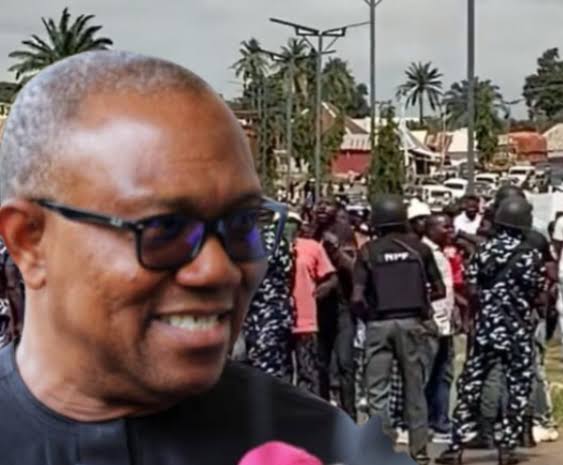
There is regulation. There is overregulation. There is political desperation masquerading as regulation. And then there is whatever the Enugu State Structures for Signage and Advertisement Agency (ENSSAA) has just announced.
ENSSAA has reminded Ndi Enugu that pasting or displaying posters is prohibited throughout Enugu State – not merely on government buildings, bridges, electricity poles, road medians, and other public infrastructure, but, astonishingly, on private property and private spaces as well.
And just in case anyone thinks this is a harmless bureaucratic advisory, the government has attached a threat of a fine of up to ₦50 million. Fifty million naira. For a poster. Welcome to Enugu State, where apparently Tomorrow Is Here, but your constitutional freedoms may have been left somewhere in yesterday.
Let me state what should be obvious. A responsible government has every legitimate reason to protect public infrastructure from indiscriminate poster-pasting. Nobody has a constitutional right to plaster Peter Obi’s face – or Peter Mbah’s, Bola Tinubu’s, or anyone else’s – on traffic signs, bridges, electricity poles, government buildings, and public monuments. The government may regulate billboards. It may protect road setbacks. It may prevent environmental defacement. It may prescribe reasonable rules governing commercial outdoor advertising. That is governance.
But when government moves from protecting public property to telling a private citizen what political message they may display on their own property, we enter a profoundly different constitutional territory.
If I own my house in Enugu and decide to put a Peter Obi poster on my gate, in my window, or on a wall that belongs to me, whose permission must I seek to express my political preference? Peter Mbah’s? ENSSAA’s? Francis Aninwike’s? Since when has displaying one’s preferred candidate on one’s own property become equivalent to defacing government infrastructure?
The Nigerian Constitution guarantees freedom of expression, including the freedom to hold opinions and to receive and impart ideas and information. Political expression lies at the heart of that freedom. Yes, constitutional rights are subject to lawful and reasonably justifiable restrictions. But that is precisely why the government should be required to explain the necessity and proportionality of something as sweeping as an outright prohibition extending into private property. This is not merely a question about posters. It is a question about power.
And why now?
The timing makes the announcement even more deserving of scrutiny. Enugu is approaching local government elections. The 2027 political season is gaining momentum. Governor Peter Mbah is now an APC member. Opposition political organizations are mobilizing. Peter Obi remains an enormously consequential political figure in the Southeast. So, Ndi Enugu are entitled to ask a simple question: Who exactly is this poster ban designed to protect Enugu from?
Funeral posters? Church crusade posters? WAEC lesson posters? Private-school admission posters? Traditional marriage announcements? New yam festival posters? A mechanic advertising his workshop? A young woman advertising her catering business? Or Peter Obi? If ENSSAA means what it says – that this is an outright ban on all posters on both public and private property – then let us see equal enforcement.
Let ENSSAA send its enforcement officers into every village in Enugu State. Let them remove every funeral poster from private compounds. Let them prosecute every church that advertises a crusade. Let them sanction every school that displays an admissions poster. Let them pursue every cultural association that announces an event. Let them investigate every business that displays promotional posters. And, of course, let them impose their threatened ₦50 million penalties.
If that sounds absurd, perhaps it is because the breadth of the announced policy itself invites absurd questions. But if those posters remain untouched while political posters suddenly become objects of extraordinary governmental interest, the public will be entitled to draw its own conclusions about what this exercise is really about.
But ENSSAA somehow made an already extraordinary directive even more extraordinary. It warned printers. Think about that. A printing press receives an order for 10,000 campaign posters. The printer prints them. That is what printers do. How exactly is the printer supposed to know where those posters will be displayed?
Must printers now interrogate customers? “Excuse me, sir. Before I print your Peter Obi posters, please swear an affidavit stating the geographic coordinates of every wall where each poster will eventually be placed.”
Suppose the posters are printed in Enugu but transported to Anambra State. Suppose they are printed in Lagos and brought into Enugu. Suppose they are printed in Abuja. Will ENSSAA dispatch enforcement officers to Ikeja to arrest the printer? Of course not. Enugu State’s regulatory jurisdiction does not magically extend across Nigeria merely because something printed elsewhere eventually enters Enugu.
More fundamentally, printing a poster and unlawfully placing one are two distinct acts. If the alleged offense is unauthorized display, liability should ordinarily attach to what the law actually prohibits and what can be legally proved – not merely because somebody operated the machine that produced the paper.
How is a printer supposed to know a customer’s future intentions? How will ENSSAA establish a printer’s knowledge or participation? What evidentiary standard will ENSSAA apply? Apparently, in the Republic of ENSSAA, the printing press must now double as an intelligence agency. This is what happens when regulation outruns reason.
But there is an even bigger elephant on the bus. A spectacular hypocrisy lies at the heart of the matter. Governor Peter Mbah’s image has appeared prominently on Enugu State mass-transit buses, accompanied by the inscription: “Experience Enugu, Tomorrow Is Here!” These are not Peter Mbah’s privately purchased campaign buses. They are public transportation assets acquired for Enugu State – with Enugu public money.
Here is the question ENSSAA should answer: If displaying political personalities and promotional messages across Enugu is such a grave threat to the state’s aesthetic integrity, why is the sitting governor’s face allowed to appear on publicly provided buses? If the government insists that “Tomorrow Is Here” is merely an administrative slogan rather than campaign branding, citizens are still entitled to ask why publicly funded assets require the governor’s portrait at all.
A public bus does not need Peter Mbah’s face to run. A government project does not become more governmental because the governor’s photograph is attached to it. Public resources belong to Ndi Enugu, not to the temporary occupant of the Lion Building.
This is precisely why the optics of this poster directive are so troubling. Imagine the absurdity: Peter Mbah’s portrait on a government bus: acceptable. Peter Mbah’s slogan on public assets: acceptable. A citizen voluntarily putting Peter Obi’s photograph on his own private wall: potentially ₦50 million?
Someone needs to explain the democratic principle behind that distinction. And please do not tell us about aesthetics. Democracy is not improved aesthetically by making only the incumbent’s face ubiquitous. Government must not become the incumbent governor’s free advertising agency.
Democratic governments must respect a fundamental distinction: the state is not the ruling party, and the ruling party is not the state. Peter Mbah is the governor today. Someone else will be the governor tomorrow. That is democracy.
The machinery of Enugu State must therefore never be deployed in ways that make it appear that governmental regulation is being used to advantage the incumbent and his party while constraining opponents’ political visibility.
This matters especially because ENSSAA had already announced a ₦150 million advertising permit for political parties and candidates for the 2026/2027 election cycle – a policy that opposition parties have reportedly challenged in court. And now we have this renewed ₦50 million threat over posters.
At some point, regulation can become so financially burdensome and so expansive that citizens are entitled to ask whether the objective remains environmental order or whether environmental regulation has become an instrument for restricting political participation.
If Peter Obi is your problem, say so.
Perhaps Peter Obi has nothing whatsoever to do with this. Fine. Then the Mbah administration and ENSSAA should have no difficulty demonstrating that through transparent, politically neutral, and consistent enforcement. Apply the same rules precisely to APC materials. Apply them to Governor Mbah. Apply them to churches. Apply them to funeral announcements. Apply them to businesses. Apply them to schools. Apply them to cultural organizations. Apply them to every poster, every politician, and every political party without distinction. And publish the enforcement records.
Until then, citizens are perfectly entitled to ask why such an extraordinarily broad restriction is being emphasized just as another political season approaches. Democracy does not mean the government may monopolize the visual landscape while citizens are priced out, regulated, or frightened out of expressing their political preferences.
An important principle here transcends Peter Obi, Peter Mbah, the APC, the NDC, or the 2027 election. A government powerful enough to decide which political poster you may display on your private property is exercising a power that every citizen should scrutinize – including those who presently support that government.
Political power changes hands. Today’s restriction on the candidate you dislike becomes tomorrow’s restriction on the candidate you support. That is why constitutional freedoms should not depend on who occupies Government House.
Regulate billboards. Protect bridges. Protect utility poles. Protect government buildings. Prevent indiscriminate defacement. Punish people who vandalize property that does not belong to them. Keep Enugu clean. These are legitimate governmental objectives. But the government should tread carefully before turning environmental regulation into a permission slip for private political expression.
If a citizen owns a property and voluntarily wishes to display a lawful political message there, the burden should be on the government to demonstrate the constitutional justification for interfering with that expression. Threatening ₦50 million makes that burden of justification even more serious.
Ndi Enugu deserve an explanation. Why should Peter Mbah’s face travel freely around Enugu on a publicly provided bus, while another citizen must fear punishment for displaying Peter Obi – or any other candidate – on private property? That question is bigger than either man. It is the difference between regulating a city and regulating political thought.
ENSSAA should understand that difference before Tomorrow Is Here becomes a warning rather than a slogan.
Dr. Vitus Ozoke is a lawyer, human rights activist, and public affairs analyst based in the United States. He writes on politics, governance, and the moral costs of leadership failure in Africa.














You must be logged in to post a comment Login