
Politics
Fani-Kayode vs Dele Momodu: A Mirror of Hypocrisy in Nigerian Politics
Until consistency is valued over convenience, until critique is disentangled from ambition, and until public figures are held to account not just for what they say but for how their positions evolve, such exchanges will continue. Different names, same pattern.

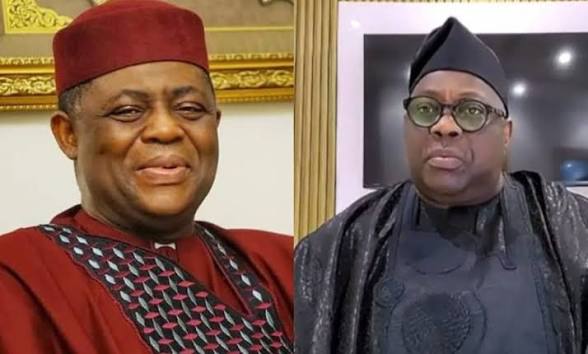
The insult itself was crude, even by the already lowered standards of Nigeria’s political discourse. But the viral question—“Who looks more like a pig?”—was less revealing for its vulgarity than for what it exposed: not just a quarrel between Femi Fani-Kayode and Dele Momodu, but a political culture in which men of influence routinely say of others what could just as easily be said of themselves.
It is tempting to treat their latest clash as spectacle—another episode in Nigeria’s long-running theatre of elite antagonisms. But that would be a mistake. What makes this exchange noteworthy is not the insults traded, but the symmetry behind them. Each man’s accusation lands with uncomfortable credibility because it draws from a shared pattern: a public life marked less by consistency than by convenience, less by principle than by proximity to power.
Over the past two decades, Femi Fani-Kayode has built a reputation as one of Nigeria’s most combative political voices—an asset in a system that often rewards volume over clarity. But his political positioning has been anything but fixed. Once a fierce critic of figures he now defends, including Bola Ahmed Tinubu, his trajectory reflects a broader pattern in Nigerian politics: alliances are rarely permanent, and convictions are often negotiable.
To point this out is not to single him out. It is to recognize a pattern that extends across the political class—one in which access to power frequently dictates the tone and direction of public commentary. Femi Fani-Kayode’s defenders might call it pragmatism. His critics call it opportunism. What is harder to dispute is the inconsistency.
Yet Dele Momodu, who casts himself as a critic of political excess, operates within a similar orbit. His long-standing alignment with Atiku Abubakar, his own presidential bid, and his visible proximity to political power complicate the image of an independent observer. Like many influential media figures in Nigeria, he occupies a dual role: commentator and participant.
This duality is not inherently disqualifying. But it does raise a question: when critique is entangled with ambition, how consistent can it be?
To understand this feud is to understand the incentives that sustain it. Nigeria’s political ecosystem has long rewarded not ideological clarity but loyalty—often personal, sometimes transactional. In such an environment, public figures are not merely analysts or advocates; they are also actors navigating a system where relevance is currency.
Both men have, at different moments, functioned as amplifiers—defending allies, attacking opponents, and recalibrating their positions as political winds shift. This is not unusual. It is, in many ways, the logic of the system. But it comes at a cost.
When public discourse becomes an extension of political alignment, it loses its capacity for independent scrutiny. Criticism becomes selective. Praise becomes strategic. And the line between analysis and advocacy begins to blur.
The result is a kind of informational instability: citizens are left to interpret arguments not on their merits, but on the perceived interests behind them.
The deeper problem is not that figures like Femi Fani-Kayode or Dele Momodu change positions. Political evolution is inevitable, even necessary. The problem is the absence of explanation—of a transparent account of why positions shift, and what principles, if any, remain constant.
Without that, flexibility begins to look like expediency. And expediency, repeated often enough, erodes trust.
In a country facing complex challenges—security crises, economic pressures, and deep social fractures—trust is not a luxury. It is a prerequisite for effective governance. When prominent voices appear guided primarily by self-interest, it reinforces a broader public cynicism: that politics is less about service than about survival.
A Mirror of a Larger Disorder
The Femi Fani-Kayode–Momodu clash is, in this sense, less an aberration than a mirror. It reflects a system in which personal loyalty often outweighs public accountability, and where influence is maintained through visibility as much as through substance.
That both men accuse each other of moral and intellectual failure is, paradoxically, what gives the exchange its resonance. Each recognizes in the other something familiar. Each, in attempting to diminish the other, inadvertently describes a shared condition.
This is why the insults linger. Not because they are clever, but because they are, in a limited way, true.
Beyond the Noise
It would be easy to dismiss this episode as noise—another distraction in a crowded media landscape. But doing so risks ignoring what it reveals about the structure of public life in Nigeria.
Until consistency is valued over convenience, until critique is disentangled from ambition, and until public figures are held to account not just for what they say but for how their positions evolve, such exchanges will continue. Different names, same pattern.
The question, then, is not who “looks more like a pig.” It is why a political culture persists in which such a question can be asked—and answered—without fundamentally altering the conditions that make it possible.

Jeff Okoroafor
Jeff Okoroafor is a social accountability advocate and a political commentator focused on governance, accountability, and social justice in West Africa.























You must be logged in to post a comment Login