National Issues
Oyo School Abductions: The Grave Questions Governor Makinde Wants the World to Confront -By Daniel Nduka Okonkwo
Governor Makinde has, in his own words, called for the truth to be established regardless of office, influence, or affiliation. That standard should apply as much to Alausa and Agodi as it does to any commander now in DSS custody. Profiles International Human Rights Advocate, Amnesty International, and other Nigerian and international human rights organizations will be watching closely to see whether the Federal Government, or indeed the United Nations, is prepared to meet that standard.

For 56 days, Nigerians spoke in whispers, wary of saying aloud what their instincts suggested: the Oriire abductions were not a routine bandit raid but a collapse in security oversight. Parents believed authorities withheld vital details, teachers feared silence meant negligence, and civil society questioned whether the rescue was slowed by official caution. Governor Seyi Makinde has now given voice to those buried fears, that the weeks of captivity may conceal failures deeper than official accounts acknowledge, failures that speculation alone cannot prove but which demand independent scrutiny
Terrorists stormed three schools in Oriire Local Government Area of Oyo State and marched dozens of pupils and their teachers into the forest, the children are home, the cameras have moved on to the next crisis, and Governor Seyi Makinde has done something no sitting Nigerian governor has done in recent memory. He has stood before his own people and effectively told them that he does not trust the Nigerian state to tell them the whole truth about what happened to their children.
The facts of the attack itself are no longer in dispute. On the morning of May 15, 2026, armed men simultaneously raided Baptist Nursery and Primary School in Yawota, Community Grammar School, and L.A. Primary School in Ahoro Esiele, all in Oriire Local Government Area. An assistant headmaster, Joel Adesiyan, was killed on the day of the attack while trying to escape. The abductors marched their captives, mostly small children and their teachers, on foot and later by motorcycle deep into the Old Oyo National Park, a federally controlled forest reserve. The gunmen were later identified as members of Ansaru, the Boko Haram splinter faction formally known as Jama’atu Ansarul Muslimeena Fii Bilaadis Sudan, who demanded the release of two detained commanders, Mahmud Usman and his deputy Abubakar Abba, alongside a ransom and other conditions.
The Minister of Defence, General Christopher Musa, would later confirm that the attackers were holding the children as leverage to force the release of their jailed commanders. Musa told the country plainly that the group threatened to kill every child if security forces came too close. That threat was carried out at least once, in the case of teacher Michael Oyedokun, whose killing in captivity was confirmed by the authorities, and in the death of Deacon John Olaleye, also killed while in captivity. In the course of the eventual rescue, Lieutenant F.A. Isaac, hunters, members of the Oyo State Amotekun Corps, and other personnel also lost their lives.
For fifty-six days, the country watched a slow-motion national trauma unfold. Teachers in Ogbomoso downed their tools. Civil society groups demanded action. Then, on July 10, an intelligence-led operation by the Nigerian Army’s 2 Division, under General Officer Commanding Major General C.R. Nnebeife, working with the Office of the National Security Adviser, the police, the DSS, and local hunters and vigilantes, secured the release of the pupils and teachers. Eight suspected members of the gang were arrested and handed over to the DSS. The Presidency, through Special Adviser on Information and Strategy Bayo Onanuga, insisted no ransom was paid and no prisoner was exchanged, framing the outcome as vindication of a hard line against negotiating with kidnappers. Some accounts suggest troops applied sustained pressure on the group in the weeks before the final assault, an account that, if true, raises its own uncomfortable questions about how long the state knew where the children were being held and why it took nearly two months to act on that knowledge.
Governor Makinde, on Monday, formally received the forty-four survivors at the State Secretariat in Ibadan and delivered a broadcast that has since detonated a political firestorm. Rather than simply thank the security agencies and close the chapter, he described the circumstances of the abduction and its resolution as sufficiently grave and unusual to warrant scrutiny beyond Nigeria’s own institutions, and called on the United Nations and other international human rights bodies to independently examine what happened, who was responsible, and whether there was negligence or collusion at any level. He was careful to frame the request as a reinforcement of accountability rather than an attack on the country, and reminded Nigerians that, constitutionally, responsibility for national security rests with the Federal Government, not with him.
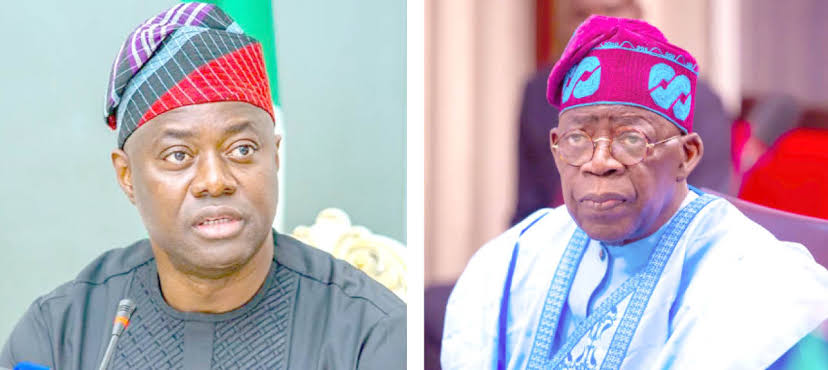
The Presidency did not take it well. Onanuga dismissed the governor’s demand as unnecessary and politically motivated, arguing that Nigeria’s security agencies had already given a full account and that no institution would deliberately leave children in captivity for nearly two months. He accused Makinde, who recently declared a 2027 presidential ambition on the platform of the Allied Peoples Movement, of weaponising the tragedy and chasing what he called a strange conspiracy theory. Former Ekiti State Governor Ayo Fayose had, weeks earlier, floated the allegation that Makinde’s government orchestrated the abduction to embarrass the Federal Government, a claim widely condemned by Makinde’s own party structures but one that has nonetheless lodged itself in the public conversation, not least because Makinde had declared his presidential intentions mere hours before the attack, a coincidence the governor himself has pointedly noted in public remarks.
The politics underneath all of this are not subtle. Makinde is positioning himself as a 2027 challenger to President Tinubu, and his call for UN scrutiny has been read by government allies as one more front in that contest. What both camps agree on, whether they admit it or not, is that a state governor publicly inviting the United Nations to investigate his own country’s security forces is not a routine event in Nigerian politics, and it will not be forgotten quickly by either side.
What deserves far more scrutiny than the political theatre is the operational failure that made all of this possible in the first place. Three schools were hit at once, in broad daylight, in a state that had gone years without an incident of this scale, bordering a federally administered national park. Whoever was meant to be watching those access corridors was not watching closely enough. Oyo State had already imposed a curfew across ten local government areas bordering Old Oyo National Park in the weeks before the rescue, later relaxing it as operations intensified, and Makinde has now announced that the state will tighten oversight of the corridors leading into the park. Those measures are themselves an admission that the security gaps exploited on May 15 had been there, known and unaddressed, for far longer than anyone in government has been willing to say out loud.
Nigerians deserve answers that this newspaper intends to keep pursuing. Who had prior intelligence of a planned attack on Oriire and did nothing with it? What does the length of this operation say about the true cost, in trauma and in blood, of the state’s insistence that it does not negotiate? Has the Old Oyo National Park, sitting under federal jurisdiction while its surrounding communities remain the constitutional responsibility of Oyo State, become the kind of ungoverned space that armed groups will continue to exploit long after the cameras leave Ibadan?
Governor Makinde has, in his own words, called for the truth to be established regardless of office, influence, or affiliation. That standard should apply as much to Alausa and Agodi as it does to any commander now in DSS custody. Profiles International Human Rights Advocate, Amnesty International, and other Nigerian and international human rights organizations will be watching closely to see whether the Federal Government, or indeed the United Nations, is prepared to meet that standard.
Daniel Nduka Okonkwo is an investigative journalist, human rights advocate, and policy analyst based in Abuja, Nigeria. He is the publisher of Profiles International Human Rights Advocate, a platform focused on accountability journalism, governance reporting, and the documentation of human rights issues across Africa. His work examines the intersection of political power, institutional accountability, systemic failure, and the human impact of corruption, with particular focus on Nigeria and the wider African continent.
Okonkwo’s reporting and analysis have been published in Sahara Reporters, African Defence Forum, Daily Trust, Vanguard, Daily Intel, Opinion Nigeria, African Angle, Local Newsbreak, and other international media outlets. His work is driven by a commitment to transparency, democratic governance, and justice. He also collaborates with Daniels Entertainment on human rights initiatives, extending his advocacy beyond traditional journalism into broader public engagement.
He is based in Abuja, Nigeria, and can be reached at dan.okonkwo.73@gmail.com.