Africa
When Denial Becomes A Disservice: INEC’s Blind Spot On Vote-Buying In Anambra -By Isaac Asabor
Democracy cannot thrive where truth is optional. INEC’s role is not to protect its image, but to protect the process. Until the Commission stops denying the obvious and begins addressing the uncomfortable, vote-buying will remain the unspoken rule of Nigerian elections, and every claim of “free and fair” will sound like another official joke.

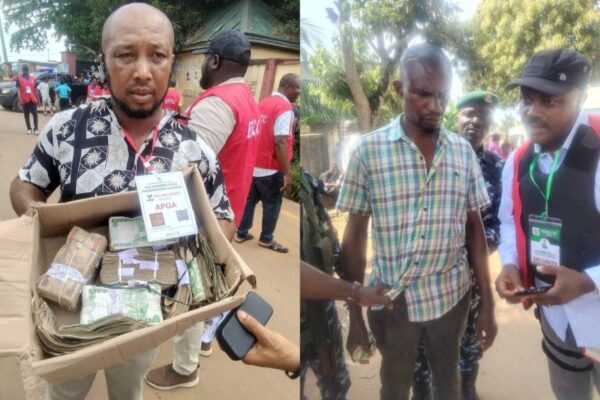
The just-concluded Anambra governorship election has once again exposed a familiar contradiction that continues to haunt Nigeria’s electoral integrity. the denial of the obvious. While the Independent National Electoral Commission (INEC) was quick to dismiss reports of vote-buying as “unfounded,” the Economic and Financial Crimes Commission (EFCC) was simultaneously arresting individuals caught in the very act. The contradiction is not only embarrassing but also raises disturbing questions about the credibility of INEC’s monitoring mechanisms and its willingness to acknowledge electoral malpractice when it occurs.
When INEC’s Resident Electoral Commissioner, Queen Agwu, appeared on national television to declare that there were “no verified reports” of vote-buying, her confidence seemed absolute. She insisted that “rumours carry no weight without proof,” portraying the commission as being on top of its game. Yet, barely hours after her statement, the EFCC confirmed the arrest of three suspects, Emeka Ilokasia, Nwachukwu Loretta, and Emuka Chuwudi, all allegedly caught buying votes in Njikoka, Oyi, and Dunukofia local government areas respectively.
If INEC saw no evidence while the EFCC made arrests within the same election, then something is fundamentally wrong, either with INEC’s system of election observation or with its sincerity. It is not the first time such institutional contradictions have played out, and sadly, it is unlikely to be the last. But it is deeply troubling that a body entrusted with upholding electoral credibility appears more eager to protect its image than confront the rot corroding Nigeria’s democracy from within.
Vote-buying is no longer a hidden crime in Nigeria’s elections. It has become a public transaction, brazen, organized, and often conducted in plain sight. From ₦1,000 to ₦10,000 per ballot, votes are traded like market goods, and those who refuse to participate are mocked as “wasting their votes.” The Anambra case is only the latest reflection of this degeneracy. What makes the denial by INEC so dangerous is that it suggests institutional blindness to a problem that has already been criminally documented.
When the EFCC arrests suspects for vote-buying, it is not acting on rumours. The agency operates on intelligence and credible reports. Its operatives were deployed across the state with a clear mandate to monitor and apprehend offenders. That they succeeded in making arrests proves that vote-buying indeed took place. INEC’s refusal to acknowledge this undermines the efforts of anti-corruption agencies and creates an impression of institutional disunity, a situation where one arm of government admits wrongdoing while another pretends nothing happened.
INEC’s denial also sends a dangerous signal to political actors: that as long as the commission refuses to see, no crime is officially recorded. This culture of denial emboldens politicians to continue buying votes, confident that any allegation would be dismissed as mere speculation. It erodes public trust, discourages legitimate voters, and mocks the sacrifices of those who risk their safety to defend the sanctity of the ballot.
Moreover, Queen Agwu’s assertion that “none of our officials or accredited observers reported such incidents” is precisely the problem. Nigeria’s elections have long been plagued by selective observation, polling units are often too many and dispersed for monitors to cover comprehensively, and those bent on manipulating the process know exactly where to strike. Vote-buying rarely occurs where INEC’s presence is strongest; it thrives in corners of the system where vigilance is weakest. To rely solely on INEC’s internal monitoring to detect such crimes is to trust the fox to guard the henhouse.
It is important to state that acknowledging vote-buying is not an indictment of the entire election process; it is a step toward cleaning it up. Denying it, however, ensures that it festers unchecked. The EFCC’s arrests in Anambra prove that the cancer is spreading, and pretending otherwise is tantamount to aiding the disease.
If INEC truly intends to protect electoral integrity, it must adopt humility in the face of evidence. It must work hand in hand with agencies like the EFCC and the police not contradict them. The Commission’s credibility rests not on its ability to issue denials, but on its readiness to confront uncomfortable truths. Nigerians are not blind; they see the exchange of cash and the sudden distribution of food items and wrappers on election days. They know that conscience has become a commodity in the political market.
Anambra’s election should serve as a lesson. Denial will not build public trust. Transparency will. INEC should have acknowledged the EFCC’s arrests and pledged collaboration to ensure prosecution. Instead, it chose to dismiss the issue altogether, as if silence could erase reality. The result is a credibility gap that widens with every election cycle.
Democracy cannot thrive where truth is optional. INEC’s role is not to protect its image, but to protect the process. Until the Commission stops denying the obvious and begins addressing the uncomfortable, vote-buying will remain the unspoken rule of Nigerian elections, and every claim of “free and fair” will sound like another official joke.
In Anambra, the choice was not just between candidates, it was between truth and denial. Unfortunately, INEC chose denial.