
Africa
With Enugu’s Fall, All Eyes on Umuahia: A Sad Déjà Vu -By Vitus Ozoke, PhD
Perhaps, in the final reckoning, Alex Otti is not the last man standing, but the last test – a mirror held up to a people’s will to remember who they are. And if he falls — as Enugu has fallen — then the last light in Umuahia may flicker out, and with it, the lingering dream that the Igbo once dared to dream and the dance of dignity and pride they once danced. And when that dance ends, the drums of history will fall silent. And ndi Igbo will awaken to find that they were not conquered from without — but from within.


When the news broke that Governor Peter Mbah of Enugu had crossed over to the ruling All Progressives Congress (APC), a chill, a sigh — or was it a groan? — swept through the southeast. Enugu, the coal city, the historic capital of the Eastern Region, the symbolic heart of Igbo political memory, and the citadel of Igbo pride, had fallen once again. The flags that once stood defiant over the hills of Nsukka and the coal city were lowered not to cannon fire or the thunder of artillery this time, but to the quiet artillery of politics and the relentless march of political conquest: inducement, calculation, greed, and fear.

It felt like history stirring in its restless sleep. The fall of Enugu in 1967 marked the beginning of Biafra’s retreat; its fall again today feels like the beginning of another kind of surrender — quieter, bloodless, but no less painful. And so, as in 1967, all eyes turn eastward — to Umuahia, the serene hill city that once bore the burden of being the city that held a nation’s last gasp of defiance.
For those who remember, Umuahia was more than just a dot on a map; it was the second capital of Biafra, the sanctuary to which the dream fled after Enugu’s fall. During that earlier time, as federal troops advanced from all sides, Umuahia became the beating heart of a wounded nation and the spirit of the Biafran struggle.
Between September 1967 and December 1969, the city housed the government, the military command, its living symbol of endurance, and the will to resist. The famous Ojukwu Bunker, carved deep beneath the red earth, served as both symbol and sanctuary — the underground war room where strategy met faith, where a people’s will refused to yield, and where destiny itself seemed to whisper through the walls. When Enugu fell, Umuahia stood firm. But when Umuahia fell, Biafra died.
History, they say, does not repeat itself, but it rhymes — and today’s rhymes are unmistakably and uncomfortably familiar. With the defection – more like the capture – of Enugu’s Peter Mbah, Governor Alex Otti of Abia State, the General Commander of the Umuahia outpost, stands as perhaps the last and final sentinel of southeastern moral, political, and, sadly, existential autonomy.
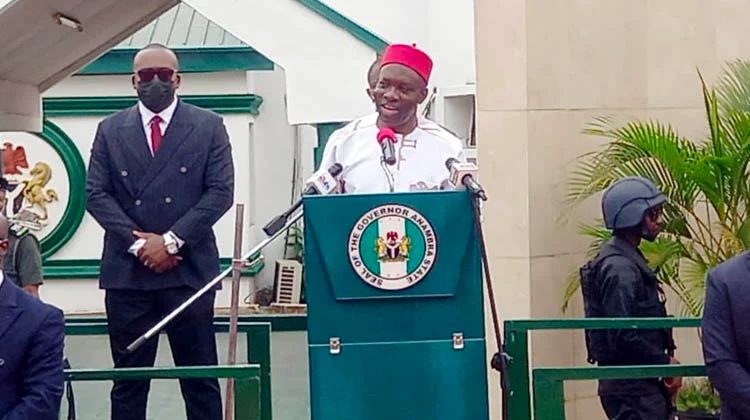
With Anambra’s Gov. Chukwuma Soludo never being in the portrait of courage – having gratuitously surrendered without a fight – Otti has become the last political holdout not yet pulled into the centripetal pull of the federal machine. The question, then, is not just whether Otti will fall or stand alone — but how long he can stand at all. Will Otti be remembered as the last general of moral resistance — or as the final dancer in a slow, humiliating waltz toward submission?
Today, the battle is no longer fought with rifles, but with inducements, contracts, and subtle threats. The invading forces no longer wear fatigues; they wear fine agbadas, bearing smiles and promises of inclusion and “national integration.” The artillery of today is covert — patronage, political appointments, federal contracts, and the persistent temptation to belong. The siege is no longer fought with bombs but with budgets, not with propaganda but with co-option. The new frontlines are not marked on maps but exist in the hearts of a people gradually taught to forget.
Enugu, once the pride of the East, has been politically annexed. In 1967, it was captured by cannons and artillery. Today, it succumbs to the fire of personal ambition and the gentle appeal of power, comfort, and convenience. Once again, the burden of the East shifts to Umuahia — the last free city of conscience – hoping for strength, for conscience, for a stand that cannot be bought.
If we extend the metaphor of history, there is a parallel that chills the soul. In April 1969, Nigerian forces first entered Umuahia. For a brief moment, the city fell — but the Biafrans fought back, reclaimed it, and held on. For months afterward, the city pulsed with resistance, and Biafra continued to breathe, not because of its firepower but because of its will. Yet by December 24, 1969, exhausted and surrounded, Umuahia finally fell for good. Its capture shattered the last organized resistance, paving the way for Biafra’s total surrender a few weeks later, in January 1970. With its fall came the end of a defiant, if doomed, dream. That fall was not just military — it was existential. The symbolic fortress of Igbo resilience crumbled, and with it, the dream of self-determination. What we face today may be the moral fall of a people.
Alex Otti stands where General Ojukwu once stood — not in the trenches, but on the fragile frontier between integrity and compromise – the moral and symbolic battlefield. His government, much like Ojukwu’s in 1968, is surrounded by forces far larger than it: a dominant federal establishment intent on uniformity, a demoralized regional political elite seeking comfort in compromise, and a people whose faith has been tested by years of political betrayal. Otti is surrounded, not by tanks, but by temptations; not by soldiers, but by sycophants. The pressure is relentless. The federal tide is rising, and every political shoreline in the southeast has already been washed over.
These are not just idle metaphors. The same patterns persist — only the weapons have changed. In the 1960s, Igbo men and women were slaughtered in the north — in Kano as in Kaduna — and the world looked away. Today, Igbo mansions and businesses are demolished in Lagos, with their owners told it is just “urban renewal.” The script is old, but the setting has been updated. Then, as now, internal betrayal hastened external defeat. The tragedy of the Igbo nation has never been in the power of its enemies, but in the weakness of its families and friends — the collaborators and opportunists within, the ones who open the gates and whisper the coordinates of Biafra’s heart and call it pragmatism. What force of arms could not achieve in 1967, personal ambition and fear may yet accomplish in 2025, as politicians who trade away the dignity of their own people for proximity to power.
So, I must ask again: How long can Umuahia hold? Can Umuahia once more serve as a beacon of principle — a reminder that leadership can mean something more than a crooked calculation for personal political survival? How long can Alex Otti withstand the slow-motion siege of Nigeria’s political centralization before the circle fully closes? Will he stand, for much longer, or will he, too, fall into the macabre dance — the same dance of shame and disgrace that history shudders to remember? If he falls — whether through seduction or surrender — then the Igbo will have no more sentinels, only servants. The fall of Umuahia will not echo with gunfire this time; it will be drowned in applause. And perhaps that is the most dangerous kind of fall — the one that feels like victory.
If Enugu’s fall is déjà vu, then Umuahia’s fate may soon become prophecy. And when that happens, we may once again hear the same lament that echoed through the forests of Afara and the fields of Owerri: that the east has lost not only its capital but also its courage.
Still, a faint glimmer remains — the stubborn ember of Igbo resilience that refuses to die, even when the world declares its end. The spirit that once dug bunkers beneath Umuahia’s soil and called them hope still survives. That spirit has not completely vanished. For now, it burns in the quiet defiance of Alex Otti, in his effort to govern with reason in an unreasonable time. Alex Otti, for now, embodies that ember. He stands in the narrow space between compromise and conviction, between the allure of power and the burden of history. Whether he will guard that ember or let it die in the winds of expedience, only time will tell. But time is unkind to those who hesitate. The “federal troops” — metaphorical or otherwise — are advancing. They come not with bayonets but with budgets. Not with tanks but with titles. And Umuahia, once again, finds itself surrounded by the politics of assimilation.
If Otti stands, Umuahia will again be remembered as the city that refused to kneel — the last light in a gathering dusk. But if he falls, then perhaps this is not the last stand at all, but the last dance — a slow, sorrowful dance of a people surrendering not to force, but to forgetfulness. So, the question is not just about one man, but about a people’s endurance. Will the southeast, like Biafra before it, allow itself to be conquered from within — by fatigue, by cynicism, by the allure of comfort? Or will it, even in the twilight, find a way to stand for something more?
Perhaps, in the final reckoning, Alex Otti is not the last man standing, but the last test – a mirror held up to a people’s will to remember who they are. And if he falls — as Enugu has fallen — then the last light in Umuahia may flicker out, and with it, the lingering dream that the Igbo once dared to dream and the dance of dignity and pride they once danced. And when that dance ends, the drums of history will fall silent. And ndi Igbo will awaken to find that they were not conquered from without — but from within.
Dr. Vitus Ozoke is a lawyer, human rights activist, and public commentator based in the United States.






















You must be logged in to post a comment Login