Education
₦3.52 Trillion: Nigeria’s Biggest Education Budget Ever — and Still Not Enough -By AbdulAzeez Toheeb Olawale
But a record budget measured only against Nigeria’s own recent history is a low bar. Measured against global benchmarks, against the scale of the out-of-school crisis, against a defence budget growing faster than schools are being made safe, and against a system that routinely fails to spend the money it is given — the ₦3.52 trillion figure looks less like a triumph and more like a floor that Nigeria has yet to build meaningfully above.

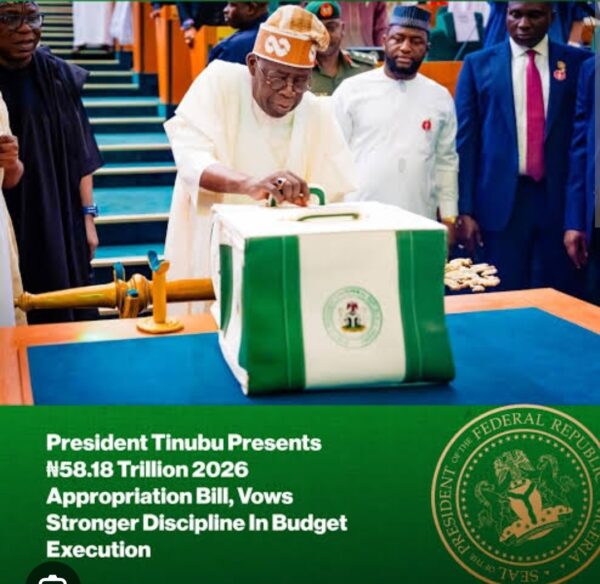
When President Bola Tinubu stood before the National Assembly to present the ₦58.18 trillion 2026 Appropriation Bill, education was framed as one of the government’s four central pillars, alongside security, infrastructure and health. The number attached to it — ₦3.52 trillion — was presented as historic: the largest sum any Nigerian administration has ever committed to education in a single budget year.
On paper, it looks like proof of a government finally taking its human capital crisis seriously. Officials have pointed to a steep climb from ₦1.54 trillion in 2023 to ₦3.52 trillion just two years later, and to concrete wins along the way — a new student loan scheme that has now supported over 418,000 students across more than 200 tertiary institutions nationwide.
But strip away the headline figure, and a more uncomfortable picture emerges. This is the story of a budget that grew in naira terms but shrank in relative priority, and of a system where money allocated on paper routinely fails to reach classrooms at all.
A Number That Doesn’t Add Up to Enough
The ₦3.52 trillion sounds enormous until it is placed next to the total budget it sits inside. At ₦58.18 trillion overall, education’s share works out to roughly 6 percent of national spending — a proportion that has stayed essentially flat since 2025 despite the naira figure climbing.
That falls dramatically short of international benchmarks. UNESCO recommends that countries devote between 15 and 20 percent of total government expenditure, or 4 to 6 percent of GDP, to education. By that measure, education policy analysts have calculated that an adequate Nigerian education budget for 2026 should have landed somewhere between ₦8.7 trillion and ₦11.6 trillion — two to three times what was actually allocated.
There is also the question of what a trillion naira is actually worth today. Nigeria’s currency has lost significant value against the dollar since the 2023 exchange rate liberalisation, meaning a budget that looks record-breaking in nominal terms buys considerably less than it would have just a few years ago. Economists have been blunt about this: the allocation is large in number, but not necessarily in value.
Security First, Classrooms Second
Perhaps the most revealing comparison in the entire budget isn’t between education and health, but between education and security — and how each has grown.
Defence and security received ₦5.41 trillion in the 2026 budget, comfortably the largest single sectoral allocation and roughly 54 percent more than education received. That gap has been widening for years. Security spending jumped by well over 100 percent in a single year between 2024 and 2025, and the Ministry of Defence’s budget alone more than doubled between 2024 and 2026.
The justification, repeated year after year by the presidency, is that security is the foundation on which every other sector depends — that classrooms cannot function, and children cannot learn, in places under threat of attack. It is a defensible logic. But the numbers raise an uncomfortable follow-up question: is the money actually buying safety for schools?
The evidence suggests otherwise. Even as defence spending has more than doubled over three years, attacks on schools have not receded — they have spread. What was once a crisis largely confined to Nigeria’s North-East and North-West has expanded into the North-Central and South-West regions. Investigators examining school safety infrastructure found that more than 10,000 schools nationwide have no perimeter fencing at all, and over 800 schools across northern Nigeria remain completely closed because of insecurity. Of the 36 states expected to implement the federal Safe School Initiative, 30 have yet to operationalise it.
Rising security budgets and a rising body count of unsafe schools are not, on their own, evidence of failure — correlation is not causation, and Nigeria’s security challenges are genuinely vast. But it does suggest that simply funnelling more money into defence has not been sufficient to make classrooms safe, and that education’s budget cannot be evaluated in isolation from the security spending that is meant to protect it.
The Money That Never Arrives
Even the ₦3.52 trillion that is allocated does not reliably become ₦3.52 trillion that is spent.
In 2024, state governments collectively used only 67 percent of the education funds budgeted to them, leaving a shortfall of roughly ₦800 billion in capital projects that were approved on paper but never executed — new buildings unbuilt, renovations undone, equipment unpurchased. Policy analysts point to this as the deeper structural problem: Nigeria’s education crisis is not simply a funding gap, but a capacity and accountability gap. Tertiary institutions in particular struggle to access capital that has technically already been approved for them, trapped behind bureaucratic bottlenecks that can take months or years to clear.
This execution gap helps explain a paradox that frustrates parents, teachers and administrators alike: budgets keep rising, yet universities remain underfunded, lecturers keep striking through the Academic Staff Union of Universities, and school buildings across the country continue to deteriorate. Money announced in Abuja does not automatically translate into money spent in Sokoto, Nasarawa or Ebonyi.
Behind the Number: 10 Million Children
The human cost behind these figures is staggering. More than 10 million Nigerian children remain out of school, according to 2026 reporting from UNICEF, one of the largest out-of-school populations in the world. Across the North-East, North-West and North-Central regions alone, roughly 8.4 million people, including close to five million children, were estimated to need humanitarian assistance in 2026, with conflict and displacement continuing to disrupt whatever access to education remains.
This is not a crisis that new school buildings alone can solve. It is tangled up with poverty, insecurity, displacement and gender inequality,meaning education policy cannot be designed in isolation from social protection and security policy. A budget line, however large, cannot substitute for a functioning, joined-up strategy.
A Tale of Two Governments: States That Are Trying
Not every layer of government is treating education as an afterthought. Several states have moved well beyond the federal government’s roughly 6 percent commitment. For 2026, Kano State is projected to direct around 30 percent of its budget to education, Enugu State around 32 percent, Kaduna 25 percent, and Abia 20 percent proportions that, unlike the federal figure, edge closer to UNESCO’s recommended range. Collectively, state governments raised their education budgets by 53 percent in a single year, driven largely by a sharp rise in capital allocations for actual infrastructure.
Whether that state-level ambition survives contact with the same execution problems — the unspent capital budgets, the bureaucratic delays — remains to be tested. But it complicates any narrative that Nigerian governments, as a whole, are indifferent to education. Some clearly are not. The question is whether that commitment can be matched at the federal level, and whether commitments on paper anywhere in the system can be reliably converted into classrooms, teachers and safety on the ground.
The Verdict
₦3.52 trillion is not a small number, and it would be dishonest to describe the administration’s investment in education as trivial. It represents genuine growth from where the country stood just three years ago, and initiatives like the student loan fund have measurably expanded access to tertiary education for hundreds of thousands of young Nigerians.
But a record budget measured only against Nigeria’s own recent history is a low bar. Measured against global benchmarks, against the scale of the out-of-school crisis, against a defence budget growing faster than schools are being made safe, and against a system that routinely fails to spend the money it is given — the ₦3.52 trillion figure looks less like a triumph and more like a floor that Nigeria has yet to build meaningfully above.
The real test of the 2026 budget will not be the number Tinubu announced in the National Assembly. It will be how much of that ₦3.52 trillion actually reaches a classroom, a teacher’s salary, or a fenced and functioning school — and whether, a year from now, the number of out-of-school children has moved at all.