
Breaking News
Climate Finance Dispute Overshadows COP31 Opening as UN Chief Demands Urgent Action
COP31 begins in Turkey with disagreements over climate financing, fossil fuels and adaptation funding as world leaders face pressure to accelerate climate action.

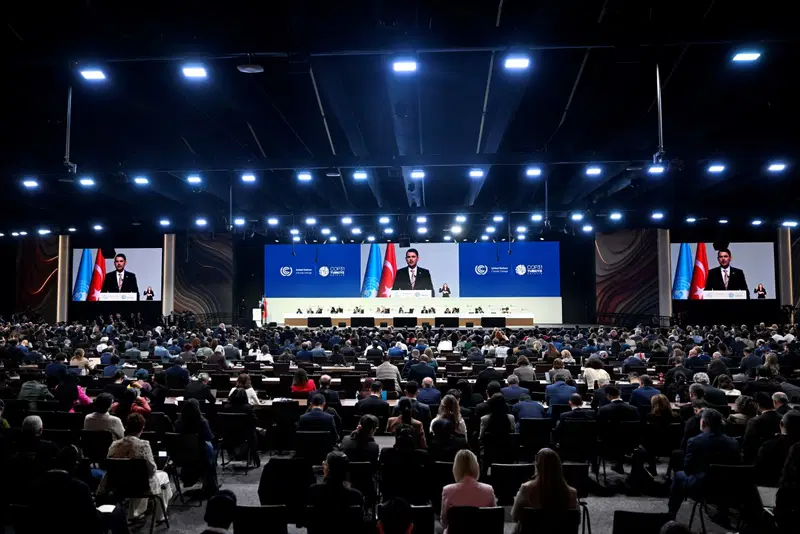
World leaders have come under renewed pressure to accelerate efforts against climate change as the 31st United Nations Climate Change Conference (COP31) opened on Monday in Antalya, Turkey, with disagreements over climate financing dominating its early proceedings.
UN Secretary-General Antonio Guterres urged governments to “get serious” about the climate emergency, warning that the world had entered a period of increasingly destructive weather extremes.
The two-week conference has attracted thousands of participants to the Turkish Mediterranean city, where governments are expected to discuss emissions reduction, climate financing, energy transition and support for vulnerable countries.
Its opening comes against the backdrop of devastating climate-related events, including severe heatwaves across Europe, major wildfires in Indonesia and catastrophic floods in Nepal. An exceptionally strong El Niño phenomenon has added to the disruption.
“We have entered a new age of climate extremes,” Guterres said in a statement.
He called on governments to “get serious by cutting emissions faster, accelerating a just transition from fossil fuels and delivering the finance and protection vulnerable countries need”.
Despite the urgency of the issues, COP31 encountered immediate procedural difficulties, with its opening ceremony starting 90 minutes behind schedule without an explanation.
The delay followed prolonged negotiations on Sunday, as developing countries pushed for climate finance to feature prominently in the official conference agenda.
Greenpeace’s COP31 delegation head, Jasper Inventor, described the development as a difficult beginning for the summit.
“This has already been a difficult start for COP31,” he said.
The disagreement centres on financial assistance from wealthier nations to developing countries. Under existing UN climate agreements, developed economies, which have historically contributed most to greenhouse gas emissions, are expected to support poorer countries in adapting to climate change and shifting towards cleaner energy sources.
Developing countries, however, maintain that the available funding falls significantly short of their requirements.
Inventor accused developed countries of taking a “hard line” on a proposed platform agreed at COP30 in Brazil last year, which seeks to provide a forum for discussions on how wealthy nations should finance climate action in developing countries.
A source familiar with the negotiations said the “climate finance work programme” would be reflected in the official agenda.
African countries also sought to secure a dedicated agenda item on tripling adaptation finance, which would enable vulnerable nations to invest in climate resilience projects, including sea walls and drought-resistant agricultural practices.
The source said the demand would not receive a separate agenda item but would instead be considered under other existing discussions.
The prospects of additional financial commitments also appear uncertain, following a warning from a senior European Union official last week that there would be “no political will” for extra funding pledges at the summit.
Limited expectations for major agreements
Analysts and observers expect limited progress on major climate commitments at COP31, with governments facing economic and geopolitical pressures.
An oil price shock, alongside tensions linked to the US war with Iran and Russia’s conflict in Ukraine, has complicated the international environment in which climate negotiations are taking place.
The longer-term outlook is equally troubling. The United Nations warned in September that global temperatures were on course to rise beyond 1.5°C above pre-industrial levels, exceeding the most ambitious threshold established by the Paris Agreement.
Turkey and Australia lead COP31 partnership
Turkey is presiding over the conference, while Australia is responsible for leading negotiations under an unusual hosting arrangement that resolved a dispute between the two countries but raised initial questions about its implementation.
Both governments have since presented the partnership as a success.
At the opening ceremony, COP31 President Murat Kurum, Turkey’s environment minister, and Australian Climate Minister Chris Bowen received applause after raising their joined hands above their heads.
The countries have positioned the summit as the “implementation COP”, with an emphasis on moving beyond repeated promises towards practical climate action.
“We know that delay carries one of the heaviest costs in climate action,” Kurum said.
As part of its contribution, Turkey is seeking support for a voluntary electrification pledge that would increase electricity’s share of global energy demand from around 20 per cent to 35 per cent by 2035.
Fossil fuel disagreement threatens consensus
However, the proposed electrification initiative could become another contentious issue during the negotiations.
The European Union wants the proposal to emphasise “clean” electrification, potentially opening a debate over whether Turkey’s initiative adequately addresses the continued use of oil, gas and coal.
The disagreement reflects broader challenges surrounding the global transition away from fossil fuels.
At COP28 in Dubai in 2023, countries reached a landmark agreement to transition away from fossil fuels. Yet, translating that commitment into concrete measures has proved difficult.
The COP30 conference in Brazil also failed to secure an explicit reference to fossil fuels in its final agreement after oil-producing countries opposed the proposed wording.
Brazil subsequently developed a voluntary roadmap containing proposals for phasing out fossil fuels, with countries free to determine how the recommendations could be adapted to their individual circumstances.
Brazilian President Luiz Inácio Lula da Silva is expected to address COP31 later this week. He was scheduled to arrive in Antalya late Monday following his re-election victory, which climate campaigners welcomed as a boost for climate action.
Meanwhile, the United States’ absence from the official government delegation is another notable development.
President Donald Trump, who has expressed scepticism towards climate action, has not sent US officials to the conference.
Nevertheless, a congressional delegation from the United States is expected in Antalya, with Democrats arriving after celebrating their historic victory in last week’s US midterm elections.












You must be logged in to post a comment Login