
Africa
Middle East: When Will The Wars End? -By Abiodun Komolafe
Diplomacy and dialogue are essential in resolving disputes, as demonstrated by various diplomatic efforts to address the conflict. Africa and Nigeria can benefit from prioritizing diplomatic engagement and regional cooperation to address security and economic challenges. Moreover, regional stability and cooperation are vital for promoting economic development and combating terrorism, as evident from the impact of the conflict on the Middle East.

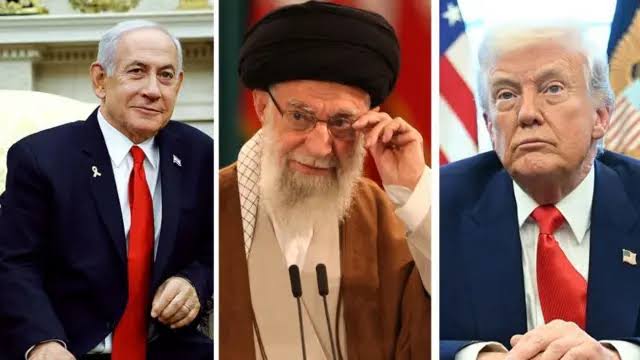
The Middle East has been a hotbed of conflict for decades, with wars and skirmishes erupting over issues like land, borders and rights. Over the decades, the region has become a complex web of alliances, rivalries, and power struggles, with global powers like the United States, the UK, France, China and Russia pursuing their own interests and agendas. Regional players like Qatar and Turkey have also been vying for influence, with some making efforts to broker peace deals.
The recent escalation between Israel and Iran has only brought the region to a boiling point, again drawing in global powers. In this volatile landscape, the question of when the wars will end is complex; it is rooted in deep-seated historical and cultural tensions shaped by colonialism, imperialism and arbitrary borders drawn by Western powers.
To understand the ongoing conflicts in the Middle East, it’s essential to examine their historical origins. A historical analysis is necessary to contextualize the multitude of conflicts plaguing the region today and determine the factors perpetuating this cycle of violence. The region’s complex politics have roots stretching back centuries, predating the Ottoman Empire and the fall of Constantinople, which marked significant turning points.
Right now, and, unlike the era of the Egyptian President Abdel Gamal Nasser, when pan-Arabism fostered regional unity, the Middle East today is characterized by fragmentation. The potent Sheikhs and Emirs, who give priority to their grip on power and strategic alliances with the US, view Iran as a threat to their interests. As such, they are unlikely to support their neighbour, which exemplifies the enduring relevance of the divide-and-rule framework in contemporary Middle Eastern geopolitics.
The Iranian issue lays bare the West’s hypocrisy and duplicity. Put bluntly, the roots of today’s conflicts can be traced back to the August 19, 1953 coup that ousted Prime Minister Mohammed Mossadegh, who championed national sovereignty and resource control. Ironically, his efforts to reclaim control over Iran’s resources could be seen as an earlier iteration of ‘Make Iran Great Again,’ long before the phrase became a catchphrase in a different context. With Mossadegh successfully ousted from power, the US subsequently initiated Iran’s nuclear programme under the Shah’s puppet regime.
Given this history, the US and its allies’ calls for the dismantling of Iran’s nuclear programme ring hollow. The critical question to ask is: who started it in the first place? Nonetheless, the enduring nature of these conflicts is tied to unresolved issues, particularly resource control and the Israeli-Palestinian conflict, which requires a two-state solution. As Dwight D. Eisenhower presciently warned in his January 17, 1961 farewell address as the 34th president of the United States, perpetual conflict serves the interests of the military-industrial complex. Of course, it highlights the need for a more nuanced approach to geopolitics.
The Arab-Israeli War (1948)! The Suez Crisis (1956)! The Six-Day War (1967)! The Yom Kippur War (1973)! The Iran-Iraq War (1980-1988)! The Gulf War (1990-1991)! The Iraq War (2003-2011)! The Syrian Civil War (2011-present)! The Yemen Civil War (2015-present)! The recurring Israeli-Gaza conflicts! The Israel-Iran conflict, which has seen periods of escalation and ceasefire! But when will the wars end and when will the Middle East heave a sigh of relief?
Again – and realistically, too – lasting peace in the Middle East seems as elusive as a mirage in the desert. The conflicts are as complex as the region’s geopolitics, and quick fixes are about as effective as a Band-Aid on a bullet wound. Diplomatic efforts, like the latest ceasefire brokered by the US, offer temporary reprieves, but it’s like putting a lid on a boiling pot. The pressure is still there!
A durable peace requires more than just diplomatic Band-Aids; it demands a deep understanding of the region’s tangled history, politics and cultures. Until the powers-that-be give precedence to dialogue, cooperation, and mutual understanding over their own interests, the Middle East will remain a perpetual battleground, fuelling the military-industrial complex’s eternal hunger for conflict.
The Israel-Iran conflict offers valuable lessons for Africa and Nigeria. One key takeaway is the importance of handling complex geopolitical relationships and maintaining strategic alliances. Africa and Nigeria can learn from Israel’s experience in building strong alliances and leveraging diplomatic relationships to advance national interests.
The conflict also highlights the need for national security and investment in security infrastructure to protect against external threats. Furthermore, economic resilience and diversification are crucial for stability and prosperity. Israel’s thriving economy, built despite significant security challenges, is a testament to the importance of innovation and investment in human capital.
Diplomacy and dialogue are essential in resolving disputes, as demonstrated by various diplomatic efforts to address the conflict. Africa and Nigeria can benefit from prioritizing diplomatic engagement and regional cooperation to address security and economic challenges. Moreover, regional stability and cooperation are vital for promoting economic development and combating terrorism, as evident from the impact of the conflict on the Middle East.
To conclude, the conflict’s global implications stress the need for African nations to manage global power dynamics effectively and build strategic partnerships to advance national interests. In this context, it is noteworthy that both the US War Powers Resolution and Nigeria’s 1999 Constitution (Section 5(4)) provide checks and balances on executive power, promoting accountability and responsible decision-making in matters of war and national security.
May the Lamb of God, who takes away the sin of the world, grant us peace in our time!
*KOMOLAFE wrote in from Ijebu-Jesa, Osun State, Nigeria (ijebujesa@yahoo.co.uk; 08033614419 – SMS only)


























You must be logged in to post a comment Login