
Africa
Nigeria’s Economic Grammar Can’t Fill Empty Stomachs -By Isaac Asabor
To bluntly sum the situation up in this context, it is germane to opine that If President Tinubu wants his reforms to succeed that he must first take care of the people as these reforms are meant to benefit. Because if the current economic hardship persists unchecked, no amount of GDP growth or foreign investment will stop the people from grumbling. Above all, the government officials, who are invariably leaders, should always have it at the back of their minds that Nigeria’s economic grammar cannot in any way fill empty stomachs.

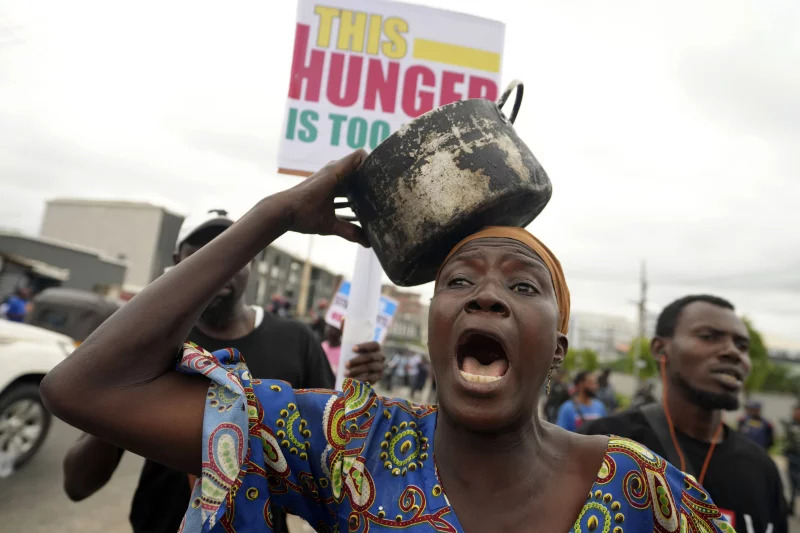
Whenever the Federal Government’s economic team steps to the podium, they speak as though addressing economists at a Davos roundtable. Terms like “tight monetary policy”,” “fiscal consolidation,” “forex liberalization”, and “macroeconomic rebalancing” are mouthed with confidence, often accompanied by PowerPoint charts and global economic jargon. But on the streets of Nigeria, where the sound of rumbling stomachs has become louder than campaign jingles, the people are asking one question: “How does all this grammar put food on the table?” Truth be told, it does not.
Across Nigeria today, hunger has become the greatest unifier. North, South, East, and West, there is no tribe or religion immune to the chokehold of skyrocketing food prices, transportation costs, school fees, and utility bills. While the government celebrates “market correction” and praises the floating of the naira as a bold step toward fiscal maturity, the ordinary man wonders when he will be able to afford a bag of rice or even pay his child’s school fees and transport fare to school.
In early 2024, President Bola Ahmed Tinubu’s administration embarked on a raft of economic reforms. Most notable among them was the removal of fuel subsidies, long deemed unsustainable. Then came the unification of foreign exchange rates and the floating of the naira, which was meant to bring transparency to the currency market and lure in foreign investors.
The moves were applauded abroad. The IMF, World Bank, and rating agencies like Moody’s and Fitch praised Nigeria for adopting what they termed “hard but necessary” measures. But here at home, the so-called reforms have plunged millions into deeper hardship.
According to the National Bureau of Statistics (NBS), Nigeria’s headline inflation as of May 2025 surged beyond 34%, while food inflation spiked to over 42% figures that have not been seen in nearly two decades. But behind these percentages lie human stories of hunger, tears, and survival.
At the popular Mile 12 Market in Lagos, 38-year-old truck pusher, Peter Iwuchukwu, summed it up in the language of the common man:
“Oga, all these big big grammar dem dey talk, na for TV. My family nor dey chop well. We dey manage every day, and we be five people. Wetin concern me with ‘floating naira’?”
In fact, the disconnect between Abuja’s policy talk and the reality in Mushin, Yenagoa, Sokoto, and Owerri is both glaring and alarming. As pleasant as highfalutin economic jargon may sound, one undeniable truth remains: Nigerians are neither lab rats nor guinea pigs.
Some economists have defended the reforms, saying the pain is temporary and necessary for long-term gain. They say we must endure this season of hardship to eventually enjoy economic growth and stability. But here is the brutal truth: “a nation of over 200 million people cannot be treated like a laboratory experiment.”
As Dr. Nkemdilim Eze, a development economist in Enugu, rightly put it: “Nigeria’s government is applying Harvard-style economic models in a country without Harvard-style systems. You don’t implement textbook austerity without robust social safety nets. What we are witnessing is economic reform without empathy.”
Her words echo what countless Nigerians have been saying for months. While economic grammar may impress foreign investors, it does nothing for the average trader, teacher, driver, artisan, or farmer. You cannot tell a man who has not eaten in two days to be patient because GDP growth is on the horizon.
The pain of these policies could have been mitigated if government had acted swiftly and transparently to deploy palliatives and safety nets. But what Nigerians witnessed instead was a palliative charade.
In late 2023, the government promised cash transfers, food relief, and CNG-powered buses. What followed was a mix of confusion, political favoritism, and even ghost beneficiaries. In many parts of the country, the so-called palliatives were either not delivered or ended up in the hands of party loyalists and middlemen.
Mama Sade, a food vendor at Ogba, Lagos, offered a bitter but truthful observation: “Dem say dem dey share rice and N25, 000. Where? We nor see am. Only dem and their people chop the palliative. Poor man nor dey benefit from anything.”
The disillusionment is growing. For many, the reforms no longer look like necessary pain for future progress, but like elite-driven punishment, meted out by those who can afford to weather the storm, on those who cannot.
Given the extant situation, it cannot be out of place to opine in this context that Nigeria has become a country on the brink. This is as realities are glaring, and proven that beyond hunger that there is a growing sense of despair. Unemployment is widespread, crime is creeping in. suicide rates, especially among young men, are on the rise. The foregoing facts are not in any way been concocted by this writer as they are on news platforms. Recall that at a point under ongoing Tinubu-led administration that protests broke out, fuel stations were guarded like military installations and markets were tense, even as labor unions threatened mass action.
Maritime economist Bongo Adi in May 2024 during the administration’s one year anniversary, described President Bola Tinubu’s one-year performance in office as a “mixed bag,” rating it four out of ten. Speaking during an interview with ARISE News, Adi noted that Tinubu assumed office with high expectations, particularly after the Buhari administration’s failures, but has so far failed to deliver meaningful change. Although he acknowledged Tinubu’s bold steps like subsidy removal and exchange rate harmonization, he stressed that most Nigerians were yet to feel any tangible improvement in their lives.
Adi criticized the administration’s handling of economic reforms, especially the lack of preparation for the consequences of the subsidy removal. He said while the removal was widely supported and necessary, the government’s poor planning and “trial-and-error” execution worsened public perception and deepened economic hardship. He added that Nigerians expected a well-thought-out strategy post-inauguration but were instead faced with policy confusion and worsening conditions.
Commenting on the floating of the naira, Adi supported the move, arguing that Nigeria’s mono-cultural economy and weak revenue base made a fixed exchange rate unsustainable. He explained that the shift was necessary due to dwindling oil revenues and an inability to defend the naira. Concluding on a personal note, Adi expressed disappointment over returning to Nigeria with hopes of contributing to national growth, only to be disillusioned by the current economic realities and policy missteps.
In all this, the overall view of this writer is that the government must ensure that the people are fed first. This is as there is a famous African proverb that says: “A hungry man is an angry man.” In Nigeria today, millions are both hungry and angry. But unlike the politicians in power, they cannot afford to retreat to air-conditioned offices and gated mansions. Their reality is lived daily, in the heat, amid biting hunger, and always in a state of hopelessness.
To bluntly sum the situation up in this context, it is germane to opine that If President Tinubu wants his reforms to succeed that he must first take care of the people as these reforms are meant to benefit. Because if the current economic hardship persists unchecked, no amount of GDP growth or foreign investment will stop the people from grumbling. Above all, the government officials, who are invariably leaders, should always have it at the back of their minds that Nigeria’s economic grammar cannot in any way fill empty stomachs.

























You must be logged in to post a comment Login