
Africa
Uromi Lynching: A Tragic Verdict On A Failed State -By Isaac Asabor
Those lynched in Uromi identified themselves as hunters. Survivors say they were headed to the North from Port Harcourt for the Sallah celebrations. But they weren’t traveling openly. They were covered in a trailer filled with palm kernel shells. They carried Dane guns. They had dogs. And there was cash. Why hide if you’re genuine? Hunters usually move in the open. Why conceal your presence in a truck if you have nothing to fear? These are the questions that triggered suspicion.

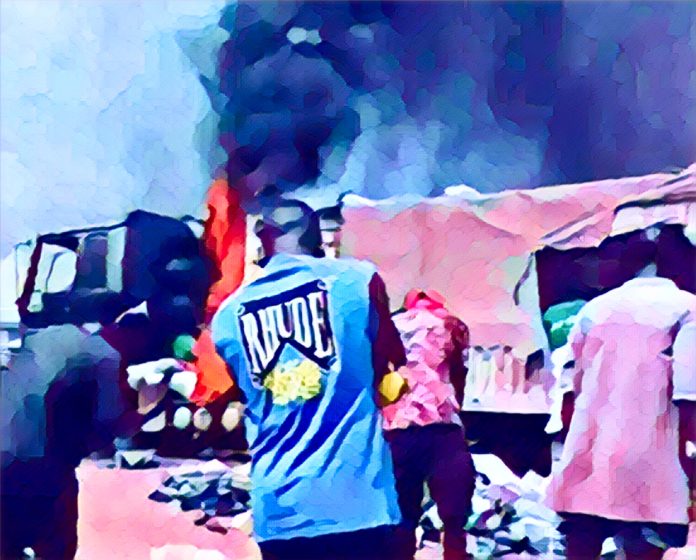
What happened in Uromi, Edo State, on Thursday, March 27, wasn’t just an incident of jungle justice, it was a damning verdict on the Nigerian state’s failure to protect its citizens. When ordinary people are pushed to the edge, witnessing the horrors of their neighbors being kidnapped, raped, slaughtered, and even seeing newborn babies fed to dogs by abductors, something eventually snaps. And what snapped in Uromi was not just patience, but faith in the justice system.
Let’s be clear: jungle justice is wrong. There is no justification for killing suspects without trial. But to condemn the action without condemning the reasons that led to it is to willfully ignore the context. And the context here is terrifying.
Uromi and its surrounding communities have lived under siege. From Edo Central to Delta and Bayelsa, criminal herders have turned peaceful towns into war zones. Women no longer go to farms for fear of being raped or burned alive. The Onojie of Uzea, HRH Solomon Itoya Iluobe, publicly declared his forests off-limits to Fulani herders after personally paying ransoms multiple times for kidnapped relatives.
It gets worse. Just a few months ago, the people of Uromi were in uproar after a woman in labor was kidnapped alongside her husband. She delivered her baby in captivity, only for the child to be fed to dogs by the kidnappers. That kind of evil, witnessed firsthand, lives in people’s memories forever. It radicalizes communities. It stokes uncontrollable rage. And when the same communities begin to see suspicious movements, such as armed men hidden under tarpaulin in a Dangote trailer with large sums of new currency, the fear, the trauma, and the distrust boil over into mob action.
Those lynched in Uromi identified themselves as hunters. Survivors say they were headed to the North from Port Harcourt for the Sallah celebrations. But they weren’t traveling openly. They were covered in a trailer filled with palm kernel shells. They carried Dane guns. They had dogs. And there was cash. Why hide if you’re genuine? Hunters usually move in the open. Why conceal your presence in a truck if you have nothing to fear? These are the questions that triggered suspicion.
Eyewitnesses say the trailer refused to stop when signaled by vigilantes. One of the passengers stabbed a local vigilante during questioning. The tension, already sky-high, exploded. Within minutes, 16 lives were lost. And yet, this horror didn’t happen in a vacuum.
In fact, when news filtered in about the killings, Uromi, a once peaceful and culturally proud community in Edo State, many Nigerians were left shaken. Another violent episode. Another community in mourning. Another preventable tragedy.
It is easy, and rather convenient, for government officials and security agencies to reduce such incidents to “ethnic crises” or “misunderstandings between the northern and the southern divide of Nigeria.” But anyone who understands the traditional systems that once governed community interactions knows that this bloodshed didn’t just happen out of the blue. It is a tragic outcome of long-standing neglect, a neglect of tradition, of communal protocols, and of effective governance.
Let’s take a step back to when communities, though not wealthy in modern infrastructure, were rich in wisdom, customs, and protocols. In those days, there was an unspoken but deeply respected tradition that governed how hunters operated across community boundaries.
A hunter did not just wake up, pick up his Dane gun, and march into another community’s forest in search of prey. That would be asking for trouble.
Tradition dictated that visiting hunters must first seek the consent of the paramount hunter or traditional authority in the host community. This wasn’t merely for protocol’s sake, it was a system grounded in mutual respect, territorial integrity, and community safety. Once permission was granted, the local hunters would accompany the visitors, ensuring they didn’t stray into sacred groves, farmland, or restricted zones. After the hunt, the visitors would show appreciation, offering part of the prey to the paramount hunter and compensating the indigenous hunters. This wasn’t just culture. It was governance. It was conflict prevention. It was community diplomacy.
In fact, given the backdrop of present day’s chaos as occurred in Uromi, it is not hyperbolical to opine that there is a government sleeping on the wheel as it has failed to address the underlying issues that are by each passing day spurring bloodshed across the country.
Fast forward to today, and we are seeing a complete breakdown of these indigenous systems. The killings in Uromi are not just a result of “stray hunters” or “clashes.” They are the result of the government’s inability, or outright refusal, to recognize and support local structures that once kept peace.
As gathered from Vanguard Newspaper online edition of April 5, 2025, in one its expose titled, “Uromi Killing: Untold story of how villagers identified some of them as kidnappers before lynching”, locals recount how five kidnappers arrested in Uromi were handed over to the police, only to be released days later. That betrayal cuts deep. Why should the people trust a system that returns known criminals to their communities?
And let’s not forget: just a day before this lynching, herders collected N25 million ransom for a kidnapped couple, then still murdered them. Another woman who went to deliver N5 million to free her sister was held instead. As of today, that woman is still in captivity. In that same forest. The same criminal network is still operating.
What happened in Uromi is not just about suspicion or ethnicity. It’s about a people abandoned by the state. It’s about communities taking up the fight because those empowered to protect them have failed, or worse, compromised. That doesn’t make jungle justice right. But it does make it predictable.
The solution is not to issue hollow condemnations from Abuja. The solution is justice that works. If a crime is committed, investigate it thoroughly and prosecute offenders swiftly and transparently. If innocent people were killed in Uromi, their names must be cleared, and those responsible must be held accountable. But the government must also answer for why Uromi, and dozens of other communities like it, has become a hunting ground for terrorists in the first place.
The root of this tragedy is failed governance. If the people had faith in the law, they wouldn’t take it into their own hands. If security agents did their jobs, civilians wouldn’t be patrolling forests or raising funds for ransom. And if our leaders were in touch with the daily horrors faced by Nigerians, perhaps this story would never have happened.
Until then, Uromi will not be the last.


























You must be logged in to post a comment Login