
Africa
Who Is Eating The National Cake, And Who Is Going Hungry? -By Isaac Asabor
Until we confront this truth, Nigeria will continue to be a land of potential without progress, riches without equity, and dreams deferred indefinitely. It is time we rise and say: Enough of their cake. We want our share.

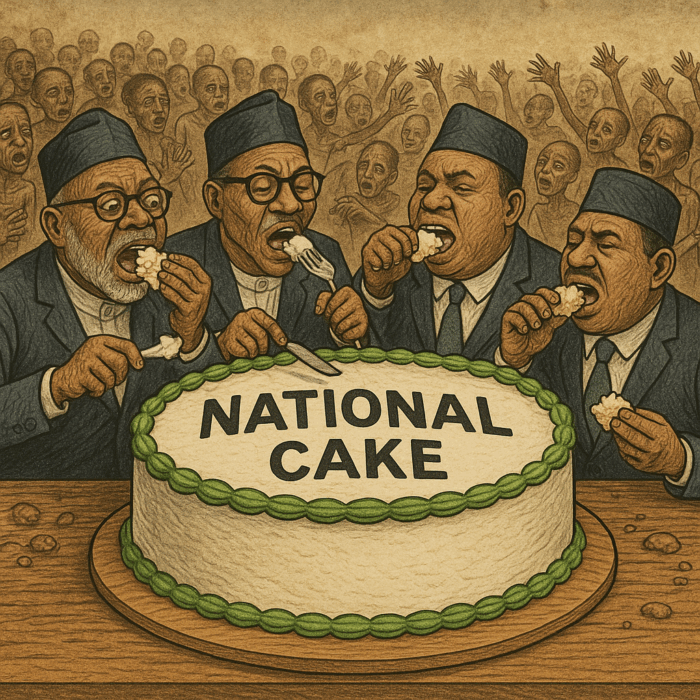
In Nigeria, the term “National Cake” has long been a metaphor for the collective wealth of the country, an imaginary cake that, in principle, should be equitably sliced and served to all citizens, regardless of ethnicity, religion, or social class. But in reality, this proverbial cake has morphed into something else entirely: a lavish banquet for a privileged few and mere crumbs, if anything at all, for the rest. This growing disparity raises a pressing question that stares us in the face every day: Is it really a national cake, or has it been privatized into “their” cake?
This rhetorical shift is not just semantic; it is symptomatic of a deep structural malaise within the Nigerian polity. The national cake has become the preserve of the political elite and their cronies, a high table at which only the connected dine, while the masses hustle for the leftovers, often tossed in the form of palliatives, tokenistic empowerment schemes, or stomach-infrastructure politics.
To this writer, it is a shared inheritance denied every Nigerian that is not opportune or privileged to be in government or have somebody in politics. This is as the logic of a national cake presupposes a shared inheritance.
It is even surprising that despite the fact that Nigeria is abundantly blessed with natural and human resources that cut across oil, gas, arable land, solid minerals, a vibrant youthful population, enough to make any nation prosperous if harnessed justly and transparently, only a few Nigerians are eating the national cake. The reason for the foregoing view cannot be farfetched as in more than six decades after independence, the commonwealth continues to be cornered by a self-serving elite, whose interpretation of governance is little more than “elite capture” disguised as “public service”.
Budgets are passed yearly with trillions of naira earmarked for capital projects, but year after year, the physical manifestations of these allocations remain invisible. Roads remain death traps, hospitals are glorified consulting clinics, and public schools are in shambles. Yet we are told the cake has been shared. To whom, and for what purpose?
It is no longer even shameful that government officials build sprawling estates, own fleets of luxury cars, send their children abroad for schooling, and access first-rate healthcare in foreign hospitals, all funded directly or indirectly by public resources. These are not benefits of service; they are fruits of exploitation. They are not eating the national cake on our behalf; they are eating it instead of us.
Nigeria’s political structure and reward system have institutionalized a form of legalized looting. Politics is seen as the surest path to wealth, not a call to serve. Elections are often nothing more than expensive rituals of deceit, where the highest bidder buys votes with stolen money, only to recoup it multiple times over once in office.
Appointments and contracts are rarely awarded on merit but on nepotism and patronage. The so-called federal character principle, originally designed to promote inclusiveness, has been bastardized into a tool for distributing slices of the cake among the powerful, not for equity but for appeasement. Ministries, departments, and agencies become silos of looting. Monthly FAAC (Federation Account Allocation Committee) disbursements often end up as salary payments and inflated overheads, while infrastructural decay festers across states and local governments.
Meanwhile, those who dare raise their voices against this rot, journalists, whistleblowers, and civil society activists, are hounded, silenced, or branded enemies of progress. In some cases, they are made scapegoats to distract from the real culprits. This deliberate gas lighting only reinforces the perception that the national cake is no longer a collective resource but a rigged buffet.
One of the clever manipulations that continue to fuel this systemic greed is the myth that everyone will eventually “benefit” from the cake if they stay loyal, play politics right, or wait for their turn. This myth is how the elite class majorly comprising of politicians control the masses and perpetuate the status quo. It is how party loyalists are groomed into sycophants, not advocates for the people. It is how civil servants become complacent. And it is how the youth are lured into cybercrime, fraud, and political thuggery, with the false promise of a share of the cake.
But the truth is glaring: it is not your cake. It has never been. And unless something drastic changes, it never will be. The distribution of wealth in Nigeria is one of the most skewed in the world. According to Oxfam, a handful of Nigerians control as much wealth as the bottom 50% of the population. That is more than 100 million people. The implication is that the so-called national cake has already been sliced, served, and eaten, over and over again, by a tiny cabal. And they are not planning on baking another one for you.
Nothing exemplifies the insult to the masses more than the recent distribution of palliatives in the form of rice, noodles, and N10,000 cash transfers in the wake of economic hardship triggered by subsidy removal and devaluation. These palliatives, publicized with elaborate media fanfare, are meant to pacify the people, not empower them. It is the equivalent of throwing bones to a starving dog while you feast in opulence.
For the sake of clarity, palliatives are not policies; they are placeholders for real governance. They do not address the root causes of poverty, unemployment, and inflation. Instead, they reinforce dependency and encourage short-term gratitude for long-term suffering. The idea of palliatives being rolled out while politicians receive wardrobe allowances and security votes in the billions is the clearest sign that what they are eating is not our cake.
Against the backdrop of the foregoing view, it is germane to opine that if Nigeria must survive as a functional nation-state, the idea of the national cake must be radically redefined. It cannot continue to be about who gets what from the treasury; it must be about how wealth is created, distributed, and sustained for the benefit of all.
Therefore, to create wealth, distribute it and make it sustainable for all Nigerians, there must be institutional reform. We need real consequences for corruption, not plea bargains or political rehabilitation. Institutions like the EFCC, ICPC, and Code of Conduct Bureau must be depoliticized and empowered to work without fear or favor.
Again, there must be public finance transparency. To achieve the foregoing, every naira spent must be accounted for. Tools like the Freedom of Information Act must be actively utilized by journalists and citizens to demand answers.
In a similar vein, there must be active citizenship. This is as Nigerians must discard apathy, given that democracy does not end at the ballot box. Rather, they should understand that civic engagement, peaceful protests, public commentary, and watchdog journalism are all tools for reclaiming ownership of the national cake.
Also in a similar vein, there should be pragmatic and intentional moves toward economic diversification. Therefore, the cake must be enlarged through value addition, industrialization, and entrepreneurship as a country cannot eat what it does not bake.
Also, there must be constitutional restructuring. We need to revisit the foundations of our union. True federalism, resource control, and decentralization are key to ensuring that no part of Nigeria is parasitic on another, and that wealth is not hoarded in Abuja.
In fact, the harsh truth is that for now, it is their cake, held in the death grip of a few who believe the rest of us are either too poor, too tired, or too scared to challenge them. But history shows that even the most entrenched elites fall when the masses awaken to their power.
The question is not whether there is a national cake. The question is: who is eating it, and who is going hungry?
Until we confront this truth, Nigeria will continue to be a land of potential without progress, riches without equity, and dreams deferred indefinitely. It is time we rise and say: Enough of their cake. We want our share.

























You must be logged in to post a comment Login