
Africa
Why The War Against Dangote Trucks Is Misguided -By Isaac Asabor
To fight Dangote Trucks is to risk higher unemployment, disrupted supply chains, and further economic instability. To support it is to embrace a model of structured logistics that Nigeria desperately needs.

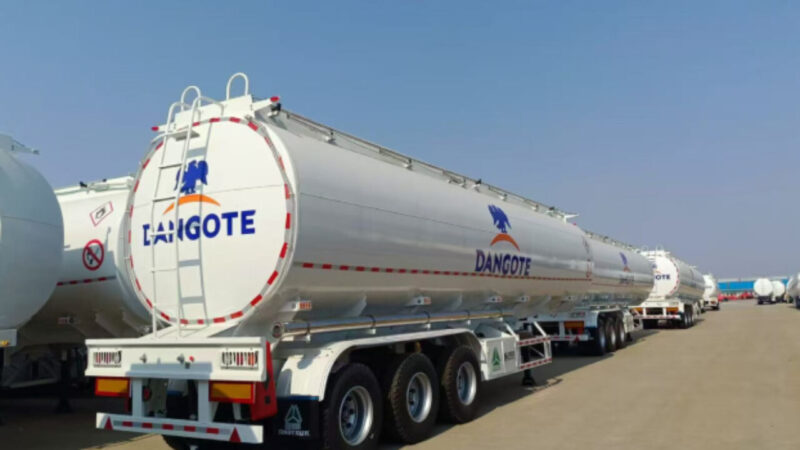
In the past few days, the debate over Dangote Trucks and its clash with transport unions, such as the Nigeria Union of Petroleum and Natural Gas Workers (NUPENG), the Nigeria Labour Congress (NLC), and their affiliates has grown louder. Union leaders accuse the Dangote Group of undercutting established transport structures, exploiting drivers, and operating in ways that undermine collective bargaining. Yet the more the rhetoric intensifies, the more one is forced to ask: Who exactly benefits from this war? The Nigerian worker, or a few union leaders desperate to protect their fiefdoms?
The issue is bigger than one company or one union. It touches on how Nigeria balances industrial growth with labor rights, and how the nation treats investors who dare to put their money where their mouth is. For decades, unions have played important roles in defending workers against abuse. But in this particular battle, the facts tilt in favor of Dangote.
At this juncture, it is expedient to throw a brief insight into the history of union power. To start, it is not an exaggeration to opine that Nigeria’s unions are not new to confrontation. In the 1970s and 1980s, NLC and NUPENG built reputations as fearless watchdogs, confronting military regimes and forcing government accountability. The fuel strikes of the 1990s and early 2000s crippled the economy but also amplified the voice of the ordinary worker.
Yet over time, the lines blurred. What started as a noble struggle to protect wages and welfare often morphed into power contests, sometimes hijacked by political actors. NUPENG, in particular, has become notorious for its ability to ground the economy by blocking fuel supply chains. It is precisely this weapon, economic sabotage, that is now being threatened against Dangote Trucks.
The question Nigerians must ask is whether the same tactics that once worked against authoritarian governments should be deployed against private investors who are keeping the economy afloat.
The answer to the foregoing question is unarguably expedient as Dangote’s role in Nigeria’s economy cannot be pooh-poohed with the mere wave of hands.
Aliko Dangote is not just another businessman; he is arguably Nigeria’s single biggest private investor. His footprint stretches from cement and sugar to fertilizer, flour, and oil refining. The Dangote Refinery alone, commissioned in 2023, has been hailed as a potential game-changer for Nigeria’s chronic fuel import dependency.
Behind this industrial empire lies an enormous logistics challenge. Moving cement from Obajana to Onitsha, sugar from Apapa to Kano, or fertilizer from Lagos to Maiduguri requires one thing: trucks. Nigeria’s railways remain underdeveloped, pipelines are inadequate, and air freight is not an option for bulk cargo. Dangote Trucks emerged as a response to this gap.
Today, the company’s trucking division sustains thousands of direct jobs; drivers, mechanics, loaders, dispatchers, while indirectly supporting even more across roadside businesses, fuel stations, and spare parts markets. To cripple Dangote Trucks is to risk collapsing this entire employment chain.
At this juncture, it is germane to ask whether the union opposition is of genuine concern or a turf war? Union leaders argue that Dangote Trucks exploits drivers with poor working conditions and harsh policies. Some allege the company runs a monopoly, squeezing out independent truckers. But scratch beneath the surface, and a different story emerges.
For years, Nigerian roads have been dominated by union-controlled trucking systems notorious for extortion, inefficiency, and outright lawlessness. Drivers are forced to pay multiple “levies” to union officials, and disputes are often settled with intimidation rather than negotiation. These unions thrive in chaos. Dangote’s structured trucking model, corporate accountability, centralized management, and monitored operations, threatens this status quo.
The agitation, therefore, looks less like a fight for workers and more like a turf war. The unions fear losing control of a lucrative industry if corporate players like Dangote become the new face of trucking.
Unfortunately, the bigger threat is national instability. What the unions may not realize is that destabilizing Dangote Trucks destabilizes Nigeria itself. Cement distribution delays would cripple construction projects and inflate housing costs. Fuel delivery disruptions could trigger artificial scarcity. Food prices would climb as logistics costs soar.
Nigeria’s economy is already battling high inflation, unemployment, and currency depreciation. To add a union-triggered logistics crisis is to risk a perfect storm. This is why the government and the public must view the issue not as a corporate-versus-union quarrel, but as a national economic risk.
If unions truly care about the welfare of drivers, they should redirect their energy. The biggest threats to truckers in Nigeria are not Dangote’s policies but the appalling state of infrastructure. This is as bad roads destroy vehicles, cause accidents, and shorten driver lifespans.
In a similar vein, insecurity on highways, from kidnappers to armed robbers, remains a daily terror. Fuel costs eat deeply into profits and wages, leaving drivers with little to save.
These are the real killers, not Dangote. Instead of expending energy fighting a company that provides structured employment, unions should pressure government to fix roads, improve security, and stabilize energy costs.
Without a doubt, industrial progress demands private-led models. Across the world, private conglomerates have driven logistics transformation. Toyota in Japan, Samsung in South Korea, Tata in India, all developed efficient supply chain systems that supported national growth. Dangote’s trucking system is Nigeria’s equivalent.
If replicated by other conglomerates like BUA, Flour Mills, and Lafarge, the entire transport sector could modernize faster than any government intervention. But if unions succeed in strangling Dangote Trucks, they will not just stop one company, they will discourage others from attempting similar innovations.
Nigeria cannot afford to chase away the very few investors willing to risk capital on large-scale infrastructure.
Against the foregoing backdrop, it is germane to make a call for partnership, not persecution. This does not mean Dangote Trucks is perfect. Reports of driver grievances deserve attention. Labor welfare must never be secondary. But the solution lies in dialogue, not destruction.
Instead of positioning themselves as enemies of progress, unions should negotiate better conditions for drivers within Dangote’s structure. That is how real labor movements work: they engage, they reform, they improve, not dismantle.
Nigeria is at a crossroads. On one side are unions, wielding old tools of confrontation, sometimes for genuine causes, but too often for control. On the other side is a company that, for all its flaws, has consistently put its money into industries many others shun.
To fight Dangote Trucks is to risk higher unemployment, disrupted supply chains, and further economic instability. To support it is to embrace a model of structured logistics that Nigeria desperately needs.
The choice before the public, the unions, and the government is clear: Do we reward the hand that builds or empower the hand that destroys?
For the sake of jobs, stability, and national development, Dangote Trucks must not be brought down by union power games. Nigeria cannot afford it.

























You must be logged in to post a comment Login