
Africa
With Oborevwori’s Defection, Whither Omo-Agege’s Gubernatorial Ambition in Delta State? -By Isaac Asabor
In a system where defection is the norm, not the exception, the game is no longer just about loyalty or ideology, it is about structure, incumbency, and control. With Oborevwori’s defection, the APC now finds itself having to choose between two elephants. And as the old saying goes, when elephants fight, it is the grass that suffers. In this case, that grass may be Omo-Agege’s long-nurtured gubernatorial ambition.

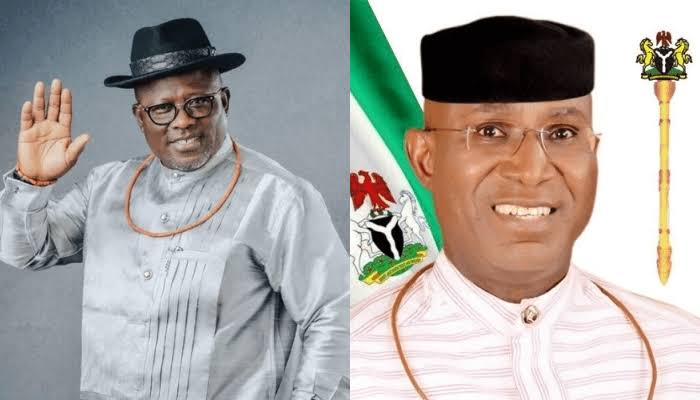
In the combustible terrain of Nigerian politics, especially at the sub-national level, defection is more than just a political maneuver, it is a weapon. It is a signal, a message, a realignment, and at times, a declaration of war. The recent defection of Governor Sheriff Oborevwori from the Peoples Democratic Party (PDP) to the All Progressives Congress (APC) has all the trappings of a calculated political chess move that throws up urgent questions about the future of one of Delta State’s most visible politicians: Senator Ovie Omo-Agege.
Omo-Agege, a key player in Delta’s power circle and former Deputy Senate President, has had his eyes on the governorship seat for years. Despite losing to Oborevwori in the fiercely contested 2023 gubernatorial election, he remained the face of the APC in Delta State. But with the entry of the sitting governor into his party, armed with the weight of incumbency, Omo-Agege’s pathway to gubernatorial power may have just gotten dramatically narrower, if not completely blocked.
Oborevwori’s defection is not a simple change of political jersey. He did not switch allegiance as a lame duck politician. He moved with the power of incumbency and the strategic advantage of being in control of the state apparatus. The implications of this move go beyond Oborevwori seeking refuge in APC due to cracks in the PDP, it is about consolidating power for 2027 and beyond.
Political watchers are already reading between the lines. The question being whispered in political backrooms and party secretariats is simple yet profound: Was this defection orchestrated to kneecap Omo-Agege within his own house?
To understand the gravity of the threat Oborevwori now poses within APC, it is crucial to understand Omo-Agege’s journey. A man not unfamiliar with controversy, Omo-Agege has been a lawyer, commissioner, Secretary to the State Government (SSG), senator, and Deputy Senate President. Known for his boldness and political brinkmanship, he became one of the most prominent APC figures in the South-South, a region largely dominated by PDP.
After championing progressive legislation in Abuja and building a formidable political structure in Delta Central, especially among his Urhobo ethnic group, he was seen as the most viable alternative to PDP’s dominance. His 2023 governorship bid was powered by a heavy war chest, ground troops, federal backing, and a strong media narrative of “liberation” for Delta State. Yet, he lost.
But like most political heavyweights in Nigeria, losing an election did not push him into oblivion. If anything, it strengthened his resolve to remain relevant and mount a comeback in 2027. That plan, however, seems to be under serious threat now.
Until Oborevwori’s defection, Omo-Agege was largely seen as the undisputed leader of the APC in Delta. But that status is now up in the air. In Nigerian political culture, the sitting governor, regardless of when he joins a party, automatically becomes the leader of that party in the state. The reasons are simple: he controls appointments, patronage networks, state funds, and grassroots mobilization structures, including local government chairmen and councilors. These assets are often more critical than federal influence when it comes to swaying delegate votes and controlling party primaries.
For the APC, which has struggled to unseat the PDP in Delta for decades, Oborevwori’s defection is viewed as a win. But for Omo-Agege, it is a political tsunami. He now faces the awkward prospect of having to negotiate space within his own political turf, if not outrightly playing second fiddle to the same man he accused of electoral manipulation just a year ago.
At this juncture it is germane to ask, “Was Oborevwori’s motivated to decamp from PDP as a way of escape or expansion?” The foregoing question since the last few days he defected to APC has remained unanswered. In fact, since then, not a few people are asking “Why did Oborevwori defect?” To answer the foregoing question, several theories abound.
Some argue he is merely escaping a sinking PDP ship, particularly with his godfather Ifeanyi Okowa’s influence in decline. Others suggest he is preparing to cut his own political path without being shackled by lingering intra-party crises that have plagued the PDP at both state and national levels. However, a more strategic interpretation is gaining ground: that Oborevwori’s entry into APC was engineered by powerful forces in Abuja to neutralize Omo-Agege and consolidate APC’s hold in Delta by offering the party a sitting governor in return for internal restructuring.
This theory is not far-fetched. Political analysts familiar with Abuja’s power play know that national leaders are not emotionally attached to old loyalists. They are more concerned with win-ability, optics, and strategic advantage. And in the 2027 political calculus, a sitting governor seeking re-election on the platform of APC may offer better prospects than a former senator, regardless of how loyal the latter has been.
Although elections are still over two years away, the groundwork for 2027 is already underway. Within Delta APC, power blocs are forming, and battle lines are being drawn. If Oborevwori seeks a second term under the APC, it will require full control of the party’s structure. That puts him on a collision course with Omo-Agege, who will also be eyeing another chance at the top seat, perhaps his last viable opportunity, given political realities and the shifting sands of age and relevance.
Against the backdrop of the foregoing view, there is no denying the fact that Delta APC now faces the challenge of balancing political egos without imploding. If the leadership at the national level chooses to back Oborevwori, perhaps as part of a broader realignment in the South-South ahead of 2027, Omo-Agege may find himself increasingly isolated, unless he can negotiate power-sharing or stage an internal rebellion.
Delta’s politics is shaped as much by ethnic identity as by political ideology. The tripod structure, Delta North (Anioma), Delta Central (Urhobo), and Delta South (Ijaw, Itsekiri, and Isoko), has an unspoken rotational agreement. Oborevwori is Urhobo, like Omo-Agege, and with him currently occupying the top seat, many believe the next governorship cycle (barring Oborevwori’s re-election) should tilt towards either Delta North or Delta South.
This further complicates Omo-Agege’s ambition. If zoning holds, he may be effectively disqualified from contesting, especially if Oborevwori is not seeking re-election. But if Oborevwori decides to run for a second term under APC, and the national party backs him, Omo-Agege’s window closes further.
President Bola Tinubu’s own political style adds another layer to this drama. Known for pragmatism and reward-based politics, Tinubu may find Oborevwori’s defection appealing, especially if it adds a South-South governorship to his political portfolio in 2027. But Tinubu also respects loyalty and strategic alliances, and Omo-Agege has been loyal.
Now another question, “Will Tinubu attempt to broker peace between both men? Or will he back the man with executive power in the state?” Either way, Omo-Agege will need more than loyalty to secure APC’s 2027 ticket. He will need a compelling counter-strategy.
Then another question is the option left for Omo-Agege’s that of reinvention or resistance? Faced with this new reality, Omo-Agege has three clear options that cut across that of negotiating a power deal, lead a legal resistance, or lead a political resistance.
Explanatorily put, he can work out an internal compromise with Oborevwori and the APC national leadership, perhaps stepping aside in exchange for a senatorial return, ministerial slot, or control of some critical state structures.
If sidelined, Omo-Agege may rally aggrieved APC members and stake his claim in the court of public opinion and intra-party politics. This could split the party and damage its electoral chances, but may secure him leverage.
Though risky, a strategic defection to another party, possibly Labour Party or even a Third Force, could allow Omo-Agege to redefine himself as the real opposition. However, the absence of federal backing could handicap such a move.
The political theater in Delta State has just taken a dramatic twist, and the leading actors, Oborevwori and Omo-Agege, are set for a backstage tug-of-war that will shape the next act in the state’s political narrative.
In a system where defection is the norm, not the exception, the game is no longer just about loyalty or ideology, it is about structure, incumbency, and control. With Oborevwori’s defection, the APC now finds itself having to choose between two elephants. And as the old saying goes, when elephants fight, it is the grass that suffers. In this case, that grass may be Omo-Agege’s long-nurtured gubernatorial ambition.
Unless he reinvents himself, regroups his base, and retools his strategy, he may find himself not just sidelined but entirely shut out of the 2027 equation. The storm is gathering, and only time will tell who emerges with their political sails still intact.


















You must be logged in to post a comment Login