
Football
Manchester City: Enzo Maresca, It’s Your Turn to Scale the Hurdle -By Onyejaka Alexander Arinzechukwu
City suffered defeat to Arsenal in the Community Shield before opening their Premier League campaign with victory over Bournemouth. They then followed that with a convincing 4-1 victory over Crystal Palace, with Rayan Cherki making a particularly strong impression under the new manager.

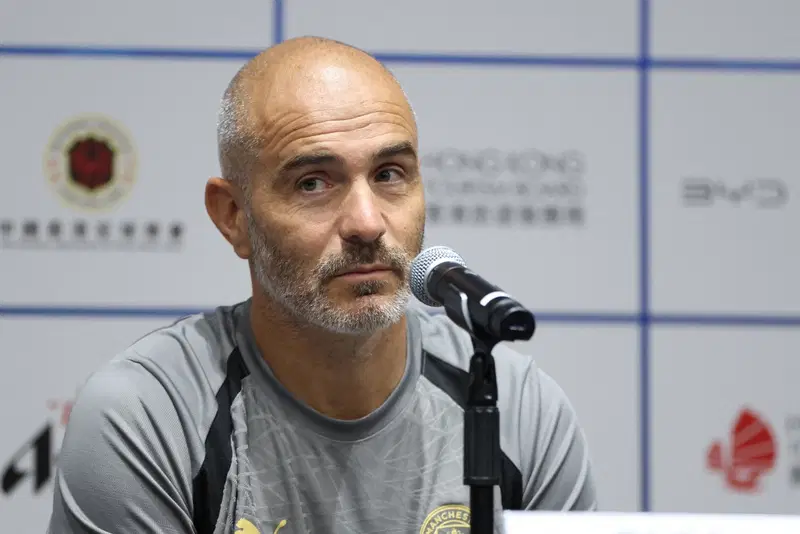
There are football jobs, and then there are football jobs.
There are clubs where a manager is appointed with the simple instruction to win a few matches, improve the team, qualify for Europe and perhaps compete for a domestic trophy. There are clubs where finishing in the top four is considered a successful season and where a respectable campaign can be celebrated even without silverware.
Manchester City is no longer one of those clubs.
At the Etihad Stadium, the definition of success has been rewritten.
The new Manchester City manager, Enzo Maresca, has not inherited an ordinary football club. He has inherited an institution that, over the last decade and a half, has transformed itself from an ambitious challenger into one of the dominant forces in world football.
He has also inherited something perhaps more difficult to manage than tactics, formations or players: expectations.
The question confronting Maresca is therefore not simply whether he can coach Manchester City.
The question is whether he can maintain the extraordinary standard that has been established before him.
Can he keep City competing for the Premier League title?
Can he preserve the club’s winning mentality?
Can he ensure that Manchester City remain one of the most dominant footballing sides in England?
Can he take the club deep into the Champions League?
And, ultimately, can he create his own chapter without allowing the remarkable standards established by his predecessors to collapse?
These are not unfair questions.
They are the questions that come with inheriting Manchester City.
The revolution that changed everything
To understand the size of Maresca’s assignment, one must first understand where Manchester City came from.
The modern revolution did not begin with Pep Guardiola.
It began earlier.
The transformation gathered enormous momentum following the Abu Dhabi takeover in 2008, when Manchester City suddenly possessed the financial resources and ambition to challenge the established order of English football.
But money alone does not build a dynasty.
Manchester City needed managers capable of converting investment into trophies, identity and sustained competitiveness.
Roberto Mancini was one of the men who laid the foundation.
When Mancini arrived in December 2009, City were ambitious but still searching for their place among England’s elite. He brought a demanding mentality and, importantly, delivered the club’s first major trophy of the new era when City defeated Stoke City to win the FA Cup in 2011. That triumph also helped secure Champions League qualification.
Then came the moment that permanently altered Manchester City’s history.
April 2012.
Sergio Agüero’s famous last-minute goal against Queens Park Rangers delivered City’s first Premier League title in 44 years.
That goal was more than a footballing moment.
It was a declaration.
Manchester City had arrived.
The psychological barrier had been broken.
City were no longer the noisy neighbours merely hoping to challenge Manchester United, Arsenal, Chelsea or Liverpool. They had become champions.
That championship established an important principle that would remain with the club: Manchester City should expect to win.
Pellegrini showed that the success was not a one-man accident
After Mancini came Manuel Pellegrini.
The Chilean inherited a club that had already tasted Premier League glory, but he demonstrated that City’s transformation was not dependent on one manager.
In 2013/14, Pellegrini guided City to the Premier League title and League Cup, giving the club two trophies in one season.
His City were different from Mancini’s.
They were attacking, confident and technically gifted.
Pellegrini’s side scored goals with remarkable consistency and played football that reflected an increasingly sophisticated footballing culture at the Etihad.
That period was important because it established another characteristic that would later become synonymous with Manchester City:
winning while playing attractive football.
The club was no longer satisfied with merely getting results.
The expectation was increasingly to dominate games, control possession, create chances and impose its personality on opponents.
And then came Pep Guardiola.
That was when the revolution became a footballing empire.
Then came Pep Guardiola
If Mancini built the foundation and Pellegrini strengthened the structure, Guardiola transformed the building.
When Pep Guardiola arrived in 2016, he inherited a talented squad and a club with considerable ambitions.
What followed was extraordinary.
Guardiola did not merely win trophies.
He changed the way Manchester City played.
He changed the way opponents prepared to play against City.
He changed the tactical vocabulary of the Premier League.
And perhaps most importantly, he changed the psychological expectations within the club.
Under Guardiola, Manchester City developed an unmistakable footballing identity.
Possession was not possession for possession’s sake.
It was a weapon.
The ball became City’s means of controlling territory, tempo and the opponent’s emotions.
Defenders were expected to participate in build-up play.
Midfielders were expected to understand space.
Full-backs could move into midfield.
Centre-backs could step forward.
Goalkeepers became additional passing options.
Wingers were expected to stretch the pitch.
The striker was required to contribute to the structure.
The result was a team that could suffocate opponents without necessarily appearing to do so.
City would circulate the ball, patiently waiting for a weakness.
Once the weakness appeared, they attacked it ruthlessly.
That became the Manchester City formula.
The Premier League became City’s territory
Under Guardiola, Manchester City’s dominance became unprecedented.
The club won six Premier League titles during his decade in charge, including four consecutive league titles — the first English men’s team to achieve that feat.
There was also the extraordinary 2017/18 campaign.
City accumulated 100 points.
One hundred.
No Premier League team had ever reached that number before.
It was not simply a championship.
It was domination.
The following season brought another extraordinary achievement. City became the first English men’s side to win all four major domestic trophies available in the same campaign — Premier League, FA Cup, League Cup and Community Shield.
This is the environment Maresca has entered.
This is why a normal definition of success cannot be applied to Manchester City.
At many clubs, winning the League Cup can save a manager’s job.
At Manchester City, it may barely satisfy the appetite.
At some clubs, finishing second in the Premier League is an achievement.
At Manchester City, second place can feel like failure.
That is the psychological transformation that Guardiola helped create.
The treble changed the conversation forever
But Guardiola’s greatest achievement at Manchester City was still to come.
The 2022/23 season.
Manchester City won the Premier League.
Then the FA Cup.
Then, finally, the Champions League.
The victory over Inter Milan in Istanbul gave Manchester City the European crown that had eluded the club for years and completed a historic treble.
It was arguably the most significant season in Manchester City’s history.
For years, critics had questioned whether City could conquer Europe.
They had won England.
They had broken domestic records.
They had assembled extraordinary squads.
But the Champions League remained the missing piece.
Guardiola finally delivered it.
And he did not deliver it alone.
He delivered it as part of a treble.
Manchester City became champions of England, winners of the FA Cup and champions of Europe in the same season.
That was the moment the club’s status changed again.
City were no longer merely an English superpower.
They were European champions.
They had reached the summit.
And Guardiola was still not finished
Perhaps the most remarkable thing about Guardiola’s Manchester City was that the treble did not represent the end of the journey.
City continued winning.
They won the UEFA Super Cup.
They won the FIFA Club World Cup.
And in 2023/24, they won an unprecedented fourth consecutive English top-flight title.
By the time Guardiola finally closed the chapter on his Manchester City era, his trophy cabinet contained 20 trophies, including six Premier League titles, three FA Cups, five League Cups, three Community Shields, the Champions League, UEFA Super Cup and FIFA Club World Cup.
Twenty trophies.
Six Premier League titles.
One Champions League.
One historic treble.
Four consecutive Premier League titles.
A 100-point Premier League campaign.
A domestic quadruple.
These are not merely achievements.
They are the standards now hanging over Maresca.
Maresca’s greatest opponent may not be Arsenal, Liverpool or Manchester United
The new Manchester City manager’s greatest opponent may actually be history.
He is competing against what came before him.
He is competing against memories.
Every time City dominate possession, supporters will remember Guardiola.
Every time a tactical adjustment succeeds, comparisons will be made.
Every time City lose two consecutive matches, people will ask whether the Guardiola era is truly over.
Every time City fail to win the Premier League, critics will compare the result with the extraordinary consistency of the previous decade.
That is the burden of succession.
Maresca cannot escape it.
But he should not run from it either.
He should embrace it.
Manchester City themselves have explained why Maresca was considered a suitable successor: his footballing ideas are compatible with the positional play and ball-retention philosophy that has become associated with the club. He also has previous experience working within Guardiola’s footballing environment.
That gives him an advantage.
But familiarity is not enough.
Maresca must prove that he can manage Manchester City rather than simply reproduce Manchester City’s previous manager.
That distinction is crucial.
He must respect Guardiola without becoming imprisoned by Guardiola
There is a danger in succeeding a manager as successful as Pep Guardiola.
The new manager can become obsessed with copying the old one.
That would be a mistake.
Maresca must learn from Guardiola without becoming his shadow.
He must preserve the principles that made City successful — possession, positional intelligence, technical quality, pressing, control, attacking ambition and tactical flexibility.
But he must also introduce his own ideas.
Football evolves.
Opponents evolve.
Players evolve.
Manchester City must evolve.
The greatest tribute Maresca can pay Guardiola is not to imitate him.
It is to keep winning.
The Manchester City playing pattern cannot disappear
For more than a decade, City have developed a recognisable style.
They want the ball.
They want to control the game.
They want to dictate where the match is played.
They want their opponents to spend long periods chasing.
They want to create numerical advantages.
They want to attack with precision.
And when they lose the ball, they want to recover it quickly.
This is more than a tactical plan.
It is now part of the club’s identity.
Maresca therefore has a difficult balancing act.
He must modernise without destroying the culture.
He must change without creating confusion.
He must introduce his own tactical ideas without abandoning the principles that made Manchester City one of the most feared teams in Europe.
The winning mentality must remain non-negotiable
But there is something even more important than tactics.
Mentality.
Manchester City have spent years developing a culture in which losing is unacceptable.
Not because football does not contain defeats — it does.
Not because City will win every match — no team can.
But because the club has developed the expectation that every competition must be approached with the belief that it can be won.
That mentality must survive Guardiola.
Maresca must make sure that Manchester City do not become a team satisfied with participation.
The club must continue to believe that the Premier League belongs among its objectives every season.
The Champions League must remain an ambition.
The FA Cup and League Cup must not become distractions but opportunities.
The players must understand that wearing the Manchester City shirt carries an obligation to compete.
The new manager must understand the difference between transition and decline
This is perhaps Maresca’s greatest challenge.
Every successful football dynasty eventually faces transition.
Players leave.
Legends retire.
Young players emerge.
Tactical systems change.
The manager changes.
Leadership groups change.
Manchester City are already experiencing some of that transition.
The departures of important figures mean that Maresca must build a new leadership structure while preserving the standards of the old one. Recent reporting has highlighted his desire for additional experienced leaders within the squad.
That is sensible.
Because winning teams are not built only around talent.
They are built around standards.
A new generation of players must learn what Manchester City expects.
They must understand why the club became successful.
They must understand the significance of the badge.
And they must understand that the previous generation did not win because success was guaranteed.
They won because they worked relentlessly for it.
Maresca has already received his warning
The opening of the new era has already demonstrated the difficulty of the task.
City suffered defeat to Arsenal in the Community Shield before opening their Premier League campaign with victory over Bournemouth. They then followed that with a convincing 4-1 victory over Crystal Palace, with Rayan Cherki making a particularly strong impression under the new manager.
The early results should neither provoke panic nor excessive celebration.
Two or three matches cannot define a manager.
Maresca needs time.
But time at Manchester City is different from time elsewhere.
The club can afford patience with development, but patience must exist alongside ambition.
The objective remains clear.
Manchester City must remain Manchester City.
He does not have to win the treble immediately — but he cannot lower the ceiling
This is an important distinction.
It would be unreasonable to demand that Maresca immediately reproduce Guardiola’s treble.
The Champions League is unpredictable.
The Premier League is increasingly competitive.
Arsenal, Liverpool, Chelsea, Manchester United and other clubs will continue to challenge.
Injuries happen.
Form changes.
Football contains an element of uncertainty.
But Maresca cannot use those realities as an excuse to lower the club’s ambitions.
He may not win the treble.
He may not win every trophy.
But Manchester City must remain in the conversation.
They must remain difficult to beat.
They must remain tactically sophisticated.
They must remain contenders.
They must remain hungry.
And most importantly, they must remain convinced that winning is their responsibility.
The Premier League will not wait for Manchester City
There is another reason Maresca must be careful.
English football is not standing still.
Arsenal are building.
Liverpool remain ambitious.
Chelsea are investing.
Manchester United are attempting to rebuild their identity.
Tottenham are strengthening.
The Premier League is becoming increasingly competitive.
Manchester City’s advantage cannot therefore be taken for granted.
The era when opponents walked onto the pitch already fearing defeat may eventually disappear if City become complacent.
Maresca must prevent that.
He must make Manchester City the hunter rather than the hunted.
He must also manage the dressing room
Great managers understand that tactics alone do not win championships.
Maresca must establish authority.
He must know when to challenge senior players.
He must know when to protect young players.
He must manage egos.
He must maintain competition for places.
He must ensure that substitutes remain motivated.
He must make every player believe that his contribution matters.
And perhaps most importantly, he must create a dressing room in which the collective remains more important than the individual.
Guardiola was exceptional at this.
His teams contained enormous personalities and world-class players, yet the system remained supreme.
Maresca must achieve something similar.
The Guardiola shadow will be enormous
There is no escaping the reality that Guardiola has left enormous shoes behind.
He is Manchester City’s most successful manager.
He did not simply win trophies; he created records.
He made City the first team to reach 100 Premier League points.
He guided them to a domestic quadruple.
He delivered the Champions League.
He delivered the treble.
He delivered four consecutive Premier League titles.
He left after a decade having accumulated 20 trophies.
Maresca cannot erase that history.
Nor should he try.
Instead, he should use it as fuel.
The question should not be, “Can Maresca be Pep Guardiola?”
The answer to that question is almost irrelevant.
The real question is:
Can Maresca become the best Enzo Maresca possible at Manchester City?
If he can, City have a chance of entering another successful era.
The burden is enormous, but so is the opportunity
For Maresca, this is also an extraordinary opportunity.
He has been handed one of the strongest footballing structures in the world.
He has access to elite players.
He has world-class facilities.
He has a sophisticated football administration.
He has a club accustomed to winning.
He has supporters who have experienced the greatest period in the club’s history.
And he has inherited a squad capable of competing at the highest level.
There are few excuses.
There is also no reason to be afraid.
The challenge is enormous, but so is the platform.
Enzo, it is your turn
So, Enzo Maresca, welcome to Manchester City.
Welcome to a club where the past is not merely history.
It is a standard.
Roberto Mancini showed City how to become champions again.
Manuel Pellegrini demonstrated that the club could sustain domestic success.
Pep Guardiola transformed that success into domination and then conquered Europe.
Now it is your turn.
Your task is not to destroy what Guardiola built.
Your task is not to become another Guardiola.
Your task is to ensure that the machine continues to function while giving it a new identity.
The Premier League will test you.
The Champions League will test you.
The dressing room will test you.
The pressure will test you.
The media will test you.
And, above all, Manchester City’s own history will test you.
But perhaps that is exactly what makes this appointment so fascinating.
You are not starting from zero.
You are starting from the summit.
The challenge is to stay there.
Manchester City have spent the last decade teaching English football a powerful lesson: dominance is not achieved once; it must be defended every season.
Winning the Premier League once made City champions.
Winning it repeatedly made them a force.
Winning four in a row made them historic.
Winning the treble made them European champions.
Winning 20 trophies under Guardiola made his era almost impossible to replicate.
But football has never been kind to those who live in the past.
The moment one trophy is lifted, the next challenge begins.
That is the culture Maresca has inherited.
That is the hurdle before him.
And that is why the message from the blue half of Manchester should be simple:
Enzo Maresca, it is your turn to scale the hurdle.
Do not be intimidated by Guardiola’s shadow.
Do not be satisfied with merely surviving the transition.
Do not allow Manchester City to become a monument to what once was.
Build what comes next.
Preserve the possession.
Preserve the courage.
Preserve the tactical intelligence.
Preserve the hunger.
Preserve the winning mentality.
But above all, preserve the belief that has defined Manchester City for more than a decade:
Manchester City do not enter competitions merely to participate. They enter to win.
The revolution began long before Maresca arrived.
Mancini helped establish it.
Pellegrini strengthened it.
Guardiola took it to heights that once seemed impossible.
Now the baton has been passed.
The hurdle is high.
The expectations are enormous.
The standard is unforgiving.
But that is what it means to manage Manchester City.























You must be logged in to post a comment Login