
Africa
Musings on the Development of Cocoa Industry in Nigeria -By Abachi Ungbo
So much in research have been achieved to improve productivity. So, investment and prioritization of policies and ensuring their continuity is needed in enhancing productivity, improving farming techniques and promoting sustainable techniques.

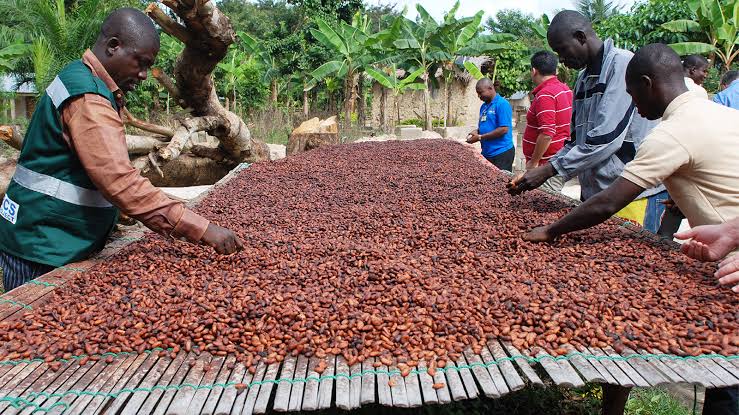
Nigeria’s future can conveniently be built on Cocoa. In the past, it enjoyed a pride of place on the strength of its capacity in attracting huge resources for development. Like yesterday, it still retains the power to change the country’s economic development narrative.
A slew of factors has overtime undermined the development of Cocoa like other cash crops. Apparently, depriving the country of the full benefits accruing from the huge Cocoa global industry despite its potential. Therefore, leaving Ivory coast and Ghana to reap huge harvest.
According to Mordor intelligence, the global Cocoa industry in 2025, is valued at USD 23.39 billion and it is expected to reach USD 27.92 billion in 2030 at a CAGR of 3.60%. Also, the European market which is the largest chocolate market was valued at EUR 47.3 billion in 2024, according to the Netherlands -Centre for the promotion of imports from developing countries (CBI)
Not a few pundits have continued to shout from the rooftop about the place of poor coordination, lack of operational frame work and policy flip-flop in acting as a gaping chasm that separates Nigeria and its West Africa Cocoa producing neighbours. Ivory coast occupies the leading position in Cocoa production with 2 million tonnes and Ghana about 800,000 tonnes annually. Together they constitute 65% of global Cocoa production.
The dissolution of the Cocoa board during the Babangida administration through the agency of the Structural Adjustment Programme (SAP) of the World bank/IMF saw to the total liberalization of the Cocoa industry. However, it is sad to say that the industry collapsed in the aftermath of the implementation of the reform as production plummeted to 170,000 tonnes from about 400, 000 tonnes in the pre- SAP era. There was a drop- off in the use of agricultural inputs and quality of beans. The export and quality control processes became disorganized.
Initially, Ivory coast accepted the liberalisation prescription before it reversed itself. The reinstatement of government strong presence led to the establishing of the Coffee and Cocoa Council. Paradoxically, the World bank got involved in the reforms that led to the birth of the council.
An article in the Financial Times of 18th June, 2014 quoted the CEO of the Coffee and Cocoa Council as describing the decade of liberalization as a “mess” since smallholder farmers were ill equipped to negotiate with middlemen leading to lower incomes. In the case of Ghana, the country bravely withstood enormous pressure to keep its cherished Cocoa industry partially liberalized. The liberalization experience wasn’t entirely pleasant.
Government of both Ghana and Ivory coast are not only investing but actively participating in their respective Cocoa industry which reveals the profound premium that they place on the commodity. Through Ghana Cocoa Board (COCOBOD) and the Ivory coast Coffee and Cocoa Council (CCC) a lot has been achieved to keep both countries as leaders in global Cocoa production. Furthermore, both countries inaugurated the Cote d’voire and Ghana cocoa initiative in 2018 as means to influence global Cocoa prices.
Recall, that Nigeria and Ghana were almost at par in the 60’s and 70’s. Regrettably, that’s not the case today. Nigeria’s annual production is put at about 300,000 tonnes. In fact, Cameroon is also doing remarkably well with production within the neighborhood of Nigeria’s production figure. It also has a controlling agency/board. Nigeria needs to start generating money by get involved instead of allowing a total takeover by the private players and also protect the interest of the farmers.
It is against this background, that the news of an executive bill aimed at establishing the National Cocoa Management Board (NCMB) is receiving rave reviews. It is bound to be a game changer.
The avowed aims of the board is a clear revelation of government intent to change the trajectory of the Cocoa industry- in effect, to place the country on competitive and productive path; bolster non-oil revenue, create jobs; actualize the much sought-after value addition promotion; create a new deal with all stakeholders and participants in the cocoa value chain; improve production and attract young crop of farmers. In essence, to establish the country in the global Cocoa map.
The present administration must place research in its crosshairs as it shoots Cocoa to new heights. It remains key to sustainable Cocoa production. Attitude towards research leaves so much to be desired as evidenced by the quantum of funding. Funding is abysmally low. So, also is the incentive available for the researchers. The conditions must be attractive enough to bait talents. Its egregious to leave researchers in the lurch- without the requisite tools. The Cocoa Research Institute of Nigeria (CRIN) needs to be retool and well-funded for the new bold agenda in Cocoa development.
So much in research have been achieved to improve productivity. So, investment and prioritization of policies and ensuring their continuity is needed in enhancing productivity, improving farming techniques and promoting sustainable techniques.
Abachi Ungbo
abachi007@yahoo.com

























You must be logged in to post a comment Login