
Africa
Rarara’s Controversial PhD and our Moral Judgment -By Usman Abdullahi Koli
As a commentator on the creative industry, I have often argued that these recognitions — real or claimed — are harbingers of greater things. If today Shata, Ala, and Rarara are discussed in doctoral language, tomorrow our literary works, our performance poetry, and our oral archives will also command celebration. Already, we see dissertations written on Hausa songs, theses dissecting the poetics of proverbs, and international conferences citing our bards as intellectual references.

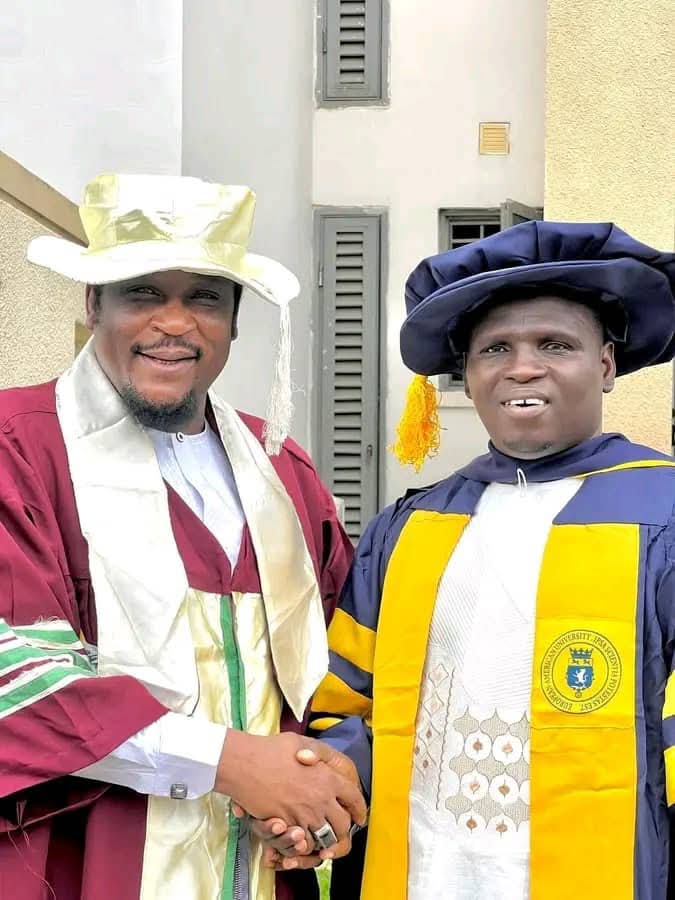
In Northern Nigeria, Rarara is seen as a rara avis, nothing more; it is because of his mastery of his trade. This has magnetized controversies for the singer.
But all over the world, singers have not only ruled the stage but also climbed the podium of scholarship. Bob Dylan received the Nobel Prize in Literature for his songwriting; Bono of U2 and Youssou N’Dour have been decorated with honorary degrees; in India, Lata Mangeshkar was honored for her timeless voice; and in South Africa, Miriam Makeba’s songs became university texts. These gestures acknowledged that art, when it speaks to the human condition, is scholarship in its own right.
Nigeria is catching up with this realization. Our universities, once the fortress of stiff robes and bibliographies, are beginning to recognize that wisdom is not only in peer-reviewed journals but also in the verses that ordinary people carry in their heads and hearts. Which is why Mamman Shata, Aminu Ladan Abubakar “Ala,” and others have found themselves robbed of honorary doctorates.
Across history, the Hausa singer has been more than an entertainer. He is an instrument of social commentary, a mobile archive of memory, and a philosopher who translates communal anxieties into verse. In the South, counterparts such as Sunny Ade, Ebenezer Obey, Fela Anikulapo-Kuti, and Oliver de Coque used music to interrogate society and mobilize consciences. In the North, Shata, Dan Maraya, Sani Sabulu, and later voices like Ala, Nura M Inuwa, and Dauda Kahutu Rarara have done the same, though in idioms tailored to Hausa culture.
Where Fela weaponized Afrobeat against military tyranny, Shata employed the kalangu to admonish emirs and governors. Where Ebenezer Obey moralized through juju metaphors, Ala refined Hausa idioms into didactic melodies. Where contemporary southern artists create anthems for democracy or protest, Rarara launches political songs that electrify the grassroots and ignite debate. These are parallel traditions of one truth: music is both the mirror and megaphone of society.
Shata Mai Ganga remains unrivaled. He sang about every subject under the sun: politics, farming, festivals, wars, and morality. His repertoire was so vast that his name became shorthand for genius. ABU Zaria’s conferment of an honorary doctorate in 1988 was not just decoration; it was an acknowledgment that his voice had become a library, his drum an archive, his songbook a curriculum.
As one who has written about Ala more than twice and served as his magatakarda, I know his contributions are priceless. Ala is not merely a singer; he is a poet, an author, a chronicler of our times. His craft resides at the junction where literature meets melody. His lyrics sting power, soothe ordinary minds, and preserve the linguistic elegance of Hausa idioms. It is no accident that his songs are now discussed as project topics in our universities. This migration of popular music into academia is proof that cultural production is scholarship, even if it comes with a guitar rather than a bibliography. He too has been conferred an Honorary Doctorate Degree (by CEGT University, Benin, among other recognitions).
Rarara is a different proposition. His songs are weapons in the theater of politics, sometimes praise, sometimes ridicule, always unapologetic. Loved by many, disliked by others, his reach among the youth is undeniable. Yet, here lies the controversy. A convocation in Abuja recently announced that the European-American University had conferred on him a Doctor of Science in Humanitarian Service, Music, and Entertainment. But the university itself swiftly disowned the ceremony, declaring it unauthorized and disavowing any such conferment. This raises two questions: one of legality and another of merit.
On the legal side, the matter seems clear: if the awarding body denies involvement, then the parchment carries no institutional weight. But on the question of merit, the debate is more nuanced. Does Rarara, by his musical contributions, deserve to be recognized? The answer depends not on paperwork but on cultural memory. For before him, there was Shata, Ala, Dan Maraya, and Nura M Inuwa, and within that lineage, Rarara has carved his place. His mastery of Hausa music, his clever use of innuendo, and his ability to weaponize song in the service of politics mark him as one of the most consequential griots of his generation. He is, whether adored or criticized, a good political singer.
As a commentator on the creative industry, I have often argued that these recognitions — real or claimed — are harbingers of greater things. If today Shata, Ala, and Rarara are discussed in doctoral language, tomorrow our literary works, our performance poetry, and our oral archives will also command celebration. Already, we see dissertations written on Hausa songs, theses dissecting the poetics of proverbs, and international conferences citing our bards as intellectual references.
The honors, then, whether valid or falsified, serve as reminders. They remind us that the Hausa singer is not merely an entertainer; he is a historian, satirist, philosopher, and social conscience. He may wear a patched robe, but his words outlast many policies.
The lesson is clear: wisdom has many homes. It can wear a professor’s cap, a mallam’s turban, or a singer’s patched robe. What matters is not the cloth but the truth it carries. And so, when singers mount the podium — legitimately or controversially — they remind us that art is not a distraction from scholarship. It is scholarship.
But if the parchment turns out to be paper without pedigree, then history will still keep its own records — and that register is harder to forge.
Usman Abdullahi Koli
mernoukoli@gmail.com.



















You must be logged in to post a comment Login