
Breaking News
FBI records: Obi, Baba-Ahmed demand answers from Tinubu
Peter Obi and Hakeem Baba-Ahmed have criticised Tinubu over alleged efforts to withhold US records, demanding transparency and credible answers.


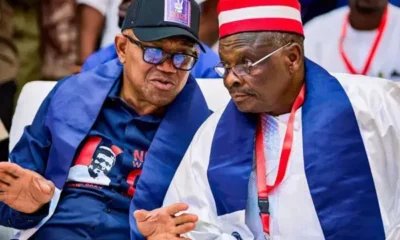
ABUJA — Peter Obi and Dr Hakeem Baba-Ahmed have launched fresh criticism of President Bola Tinubu over alleged moves to prevent the release of records concerning his past in the United States.
Obi, the 2027 presidential candidate of the Nigeria Democratic Congress (NDC), described the alleged attempt as “profoundly embarrassing,” while PRP National Chairman Baba-Ahmed questioned the absence of both President Tinubu and Vice President Kashim Shettima from Nigeria.
The two opposition figures spoke separately yesterday amid controversy over alleged efforts to withhold records relating to Tinubu from the United States Federal Bureau of Investigation (FBI).
Baba-Ahmed questions Tinubu, Shettima’s absence
Baba-Ahmed raised the issue while speaking at the first national summit of opposition political leaders in Abuja.
He alleged that Tinubu’s emergency foreign trip was connected to efforts to stop the possible release of documents concerning the President by the FBI.
The PRP chairman also questioned the constitutional and political implications of the President and Vice President being outside the country simultaneously.
He described the situation as unprecedented in Nigeria’s history and asked pointedly: “Who is in charge now?”
Obi: Presidential office must uphold transparency
Reacting in a post on his X handle, Obi said he was deeply saddened by the direction Nigeria was taking.
The former Anambra State governor and 2023 Labour Party presidential candidate said it was embarrassing for a sitting president to seek the withholding of records about his past, particularly where such records involve issues of legitimate public interest.
“It is profoundly embarrassing that we have reached a point where a sitting President is asking a foreign court to withhold records concerning his past, particularly records relating to matters of legitimate public interest,” Obi said.
He argued that public leadership requires individuals in authority to confront difficult questions about their past with honesty and humility.
“Leadership, in my humble view, demands the courage and humility to confront one’s history – to acknowledge mistakes, provide candid explanations where questions arise, and, where necessary, apologise and seek forgiveness,” he said.
Obi maintained that attempts to shield controversial aspects of a leader’s past from scrutiny could undermine rather than protect the authority of the office.
“True authority is strengthened, not diminished, when a leader accepts responsibility rather than seeks to shield uncomfortable aspects of the past from legitimate scrutiny,” he added.
Educational records should be explained
Obi said the controversy was even more significant because some of the questions reportedly concern educational credentials.
He argued that matters involving a person’s primary and secondary education should not remain unresolved or be handled mainly through court proceedings.
“This becomes particularly important when questions concern educational credentials. Issues surrounding foundational schooling – primary and secondary – should not remain unresolved or be addressed primarily through legal proceedings,” he said.
He insisted that Nigerians deserved explanations that could be independently understood and verified.
“Nigerians deserve clear, credible, and verifiable explanations, especially when such had been submitted in the past,” Obi said.
‘What example are we setting?’
According to Obi, the controversy goes beyond the individual involved because of the example it presents to Nigerians, particularly young people.
“My deepest concern is the example this sets for more than 200 million Nigerians, particularly the over 30 million young people in schools,” he said.
He said the country’s highest office should demonstrate the principles expected of citizens.
“The nation’s highest office should exemplify integrity, accountability, transparency, and ethical leadership,” he stated.
Obi also said an imperfect past should not necessarily define a person’s character, provided there is a willingness to acknowledge mistakes, apologise and correct wrongs.
“An imperfect past is part of the human condition. What matters is the willingness to confront it with humility, honesty and deep apology, to make amends where necessary and, when circumstances so demand, to place the interests of the nation above personal ambition,” he said.
The NDC candidate ended his statement with a broader challenge to Nigeria’s political class, questioning the prioritisation of personal political ambitions over national interests.
“When will our political class fully appreciate that individual ambitions are temporary, while the nation endures?” Obi asked.
Africans Angle News





















You must be logged in to post a comment Login