
Politics
A Handbag, a Handover Note, and the Bankruptcy of Nigerian Public Discourse -By Jeff Okoroafor
As Nigerians debate Margaret Obi’s handbag, documented public spending under Tinubu goes unchecked. Read the op-ed on evidence, accountability, and distraction.

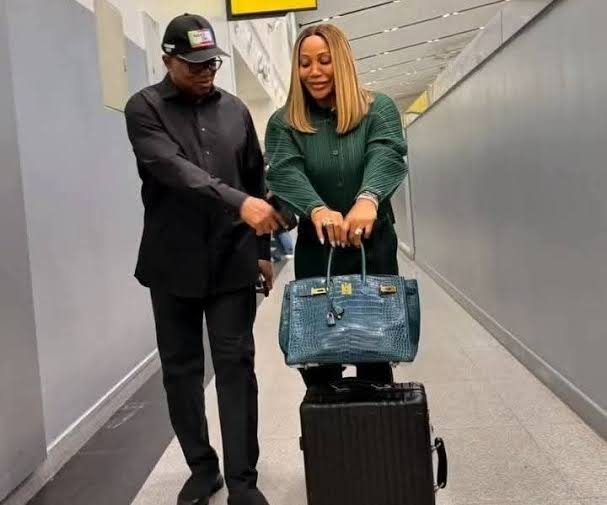
Something remarkable has happened in Nigeria’s public conversation. At a time when over 35 million Nigerians face acute hunger, when children kidnapped from schools in Borno and Oyo remain in captivity, when the supposed Commander-in-Chief has been abroad on a three-week vacation, and when violent incidents claimed 12,162 lives in 2024 alone, the national discourse has found its scandal of choice: the handbag carried by Margaret Obi, wife of Peter Obi .
This is not merely a distraction. It is a symptom of a deeper malaise — a nation that has become so accustomed to the abnormal that it can no longer recognise genuine accountability when it appears before it.
The Handbag and the Standard of Evidence
Let us begin with the facts, such as they are. Mrs. Obi was photographed carrying what online critics identified as a Hermès Kelly 35 in Malachite crocodile leather, with valuations ranging from ₦230 million to ₦250 million at parallel market rates . The backlash was immediate and fierce, with critics arguing that the bag’s cost is “fundamentally irreconcilable with the stark, anti-luxury asceticism preached by Peter Obi” .
But let us pause and apply the most basic standard of reason: What does a woman’s handbag have to do with the misappropriation of public funds? What does it have to do with irregularities in government? Is modest dressing — or expensive dressing — evidence of corruption?
The answer, of course, is no. And yet, the same people demanding scrutiny of Margaret Obi’s wardrobe have shown a remarkable disinterest in the actual records of public expenditure under the current administration.
The Evidence Peter Obi Left Behind
Here is what is conspicuously absent from the handbag conversation: the documentary record of Peter Obi’s stewardship of Anambra State between 2006 and 2014.
When Peter Obi handed over power to Willie Obiano on March 17, 2014, he did so with a letter listing assets and liabilities, complete with certified bank statements and a Handover Report. According to Oseloka Obaze, who served as Secretary to the Anambra State Government and was present at the handover, the documents showed a net positive balance of over ₦86.6 billion. This included local investments valued at ₦27 billion, foreign currency investments of ₦26.5 billion, state and MDA balances of ₦28.17 billion, and an approved Federal Government refund of ₦10 billion .
Peter Obi has consistently maintained that he left about $150 million in the state’s treasury — a claim he recently reiterated, stating: “I left $150 million. Can any other person who finished here come and say where he left? Nobody asked me to save dollars” . He added that had the funds remained intact, their value could now be close to $1 billion .
Crucially, Peter Obi did not merely leave behind cash. He left behind investments. Alex Otti, now Governor of Abia State and formerly the Managing Director of Diamond Bank (one of the banks that held Anambra State’s funds), has publicly testified that he was “part of the process” through which about $155 million was converted from naira and invested in Eurobonds and the Tier-2 capital of Nigerian banks including Diamond Bank, Fidelity Bank, and Access Bank, with maturity dates extending beyond 2014 . Alex Otti stated unequivocally: “Peter Obi actually left all the money he said he left” .
This is not hearsay. This is not political spin. This is a sitting governor, a former bank chief executive, testifying to his direct involvement in the financial arrangements he himself helped structure.
Obiano’s Admission and the Controversy That Should Not Exist
The matter ought to have been settled in 2017, during a Channels Television governorship debate. Willie Obiano, the man who received the handover documents and signed an acknowledgement for his copy, initially questioned the funds. But when confronted by Obaze on national television — asking how, as a certified accountant and auditor, he could have accepted the financial documents and later expressed reservations — Obiano publicly acknowledged that specified funds were in place .
Obiano’s subsequent complaint was not that the money was missing, but that he questioned the wisdom of saving money when there were projects to execute . This is a policy disagreement, not evidence of fraud. And yet, the current Anambra State Government, under Governor Chukwuma Soludo, has chosen to revive the controversy, claiming the state inherited debts of ₦127.37 billion from the Peter Obi and Obiano administrations .
But here is the question Obaze posed, and it remains unanswered: “If Governor Obiano, to whom Peter Obi handed over to in 2014, would eventually acknowledge — implicitly and explicitly — that Governor Peter Obi indeed left the stipulated funds; a fact that was also publicly corroborated by Governor Alex Otti, in his capacity as an ex-banker, what then, one may ask, is the beef and grouse of the incumbent Anambra State Government?” .
The Pensions He Refused and the Liabilities He Denies
Peter Obi has consistently denied leaving unpaid salaries, pensions, gratuities, or contractor liabilities. He has challenged his critics to produce evidence, stating: “If anybody can establish anything to the contrary, I will stop campaigning” . He has also stated that he refused to sign the pension law for governors, which is why he has never received any pension, gratuity, or even a bottle of water from the Anambra State Government since leaving office .
This is the man whose lifestyle is being questioned. A man who left office over a decade ago, who declined post-office benefits, and who has publicly explained the source of his wealth through his business enterprises — a supermarket he owned as a student at the University of Nigeria, Nsukka, and his career in banking, where he sat at the apex of institutions alongside figures like the late Otunba Subomi Balogun, founder of First City Monument Bank.
The Double Standard That Cannot Be Ignored
Now, let us apply the same standard of scrutiny to the other side.
Under President Bola Ahmed Tinubu, Nigeria has been ranked among the most terrorised countries in the world. More than 35 million people now face acute hunger. The number of Nigerians living in extreme and multidimensional poverty has risen from over 80 million to more than 140 million. The World Bank reported that 129 million Nigerians — 56 per cent of the population — now live below the national poverty line, a sharp rise from 40.1 per cent in 2018 .
Meanwhile, the Presidency spent over ₦25.27 billion on travel-related expenses in 2024 alone . The First Lady’s foreign exchange expenditure for 2024 exceeded ₦478 million . The Federal Government borrowed ₦12.62 trillion in 2024, exceeding its approved borrowing limit by ₦4.79 trillion .
These are not allegations. These are documented expenditures, traceable through appropriation records and payment data. And yet, the national conversation is consumed by a handbag.
Consider, too, the reported situation where the President’s daughter travelled by private jet to Benin to intervene in the question of who should become the Obaloja or Yaloja. Consider the son of the current leader moving around with security so extensive that Professor Wole Soyinka reportedly questioned the necessity of deploying Nigerian military personnel to Benin Republic when the security detail accompanying the president’s son would have sufficed.
Where is the outrage? Where is the “national conversation”?
What a Serious Country Would Do
A serious country would not debate a woman’s handbag. A serious country would ask: What money was appropriated? What was released? Who authorised it? What was it spent on? Was the expenditure lawful? Was it properly accounted for?
These are the questions that matter. The State House was questioned by the National Assembly over significant vehicle expenditure in 2024 — with ₦4 billion allocated for operational vehicles, ₦3.9 billion released, and another ₦2 billion for SUV replacement. That is a legitimate public-interest conversation.
If there are claims that public money was spent on presidential travel, foreign-exchange purchases, donations, or other activities connected to the First Lady, those claims should be traced to appropriation documents, payment records, and audit reports. Not repeated as allegations, but verified as facts.
And if there are questions about Peter Obi’s wealth, businesses, taxes, assets, or conduct in office, let those questions be asked and investigated. Let the evidence be presented. Obi himself has invited it: “If anybody can establish anything to the contrary, I will stop campaigning.”
But let us stop turning personal lifestyle choices into evidence of corruption when there is no demonstrated connection between the two.
The Verdict of Reason
Margaret Obi is not the wife of a farmer from a village. She is a wealthy corporate businesswoman in her own right, involved in managing part of Peter Obi’s business interests . She has raised her children to become independent and build their own businesses. If she chooses to dress modestly, that should be commended. If she chooses to carry an expensive handbag, that is her right — and it has precisely nothing to do with whether her husband mismanaged public funds.
The evidence of Peter Obi’s stewardship is not in his wife’s wardrobe. It is in the handover note, signed and acknowledged by his successor. It is in the testimony of a sitting governor who personally structured the investments. It is in the fact that a man who left office over a decade ago has never received a pension from the state he governed.
Compare that with what we see on the other side — the borrowed billions, the lavish travel, the poverty statistics that grow worse by the year — and the handbag controversy reveals itself for what it truly is: not accountability, but distraction. Not scrutiny, but mischief.
Judge conduct with evidence. Judge public spending with records. Judge public office by accountability. And leave people’s private fashion choices out of the corruption debate unless someone can demonstrate a genuine connection between the two.
That is how a serious country conducts public debate. That is how Nigeria must learn to conduct its own.

Jeff Okoroafor
Jeff Okoroafor is a social accountability advocate and a political commentator focused on governance, accountability, and social justice in West Africa.









You must be logged in to post a comment Login