Breaking News
NDC Crisis: Aggrieved Edo South Members Reject Reconciliation Panel, Call It ‘A Charade’
The NDC crisis deepens as aggrieved Edo South members reject the reconciliation panel and demand a review of controversial primary election outcomes.

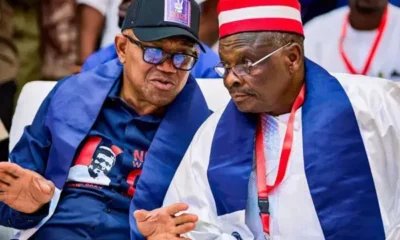
ABUJA — The internal crisis rocking the Nigerian Democratic Congress (NDC) has deepened, as aggrieved members from Edo South Senatorial District rejected the party’s National Reconciliation Committee headed by Prof. Pat Utomi and Engr. Buba Galadima.
The aggrieved members described the committee as “a charade”, arguing that the panel cannot resolve alleged injustices arising from the party’s controversial primary elections.
According to the group, establishing a reconciliation committee does not erase a disputed election or make an allegedly stolen mandate legitimate.
In a statement signed by Agbonaye Osazee Ofo on behalf of the aggrieved members, they questioned the purpose of the committee and accused the party leadership of attempting to persuade those who feel cheated to accept an outcome they consider unfair.
“The decision by the Nigerian Democratic Congress (NDC) to constitute a National Reconciliation Committee following its controversial primary elections is, on the surface, presented as an attempt to restore peace, unity, and cohesion within the party,” the statement said.
“But beneath the carefully chosen language of ‘reconciliation,’ ‘fairness,’ and ‘internal democracy’ lies a much more troubling question.”
The group argued that reconciliation could not take the place of justice, particularly where members believe their mandates were manipulated, overturned or denied.
“A reconciliation committee cannot become a substitute for justice. It cannot be used to paper over disputed primaries, silence legitimate grievances, or compel aggrieved members to accept outcomes they firmly believe were imposed upon them,” they said.
‘It was deployed to enforce compliance’
The members went further, alleging that the committee was established not to heal divisions but to compel those challenging the disputed outcomes to accept them.
“This panel was never assembled to heal wounds; it was deployed to enforce compliance,” they said.
According to them, asking aggrieved members to negotiate with those they accuse of manipulating the electoral process amounts to an attempt to manufacture acceptance.
“That is not reconciliation. That is an attempt to manufacture acceptance,” they stated.
They added: “You cannot rig the process, produce a disputed outcome, and then establish a committee to persuade those who lost their mandates to accept the result in the name of party unity.”
Ofo said the party should not confuse forced compliance with unity.
“Unity without justice is not unity. It is forced conformity,” he said.
He urged the NDC leadership to confront allegations of wrongdoing rather than suppress legitimate grievances.
“Political parties do not become stronger by suppressing legitimate grievances. They become stronger by confronting wrongdoing honestly and correcting it where necessary,” he said.
Members demand review of disputed primaries
The aggrieved members also challenged the NDC’s stated commitment to internal democracy, fairness and inclusiveness.
They asked where those principles were when the controversial primaries were conducted.
“If fairness truly matters, let the party demonstrate it by reopening the issues that have generated controversy. If democracy matters, let genuine winners retain their mandates. If inclusiveness matters, let aggrieved aspirants and party members be heard without intimidation, manipulation, or predetermined conclusions,” the statement said.
They insisted that meaningful peace could not be achieved while the facts surrounding the disputed primaries remained unresolved.
“There can be no meaningful reconciliation where the facts remain contested, and the disputed outcomes are treated as untouchable. True peace cannot take root in the poisoned soil of unpunished injustice.”
Utomi, Galadima panel faces test
The group acknowledged the reputation and experience of the personalities appointed to the committee but argued that their involvement alone could not legitimise the process.
“The appointment of respected personalities to the committee does not, by itself, confer legitimacy on the process that produced the disputes,” they said.
“Prof. Pat Utomi, Engr. Buba Galadima and the other members may bring credibility and experience to the assignment, but even the most respected individuals cannot transform an unjust process into a just one simply by sitting on a reconciliation panel.”
The members said the committee’s credibility would depend on whether it had the independence and authority to examine primary-election records, hear all parties and recommend the reversal of illegitimate decisions.
They also called for the restoration of mandates where evidence establishes wrongdoing.
‘The aggrieved are not the problem’
The group warned the party against portraying members who challenge disputed outcomes as threats to unity.
“The NDC should stop treating those who are challenging disputed outcomes as obstacles to party unity. The real threat to party unity is not the member demanding justice,” they said.
They argued that party members had every right to demand transparency, challenge primary-election results and insist that their votes and mandates be respected.
The group also rejected the argument that such demands should be abandoned because the 2027 elections are approaching.
Reconciliation ‘must begin with truth’
For the aggrieved members, any genuine reconciliation process must begin with a transparent examination of the disputed primaries.
“If the NDC genuinely wants reconciliation, then the committee should begin with the facts. Let the disputed primaries be examined. Let the competing claims be heard. Let the evidence be reviewed. Let the rules of the party be applied equally,” they said.
They urged the committee to be independent enough to make recommendations that could challenge the party leadership.
“That is what genuine reconciliation looks like. Anything short of that is merely an exercise in public relations,” they added.
The members warned that the NDC could undermine its own claim to be a democratic alternative ahead of the 2027 elections if it failed to resolve allegations of internal democratic violations.
“A party that seeks the mandate of Nigerians in 2027 must first demonstrate that it respects the mandates of its own members,” they said.
“You cannot preach democracy to the electorate while asking your own members to accept disputed outcomes without a credible remedy.”
‘A stolen mandate cannot be reconciled away’
The group said the path to unity was straightforward: review the disputed outcomes and restore mandates where the evidence supports such action.
They urged the party leadership not to turn reconciliation into a mechanism for legitimising controversial decisions.
“If the party truly believes in fairness, let it have the courage to dismantle illegitimate outcomes, restore mandates where the evidence demands it, and subject contested matters to genuinely independent arbitration,” the statement said.
The members warned that failure to do so would leave the reconciliation committee looking like “nothing more than a hollow charade”.
They concluded: “The NDC does not need forced peace. It needs justice before reconciliation, truth before unity, and democracy before electoral expediency.”
“A stolen mandate cannot be reconciled away. A disputed election cannot be wished away. And injustice cannot become legitimate simply because a committee has been established to manage the anger it created.”
The aggrieved members maintained that the current reconciliation effort appeared designed to legitimise what they described as manipulated mandates rather than address the alleged violations.
“Let it be on record that this is completely unacceptable. It is a blatant affront to fairness, justice, and due process, and it must not be tolerated,” they added.
Africans Angle News