Politics
Wike vs APC Governors: Nyendi Ebeya, Nyendi Ebeya -By Onyejaka Alexander Arinzechukwu
If Wike wants to mobilise support for Tinubu through a cross-party coalition, he should be able to explain clearly how the arrangement will coexist with the political interests of APC governors.

There is a point in every political confrontation when the original disagreement begins to disappear behind the personalities involved. At that stage, what started as a disagreement over strategy becomes a contest for political space, influence and relevance.
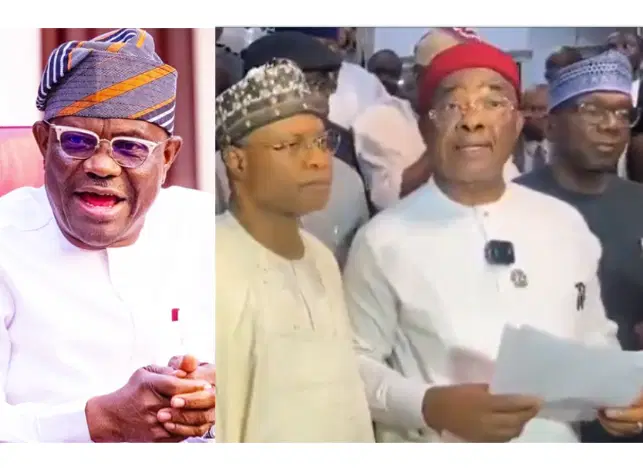
That appears to be the stage Nigeria’s political theatre has entered in the unfolding confrontation between the Minister of the Federal Capital Territory, Nyesom Wike, and governors elected on the platform of the All Progressives Congress.
At the heart of the disagreement is the emerging Rainbow Coalition promoted by Wike and other politicians across party lines in support of President Bola Tinubu’s 2027 re-election. Wike has maintained that his support is for Tinubu and does not amount to an agreement that the Peoples Democratic Party should abandon its candidates in governorship and legislative elections. The APC Governors’ Forum, however, has said it will not support political arrangements capable of weakening the APC or its candidates.
This is where the Igbo expression “nyendi ebeya, nyendi ebeya” becomes an interesting metaphor.
The expression can be understood in the context of the political argument as a reminder that everybody has his place, responsibility and political interest. In other words, one person should not assume that his political arrangement automatically determines the choices and obligations of another.
That is precisely the question confronting Wike and the APC governors.
Who determines the boundaries of political loyalty?
Can a politician support a presidential candidate without supporting that candidate’s party candidates in other elections?
Can governors belonging to a ruling party accept the support of politicians from opposition parties at the presidential level while those same politicians contest against them at the state and legislative levels?
And, perhaps most importantly, can all these competing interests coexist under one political umbrella without eventually producing a confrontation?
These are the questions beneath the latest exchange.
Wike’s political philosophy
Wike has never been a politician who hides behind ambiguity.
From his years in Rivers State politics to his emergence as governor and later as FCT minister, his political style has been associated with directness, strong alliances and a willingness to challenge political structures when he believes they are working against his interests.
His current position is consistent with the argument he has repeatedly made: politics is not necessarily a permanent marriage between individuals or parties.
Wike remains a member of the PDP while serving as a minister in the APC-led federal government. His political relationship with President Tinubu dates back to the 2023 presidential election, when Wike and members of the G5 did not support the presidential candidate of their own party, Atiku Abubakar, and instead supported Tinubu at the presidential level.
That history is important because it helps explain why the Rainbow Coalition does not necessarily appear contradictory from Wike’s perspective.
His argument is essentially that political actors can establish a common interest around the presidency while maintaining differences in other elections.
In his recent response to the APC governors, Wike argued that he had never promised that the PDP would not field candidates against APC candidates in governorship, National Assembly and State House of Assembly elections. He also questioned the electoral records of some APC-controlled states, pointing to situations in which voters supported APC candidates in legislative elections but gave the presidential vote to another party.
That is a legitimate feature of Nigeria’s electoral system.
Nigerian voters are not constitutionally required to vote for one party across every ballot.
A voter may support one presidential candidate, another governorship candidate and entirely different legislative candidates.
The real disagreement, therefore, is not necessarily about whether voters have the right to split their votes. It is about whether politicians operating within the same broader presidential coalition can deliberately organise that way without undermining one another.
The governors’ argument
The APC governors are approaching the issue from a different political location.
They are not merely political supporters of Tinubu. They are the custodians of the APC’s structures in their respective states.
The Progressive Governors’ Forum, led by Imo State Governor Hope Uzodimma, has rejected alliances or political arrangements that it believes could weaken the APC or its candidates. The governors have maintained that their campaign commitment is to APC candidates at the different levels of the 2027 elections.
Their position is understandable within the logic of party politics.
A political party is built around organisation, candidates, structures and shared electoral objectives.
If a governor is campaigning for the re-election of a president while another political group is simultaneously campaigning for the president but supporting opposition candidates against the governor’s party, a natural political question arises:
What exactly is the alliance?
Is it an alliance with the president?
Is it an alliance with the APC?
Or is it an alliance designed around a particular political objective while leaving every participant free to pursue separate interests elsewhere?
Wike’s answer appears to be the third.
The governors’ answer appears to be that such an arrangement cannot be allowed to weaken the party.
And that is where the two positions collide.
Nyendi ebeya, nyendi ebeya
Perhaps the most useful lesson from this confrontation is contained in the philosophy behind the title.
Nyendi ebeya, nyendi ebeya.
Everybody has his place.
Everybody has his interest.
Everybody has his political responsibility.
The statement should not necessarily be interpreted as an appeal for political isolation. Rather, it can be understood as an acknowledgement that politics is a marketplace of interests.
Wike has his political interests.
The APC governors have theirs.
President Tinubu has his presidential ambition.
The APC has its organisational interest.
The PDP has its electoral interest.
Individual politicians have their future ambitions.
And Nigerian voters have their own interests.
The danger begins when one actor assumes that everyone else’s political interest must automatically become subordinate to his own.
That is when coalition becomes confrontation.
The Rainbow Coalition dilemma
The Rainbow Coalition is politically interesting because it represents a model of electoral mobilisation that does not fit neatly into traditional party structures.
Wike’s argument is that different political actors can come together to support Tinubu without surrendering their identities or their separate political platforms.
The APC governors, however, are concerned about what such an arrangement means for the party’s candidates.
Both sides therefore have a definitional problem.
Wike sees the coalition primarily through the prism of the presidential election.
The governors see politics through the prism of the entire electoral ballot.
Neither perspective completely eliminates the other.
The 2027 election will not produce only a president.
Nigeria will elect governors, senators, members of the House of Representatives and state legislators.
Therefore, a politician who supports Tinubu but opposes an APC governorship candidate is not necessarily contradicting himself under Nigeria’s electoral system.
But from the standpoint of an APC governor seeking re-election, that politician is still an opponent at the state level.
That is the paradox.
And it is the paradox that Wike and the APC governors must learn to manage.
The politics of personal relationships
There is another dimension that should not be ignored.
Nigerian politics is heavily influenced by personal relationships.
Wike’s relationship with Tinubu is different from his relationship with the APC Governors’ Forum. His relationship with individual governors is different from his relationship with the PDP. His relationship with the political establishment in Rivers State is different from all of them.
The same applies to the governors.
A governor may belong to the APC but have personal relationships with politicians outside the party.
A minister may belong to the PDP but serve in an APC-led administration.
A presidential aspirant may belong to one political party today and another tomorrow.
Nigeria’s political history is filled with such movements.
Therefore, the current confrontation should not automatically be interpreted as an ideological battle between two completely different political philosophies.
It is, to a large extent, a contest over political organisation, electoral territory and competing interests.
Wike and the politics of 2027
The 2027 election is gradually forcing politicians to clarify their positions.
Wike has already clarified his own: his support for Tinubu is, in his words, specifically directed at the president.
The APC governors have also clarified theirs: they intend to defend the APC’s candidates and structures.
This means that the disagreement may continue unless a formula is found that accommodates both positions.
There is nothing inherently unusual about political actors agreeing on one election and disagreeing on another.
What matters is whether the disagreement can remain within democratic competition rather than becoming destructive political warfare.
Nigeria has suffered enough from political conflicts in which disagreements over elections become personal battles.
Political competition should not become an excuse for political intolerance.
The Rivers factor
The Rivers State dimension makes the confrontation even more sensitive.
Wike’s political influence in Rivers remains a major factor in discussions surrounding his political activities. His long-running conflict with Governor Siminalayi Fubara has already demonstrated how quickly political disagreements in Rivers can acquire national significance.
Wike has also accused some APC governors of working against him and has linked their actions to his political circumstances. In September, he specifically named Kwara Governor AbdulRahman AbdulRazaq and Imo Governor Hope Uzodimma among governors he said were working against him.
The governors, meanwhile, have continued to defend their own political interests.
Governor Francis Nwifuru of Ebonyi recently responded sharply after Wike described APC governors as politically lazy, saying his administration and the governors were not afraid of political confrontation.
Such exchanges may excite political supporters, but they also reveal something deeper: the disagreement is moving from policy and strategy into personal political territory.
That is where caution becomes necessary.
The danger of political escalation
Political disagreements are normal.
Political confrontation is also normal.
But political escalation can become dangerous.
Once politicians begin interpreting every disagreement as betrayal, every criticism as hostility and every independent political move as an attack, the political environment becomes difficult to manage.
The danger is particularly high when the actors involved control important political structures.
Wike has political networks.
The governors control state structures.
The president controls the federal executive machinery.
The APC controls the ruling-party structure.
The PDP remains an opposition party with its own candidates and interests.
If these interests are allowed to collide without mechanisms for negotiation, the result could be an unnecessarily complicated political environment before 2027.
Tinubu’s difficult balancing act
President Tinubu is perhaps the most important figure in this equation.
Wike is a minister in his government and has declared support for his re-election.
The APC governors are also central to his re-election campaign because governors control important grassroots political structures.
The president therefore has to balance two forms of political capital.
One is the independent political network represented by Wike and other cross-party supporters.
The other is the institutional machinery of the APC represented by governors, party officials and candidates.
The two should ideally complement one another.
If they become competitors, however, the political benefit of a broad coalition could be diluted by internal disputes.
The central question for the Tinubu administration is therefore not necessarily who is right in the Wike-governor disagreement.
The more practical question is:
How can different political interests supporting the same presidential candidate coexist without destroying one another’s electoral interests?
That is a political management problem.
The lessons of the G5
There is a historical lesson here.
The G5 experience demonstrated the power of coordinated political rebellion within a major political party.
Wike and four other PDP governors challenged the party’s presidential campaign structure after the 2022 presidential primary and demanded changes in the party’s leadership arrangement before giving full support to Atiku’s candidacy.
Their refusal to support Atiku became one of the significant political developments surrounding the 2023 presidential election.
Wike subsequently entered Tinubu’s cabinet.
The lesson is not that the G5 was right or wrong.
The lesson is that organised political actors can create significant consequences when their interests diverge from the formal structure of their party.
That lesson is now relevant to the APC.
A political party can have a formal structure while influential politicians operate through parallel networks.
The stronger the networks become, the greater the need for political accommodation.
The politics of tomorrow
There is also an important element of political succession.
Every major election in Nigeria is about both the present and the future.
Politicians are not only thinking about 2027.
They are also thinking about 2031.
Governors approaching the end of their constitutional tenure will naturally consider what comes next.
Ministers and party leaders will also consider their future political relevance.
Therefore, some of the disagreements visible today may contain calculations about the political architecture that will emerge after 2027.
That does not mean every current disagreement should be interpreted as a hidden 2031 presidential contest. Such conclusions require evidence.
But it would be unrealistic to pretend that politicians do not think beyond a single election cycle.
Politics should have room for disagreement
Nigeria’s democracy cannot develop if political actors are expected to agree on everything.
Wike should be able to disagree with APC governors.
The APC governors should be able to disagree with Wike.
The PDP should be able to field candidates.
The APC should be able to defend its candidates.
Politicians should be able to support a presidential candidate while maintaining different positions on other electoral contests, provided their activities comply with the law.
The voters, ultimately, should have the freedom to decide.
That is perhaps the most important element sometimes forgotten in political calculations.
Politicians may build coalitions.
Parties may sign agreements.
Governors may mobilise.
Ministers may campaign.
But voters retain the final constitutional power to determine electoral outcomes.
Beyond the insults
There is little value in turning this disagreement into an exchange of insults.
Calling opponents politically lazy, accusing them of sabotage or responding with threats may energise supporters, but it does not answer the central political questions.
What exactly is the Rainbow Coalition?
Who are its members?
What are its objectives?
What does it mean for APC candidates?
What does it mean for PDP candidates?
What commitments exist between its members?
How will disputes be resolved?
And how does the coalition relate to the formal structures of the APC and PDP?
These are the questions that deserve answers.
Political maturity is not demonstrated by how loudly one attacks an opponent.
It is demonstrated by the ability to pursue one’s interest while recognising that other actors have legitimate interests of their own.
Nyendi ebeya
That is why nyendi ebeya, nyendi ebeya provides an appropriate political metaphor for the Wike-APC governors confrontation.
Everybody has his place.
Wike has his political space.
The governors have theirs.
The APC has its structure.
The PDP has its structure.
Tinubu has his presidential ambition.
And the Nigerian voter has the sovereign democratic space to make the final choice.
The challenge is for these spaces to coexist.
Wike does not have to surrender his political identity simply because he supports Tinubu.
The APC governors do not have to surrender their party interests simply because Wike supports the president.
The PDP does not have to disappear because some of its influential members support the president.
And the APC does not have to abandon its candidates because politicians outside the party support Tinubu.
The real political wisdom lies in understanding the difference between supporting a person and joining his party; supporting a president and supporting every candidate on his party’s platform; forming a coalition and surrendering political identity.
Those distinctions are essential.
The final test
The real test of Nigerian political leadership is not whether politicians can form alliances.
They can.
It is not whether they can break alliances.
They can.
It is whether they can disagree without destroying the political environment.
Wike has demonstrated that he is capable of operating outside conventional political boundaries.
The APC governors have demonstrated that they intend to protect the interests of their party and candidates.
The next step should be negotiation rather than escalation.
If Wike wants to mobilise support for Tinubu through a cross-party coalition, he should be able to explain clearly how the arrangement will coexist with the political interests of APC governors.
If the governors oppose the coalition, they should explain their objections without turning political disagreement into personal hostility.
And if President Tinubu wants the broadest possible support for his 2027 campaign, his political managers must find a way to accommodate diverse interests without allowing them to consume the coalition from within.
Nigeria does not need another political war disguised as an electoral alliance.
It needs politicians who understand that political space is not an inheritance that belongs permanently to one individual.
Today may belong to one politician.
Tomorrow may belong to another.
The governor has his state.
The minister has his portfolio.
The party has its structure.
The coalition has its agenda.
The voter has the ballot.
Nyendi ebeya, nyendi ebeya.
Everybody has his place.
The wisdom of politics is knowing one’s place without denying another person his own.