Breaking News
Inside Operation Safe Corridor: Why Over 124,000 Boko Haram, ISWAP Members Surrendered and the Cost Paid by Nigerian Troops
The report examines the military operations behind the surrender of over 124,000 Boko Haram and ISWAP members, the intelligence gained, soldiers’ sacrifices, and the controversy surrounding rehabilitation.

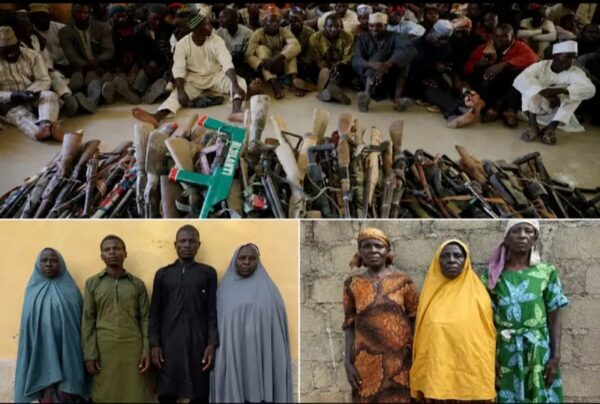
The Federal Government’s disclosure that more than 124,000 Boko Haram and ISWAP members and their dependants have surrendered through Operation Safe Corridor since 2023 has intensified national debate over the rehabilitation of former insurgents and the sacrifices made by Nigerian security forces.
While the large number of defections has been cited as evidence of progress in the fight against terrorism, military authorities say the figures represent years of sustained operations that forced insurgents to abandon the battlefield.
Surrenders driven by sustained military operations
According to military officials, insurgents are not surrendering voluntarily out of goodwill but because continued operations have significantly weakened their ability to survive.
Air bombardments, ground offensives and intelligence-driven missions have reportedly destroyed camps in Sambisa Forest and the Lake Chad Basin, disrupted supply chains and eliminated senior commanders.
Security experts say the increasing pressure has left many insurgents with limited options beyond surrender.
Operation HADIN KAI records fresh breakthrough
Authorities recently announced another operational success after troops of Operation HADIN KAI secured the surrender of a senior ISWAP finance operative.
Officials said the suspect surrendered with weapons, ammunition, a motorcycle and cash before undergoing extensive interrogation.
According to security agencies, intelligence gathered from surrendered insurgents often provides information capable of exposing terrorist camps, logistics routes, financial networks and future attack plans.
Military officials describe such intelligence as one of the most valuable tools in modern counter-insurgency operations.
Defence Minister explains rehabilitation process
Public concern has largely centred on the rehabilitation of individuals commonly described as “repentant terrorists.”
Addressing the issue in separate interviews on Channels Television and ARISE News, Defence Minister General Christopher Musa (retd.) said many Nigerians misunderstand the government’s approach.
He explained that those emerging from insurgent camps are carefully screened before any decision is taken.
According to Musa, the first category consists of people who were forcibly recruited after attacks on their communities.
The second includes abducted women, children and civilians compelled to perform support duties such as cooking, farming or carrying supplies.
The third category comprises individuals who voluntarily joined terrorist groups and actively participated in attacks.
“The military is not indiscriminately reintegrating terrorists into society,” Musa said.
He stated that only those found to have been forcibly recruited or used in non-combat roles may qualify for rehabilitation under Operation Safe Corridor after extensive evaluation, while hardcore fighters are investigated and prosecuted.
Balancing security, justice and reconciliation
Although the government maintains that the rehabilitation programme is intelligence-driven, many Nigerians remain unconvinced.
Families affected by terrorism continue to question whether former insurgents can safely return to society and whether justice is being adequately served for victims.
Security analysts acknowledge those concerns but argue that military victories alone rarely end long-running insurgencies.
According to them, successful counter-insurgency strategies typically combine sustained military pressure with intelligence gathering, rehabilitation programmes and efforts to encourage further defections while ensuring accountability for those responsible for violent crimes.
As Nigeria continues its fight against terrorism, the debate over how to balance justice, security and reconciliation remains one of the country’s most complex national security challenges.
Africans Angle News