Africa
How Wike‑Fubara’s Feud Mirrors Saul And David’s Fight -By Isaac Asabor
Like Saul and David, both men have shaped, and been shaped by, their conflict. Their trajectories reveal the costs of conflating personal dominance with public mandate. And they underscore a simple truth: political mentorship is only as valuable as the freedom it allows successors to lead.

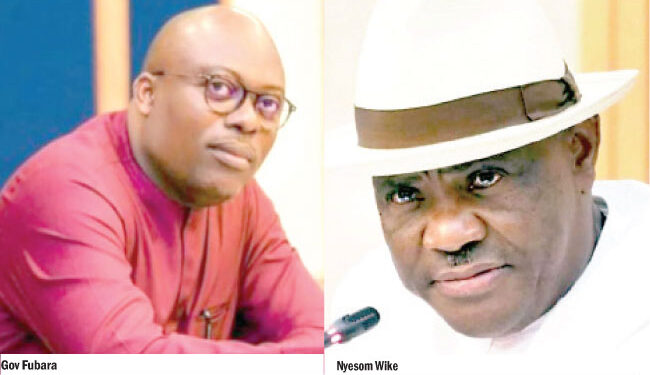
When observers of Nigerian politics reach for analogies, they usually pick gladiatorial metaphors, battles, wars, knockouts. Yet few comparisons fit the Wike‑Fubara feud as snugly as the biblical story of King Saul and David. Not because Rivers State politics is a divinely ordained drama, but because the underlying dynamics, mentorship turning into mistrust, rising talent threatening established authority, strategic maneuvering driven by fear and ambition, are identical.
This is not merely rhetorical flourish. At its core, the conflict between Nyesom Wike, the political godfather of Rivers State, and his initial beneficiary, Siminalayi Fubara, maps onto a recurring pattern in power systems: the moment a protege outshines a patron, the balance shifts from alliance to rivalry.
Long before Rivers State became shorthand for political tension, Wike wielded power with confidence. As minister, governor, and influential chieftain of the People’s Democratic Party (PDP), he built networks, rewarded loyalty, punished dissent, and shaped political careers. To many within his orbit, Wike was the architect of opportunity.
Among those opportunities was the advancement of Siminalayi Fubara. The former civil service accountant did not enter politics with the clout or household name that senior politicians enjoy. But with Wike’s endorsement, he won the Rivers State governorship in 2023; a victory rooted less in his personal political brand and more in the strength of Wike’s machinery.
There is a deliberate parallel here with the Old Testament narrative. David , a relatively obscure shepherd, becomes a warrior whose prowess wins favor with King Saul. Initially, Saul sees in David a useful ally. In the same way, Wike’s support elevated Fubara from obscurity to the pinnacle of state power.
In the Saul‑David story, acclaim changes everything. David’s victories in battle make him beloved by the people. Soon, Saul’s admiration is replaced by envy and fear, fear that David’s popularity will eclipse his own. Saul’s response is to undermine and, ultimately, to pursue David.
Wike’s posture toward Fubara followed a similar arc. Once the election was won and Fubara assumed office, the relationship began to fray. What was once political patronage hardened into suspicion. The mentor who had once propelled Fubara into power began to remind the governor that the rise had not been self‑fashioned, and that the ascendancy had been granted, not earned.
Analysts who follow Rivers State politics, and there are many , note that Wike’s influence did not wane after the election; in fact, it intensified. Fubara was expected to be an extension of Wike’s authority, ensuring that the governor’s policies and appointments remained aligned with the godfather’s preferences. But Fubara increasingly charted his own course.
For Wike, this was a violation of an unwritten pact. In political godfatherism, a term Nigerians use to describe patronage networks where elite influence trumps institutional process , loyalty is the currency. When a protege deviates, the godfather perceives a risk not just to control but also to legacy.
What followed was a sequence of calculated moves: public remonstrations, strategic appointments that bypassed the governor’s office, and a series of legislative and bureaucratic skirmishes that made headlines across the state. In tone and effect, these strategies resembled Saul’s attempts to thwart David’s efforts to diminish credibility, to contain potential threats, and to reassert authority.
Unlike in the biblical narrative, however, Fubara did not flee into obscurity. Instead, he leaned into institutional support. He cultivated alliances within the Rivers State House of Assembly. He sharpened his administrative agenda on issues that resonated with voters, infrastructure, youth employment, and local security. He also positioned himself as a modern politician who could argue competence over clout.
Where Saul saw David’s favor with the people as a threat, Wike appears to have viewed Fubara’s independence in much the same way. Yet here is where the comparison diverges. The modern political ecosystem, with media scrutiny, civil society oversight, and judicial recourse, affords Fubara tools that David did not have. In contemporary politics, the feud is played out not just in personal exchanges but through public records, court filings, and policy outcomes.
The Wike‑Fubara dispute is not an isolated case; it reflects a persistent structural challenge in Nigerian politics. Across states and parties, leaders who rise through the backing of powerful figures eventually confront the same dilemma: how to assert autonomy without igniting a backlash from those who once championed them.
Godfatherism thrives where institutions are weak and personal networks are strong. Within such systems, merit and mandate often take a back seat to influence and patronage. When a protégé turns toward independent governance, the mentor perceives that as betrayal.
In Rivers State, this dynamic has manifested visibly: appointments contested, budgets scrutinized, and policy pronouncements framed as either loyal or disloyal. The rivalry has not only consumed headlines, it has bled into governance itself.
Unlike a biblical story passed down through generations, the Wike‑Fubara feud has immediate consequences for ordinary citizens. Projects stalled, ministries realigned, and political capital diverted from service delivery to internecine squabbles.
For example, state agencies have seen leadership reshuffles with political loyalty as the primary criterion. Infrastructure contracts have been scrutinized through the lens of allegiance. Civil servants, investors, and community leaders are forced to navigate an environment where political survival sometimes trumps public value.
This is not collateral damage, it is a direct outcome of a power struggle that was never meant to be purely personal but has become intensely so.
In an era of 24‑hour news cycles and social media amplification, every gesture acquires symbolic weight. A photograph. A press statement. A tweet.
The Wike‑Fubara conflict has thrived in this environment. Each side’s supporters amplify loyalist narratives, turning what should be administrative disagreements into narrative wars. Rivers State’s reputation, long a proud symbol of cultural richness and economic vitality, increasingly becomes shorthand for political drama.
This mirrors the way ancient stories are told and retold: through symbols, contests, and moral lessons. But it also highlights the danger of reducing governance to spectacle.
What Comes Next? Biblical analogies have limits. David did not ultimately destroy Israel; he became king and unified the people. Wike’s story may not end in exile or defeat either. Political careers are long, and alliances can shift. But the core tension, an aging power broker battling a rising star, will shape Rivers State politics for years to come.
Fubara’s challenge now is to cement a legacy based on performance rather than patronage. To prove that governance can transcend personal feuds. To build coalitions that do not depend solely on anti‑godfather rhetoric but on tangible outcomes. Success on those fronts could position him not just as a governor breaking from his mentor’s shadow, but as a leader in his own right.
For Wike, the path forward is equally complex. Reasserting influence through open confrontation risks alienating the electorate and deepening fractures within the party he is presently affiliated with. Unfortunately, he is neither affiliated to the APC nor the PDP. Retreating into quiet counsel might preserve legacy but forfeit the ability to shape future direction. There is no obvious exit from this labyrinth other than compromise, a concept alien to most entrenched rivalries.
In fact, the Wike‑Fubara feud is more than a state‑level political quarrel. It exemplifies a recurring motif in power systems: when mentors fail to reconcile with the rise of their protégés, governance suffers and institutions weaken.
Like Saul and David, both men have shaped, and been shaped by, their conflict. Their trajectories reveal the costs of conflating personal dominance with public mandate. And they underscore a simple truth: political mentorship is only as valuable as the freedom it allows successors to lead.
In the end, Rivers State does not need a replay of ancient conflicts. What it needs are leaders capable of transcending the personal to serve the public. Whether Wike and Fubara can find that path remains the central question of this chapter in Nigerian politics.