Africa
Thumbs up For Akpabio -By IfeanyiChukwu Afuba
Akpabio’s outing reminds us about the moral weight Church’s voice carries. There is the impression out there that the Church is sometimes not forthcoming, not proactive on the criminal mismanagement of Nigeria. This ought to be a two – sided framework. A fair interrogation of the argument must also consider whether the problem is that the Church is not being listened to; her calls for action going unheeded.

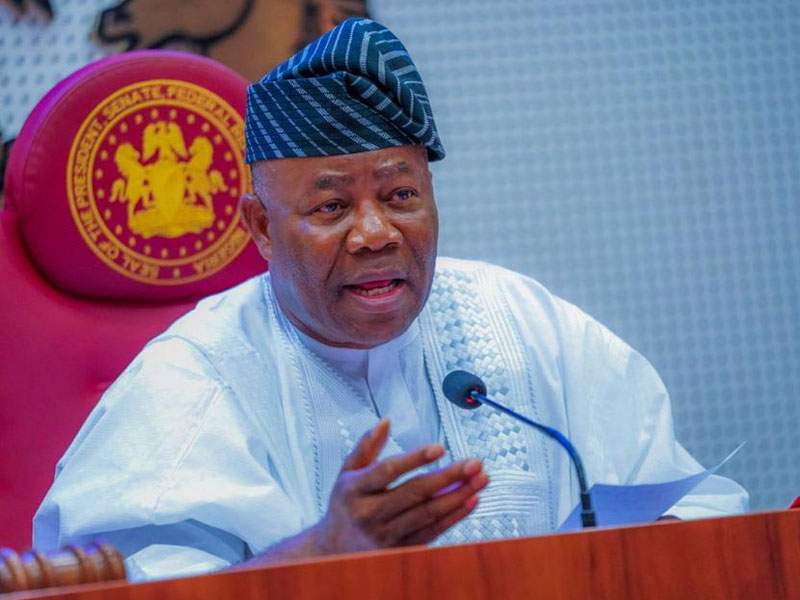
Shortly before the Wike – worshipping House of Assembly went mad again with a servile impeachment move against Governor Simnaliyi Fubara of Rivers State, a positive turn took place on our political scene. On January 2, 2026, it was announced that Senate President, Godswill Akpabio had given directive for discontinuation of defamation lawsuits he filed in court against Senator Natasha Akpoti – Uduaghan and one or two others. The action followed a homily at new year Mass attended by the Senate President. Reverend Fr Donatus Udoette reportedly emphasised the importance of peace, forgiveness and reconciliation in human society in his sermon. Touched by the message, the Senate’s presiding officer subsequently reassessed his management of political conflict.
In our society where misrule has fostered an attitude of cynicism to government, there is a chance that Senator Godswill Akpabio’s laudable conduct would not be accorded due attention. It would even likely be scoffed, trivialised, or altogether ignored along traditional lines of anti – govt rhetoric. Some are wont to see the decision as mere public relations. Political leaning has a way of influencing perception. So also resentment over past events. Chief Obafemi Awolowo never got over the Supreme Court judgment of 1979 which affirmed the election of Shehu Shagari as President. When the same Supreme Court under headship of Justice Ayo Irikefe invalidated the Revenue Act of 1981 championed by Shagari’s presidency, the press asked if he was impressed with the apex court. Awolowo responded that he did not praise people for doing what they were supposed to do. A quip for sure, but beyond the clever reasoning, many read a carryover from the past. To insist that public officers should not be commended for faithful discharge of their responsibilities is to charge at psychology theories of motivation and incentive as Don Quixote to the windmill. Marriages would collapse if spouses stopped complimenting the other for playing their roles fittingly. For good reasons, Akpabio’s new year declaration deserves applause.
According to media reports, Akpabio said: “As I listened to the priest, I suddenly realised that he was speaking directly to me.” The Senate President’s media adviser, Eseme Eyiboh weighed in with a burst of political thought. In a strong update, he stated that “Akpabio had been unapologetic about defending his name through the courts… The withdrawal of lawsuits should be read not merely as personal forgiveness but as political modelling. Forgiveness, in this sense, becomes civic pedagogy.” An analysis, as we are here embarked on, is of course not a trial. This commentary is mindful of the originating circumstances in which Senator Natasha Akpoti – Uduaghan was the complainant for alleged breach of her rights. Akpabio’s radical step however, transcends the legal status of her alleged victimhood. The self denial of right of counter claims takes the matter to a new level. It signposts a vote for the greater good. Contained in this sacrificial initiative are two powerful statements of omission and commission.
The first relates to inward investment in home truths. Implied in the later quest for peace is admission that there was a road not taken. Coming to terms with our human frailty, with the fact of our individual weaknesses borders on maturity. Akpabio’s turning is an acknowledgement of fallibility. He may not have said so in exact words but the import of his new position is an apology for the cost of the crisis. It takes humility to be sorry. And humility, which we find in Akpabio’s concessions is an act of courage and strength. Life not periodically examined is not worth living, Socrates told us. The Senate President’s comportment signals a promise of respectful and responsive leadership henceforth. This is a challenge to the leadership class. An immediate test for the ruling party arises in the controversy over the precise wording of the recent tax reform law. Government’s insistence on proceeding with implementation in the circumstance smacks of insensitivity and bad governance. The reasonable thing to do in the context is policy suspension until all grey areas are sorted out.
The Senate saga at the root of this reflection has taken many twists and turns. Senator Akpabio suffered hurt in the midst of it all. It was an act of commission on his part to graciously bear the pain of the conflict. He climbed the height of forgiveness when he chose to put the ordeal he went through behind him. That is a salutary deed. Forgiveness is about the most difficult virtue to practice. The first human instinct is to seek revenge over perceived wrongs suffered. It’s not for nothing the cliche: to err is human, to forgive divine. Beginning with Christ the Lord who forgave under the excruciating pain of crucifixion, true pardon is revolutionary. On being discharged from hospital in 1981, Saint John Paul ll visited Mehmet Agca Ali in prison where he immediately forgave the man who fired three shots at him. Nelson Mandela walked this path of greatness. He did not seek revenge for the dehumanisation apartheid inflicted on blacks. His focus on healing steered South Africa away from post – transition confrontation. Unfortunately, South Sudan shows how absence of the Mandela model can frustrate the march of nationhood. Who would have thought that bitterness and divisions would overtake South Sudan ‘s long struggle for freedom? It takes uncommon grace to let go. Akpabio has demonstrated great spirit.
Of no less significance is the causative agent of this progressive shift. The Church spoke. In popular Nigerian fashion, some would say the Church spoke truth to power. And we take note of the fact that the audience (Akpabio) listened and refrained from hardening their heart. This observation is important in driving a meaningful discussion on the secular role of the Church in society. The Church’s social teaching is very clear on the purpose and means of social action. Pursuit of justice and the common good are the primary goals of moral politics. The faithful have a responsibility to play their civic part in the body politic. Participation in politics is encouraged as there are no boundaries to Christian witnessing. The political space, with it’s multi links to the population, is therefore fertile ground for living out the gospel message. Thomas More, an influential official in 16th century king of England’s court, voted with his life for the eternal truths proclaimed by the Church. More taught by his martyrdom that public office is ultimately accountable to divine authority, not human power. Nearer home, Julius Nyerere showed that leadership is about service to the people. The former Tanzanian President was a different kind of leader; in his carriage, the simplicity associated with his office, in his detachment from material things, by responsive governance. Nyerere, who left office a poor man, was officially nominated for investigation for sainthood process about two decades ago. That says a lot. From a secular front, world renowned writer, Chinua Achebe paid tribute to Nyerere as a role model President in his 1982 book _The trouble with Nigeria._
Akpabio’s outing reminds us about the moral weight Church’s voice carries. There is the impression out there that the Church is sometimes not forthcoming, not proactive on the criminal mismanagement of Nigeria. This ought to be a two – sided framework. A fair interrogation of the argument must also consider whether the problem is that the Church is not being listened to; her calls for action going unheeded. Has religion failed in Nigeria? Or have Nigerians failed in living out the demands of religion? A major issue appears to be the divergence between professions of faith and life choices. Religious beliefs are yet to become a way of life. Nevertheless, the Church trudges on with it’s mission of beaming the gospel light to humanity. Despair does not exist in the salvation dictionary. The times call for the Church to intensify and expand political engagement. John Cardinal Onaiyekan once invited political actors of the Catholic faith based in Abuja to a discussion on the state of the nation. That worthwhile endeavour has not caught on.
What is stopping the Christian Association of Nigeria, Denominations and, indeed bodies in the Church from creating fora for conversations with public servants? The Justice, Development & Peace Commission of the Catholic Church as well as Laity should be able to organise town hall meetings for elected representatives in government to render reports and answer questions. That would be a wake up call on the inevitability of accountability. This is also an invitation for Akpabio to take the duty of leadership to the next level.